

Analog Dreaming
Remembering when we held the clouds in our hands.

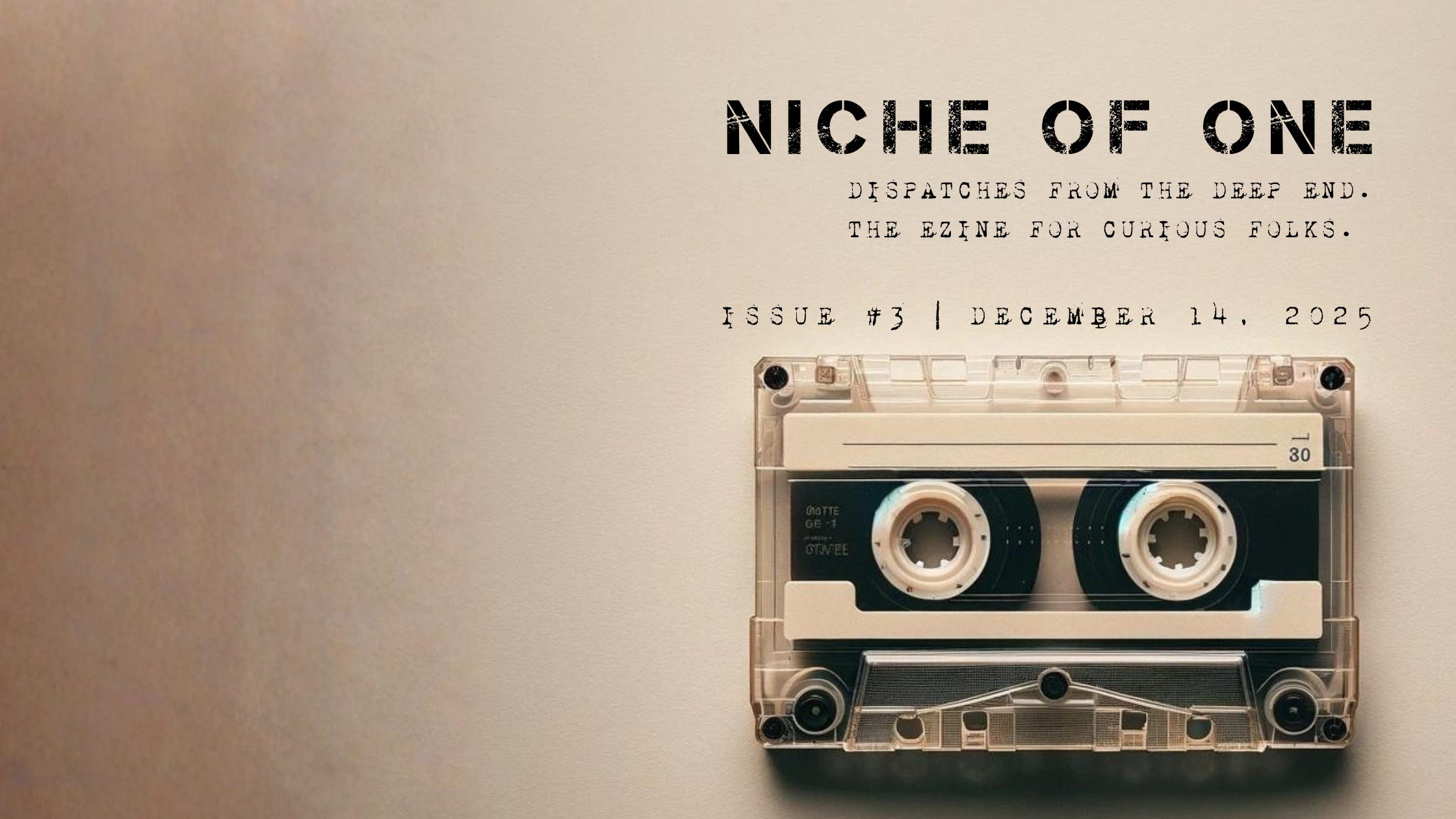
This is the memory:
I made the mix-tape in 1989. I know because I wrote the date on the label in ballpoint pen, along with a tracklist that meant something to exactly three people. The tape itself is warped, stretched in places from being played too many times on a cheap Walkman that ate batteries like a slot machine. But it still exists.
You can’t say that about your Spotify playlist. (Not a knock on Spotify. I love it so.)
This issue is about things you can hold in your hands. Ikigai turned into productivity porn. Magic demonized by the same institutions that burn heretics for profit. And we’re talking about the only competitive advantage that actually matters: being yourself. Your weird, unrepeatable combination of experiences and obsessions.
Five pieces all pointing at the same truth: the system wants you renting everything, performing constantly, buying solutions to problems they invented.
Fuck that.
You’re holding the map. Everything in here is about taking it back.
Let’s go.
THE WEIGHT OF REAL THINGS
I was twelve years old with my finger on the pause button, waiting for the DJ to shut the fuck up so I could record “Under Pressure” without his voice bleeding into the opening bassline.
The cassette deck was a piece of shit Panasonic that my old man bought at a pawn shop for fifteen dollars that I absolutely treasured, and the radio was tuned to 103.3 WKDF—”KDF Rock”—which meant I got to listen to thirty minutes of commercial interruption for every three songs that mattered to me.
But when I hit record at exactly the right moment, when David Bowie’s voice came through clean without the DJ’s commentary about concert dates I couldn’t afford to attend, I owned that song.
Not rented. Not licensed. Not subject to the terms and conditions of a streaming service that could delete it from existence whenever their licensing agreement expired.
You can’t hold a subscription in your hands.
The mixtape I made that week—the one long turned to ash when my childhood home burned—had fourteen songs on it.
I knew every one by heart because I had to listen to the radio for three days straight to capture them all. “Come as You Are” by Nirvana. “Jeremy” by Pearl Jam. “Hunger Strike” by Temple of the Dog.
Each song was a deliberate choice, placed in a specific order, building toward something that felt like meaning even if I couldn’t articulate what that meaning was.
The physical act of creating that tape mattered. Pressing record. Watching the reels turn. Writing the track list on the J-card with a black Sharpie, my handwriting terrible but mine. The tape itself became an object, a thing you could hand to someone and say, “This is what I’m thinking about. This is the architecture of my brain right now.”
It was the soundtrack of my life.
Spotify gives you infinite music and zero physicality.
The algorithm serves you songs based on data harvested from your listening patterns, which sounds convenient until you realize you’re not discovering music anymore—you’re being fed music by a machine that’s optimizing for engagement metrics, not for the moment when a song cracks you open and rebuilds you different.
The difference isn’t nostalgia. It’s about what happens in your body when you interact with physical objects versus digital vapor.
The deliberate action of making a decision gives you a better grasp on who you are, what you believe in, what makes you… you.
I plan on buying a vintage typewriter soon.
That’s actually how I learned to type. On an old manual typewriter my mom had for some reason or another. And it’s a different feel and experience.
The keys are heavy. Each one requires deliberate force. When you hit the letter “A,” you feel it in your fingertip, hear the clack of the typebar striking the ribbon, see the imprint appear on paper in real time.
There is no undo button. There is no backspace that erases your mistake and pretends it never happened. You fuck up a word, you live with it. You X it out. You grab the bottle of white out, take a big whiff, and start painting that word away. You start over. You think before you type because correction costs time and effort.
This changes how you write.
I’m not saying typewriters are superior to computers for all purposes—I’m writing this on a laptop because deadlines exist and I need to move fast—but the act of writing on a typewriter forces you into a different relationship with language.
Every word has weight.
Every sentence is a commitment.
You can’t endlessly revise, polishing until the voice is gone and what remains is a smooth, lifeless corporate memo that sounds like it was written by a committee.
The typewriter makes you decide: Is this the word I mean? Is this the sentence worth keeping? And once you strike the key, it’s permanent.
The page becomes evidence of your thinking, mistakes included. You can’t pretend the process was clean. The labor is visible.
This is what we lost when everything moved to the cloud.
We lost the friction that makes creation real.
Vinyl records are having a resurgence and half the people buying them can’t tell you why.
They’ll say something about “warmth” or “authentic sound,” which is true but incomplete. The real reason vinyl matters is the same reason cassettes matter: you have to interact with the object.
You take the record out of the sleeve. You place it on the turntable. You drop the needle and listen from beginning to end because skipping tracks requires getting up and physically moving the needle, which means most people just let the album play in the order the artist intended.
You experience the music as a complete thought instead of a playlist shuffled by an algorithm.
And when you’re done, you put it back in the sleeve and return it to the shelf where it lives as a physical artifact of your taste. Your record collection tells a story. You can see it. Other people can see it. It’s not hidden in a streaming service database; it’s evidence of what you value, displayed in your living room like a declaration of identity.
You can’t hold a subscription in your hands.
I shot film photography as a hobby for few years because digital felt too easy. Too forgiving.
With film, you get thirty-six exposures per roll and every shot costs money. You don’t spray and pray. You don’t take seventeen versions of the same image and pick the best one later.
You compose carefully. You wait for the light. You press the shutter when you’re certain, or as certain as you’ll ever be, and then you move on.
The negatives become permanent records. They exist in sleeves, physical strips of cellulose that you can hold up to the light and see the latent image captured in chemistry and time.
Even if you lose the prints, the negatives remain. Even if your hard drive crashes—and it will crash, eventually—the film survives.
Books work the same way.
Real books. Paper and ink and binding.
I’ve got a copy of Blood Meridian that I bought in 2008 with coffee stains on page forty-seven and a crease in the back cover from when I shoved it in my ruck during a deployment. The margins are filled with notes I don’t remember writing. The spine is broken from being read too many times.
That book is mine in a way that no Kindle file will ever be mine.
Amazon can’t delete it from my shelf with a software update. I can lend it to someone without violating a terms-of-service agreement. When I die, someone else will inherit it, physical evidence of what I read and cared about.
You own things or you rent things. There’s no middle ground, and the corporations have spent the last twenty years convincing you that renting is better because it’s more convenient, more accessible, more affordable in the short term.
What they don’t tell you is that once you own nothing, they control everything.
The subscription model is serfdom dressed up as innovation.
You don’t own your music. You rent access to Spotify’s library.
You don’t own your movies. You rent access to Netflix’s catalog.
You don’t own your software. You rent access to Adobe’s cloud services.
You don’t own your documents. You store them on Google Drive, which means Google owns them and you’re allowed to use them as long as you keep paying and abide by their policies.
This is the endgame of late-stage capitalism: own nothing, rent everything, pay forever.
And when the service decides your content violates their evolving terms of service, or when the licensing agreement with the artist expires, or when the company goes bankrupt, your collection evaporates.
Gone. No physical media to fall back on. No ownership to protect you.
You become dependent. And dependence is control.
The body knows this, even if your conscious mind has been trained to accept it as progress.
When you hold a vinyl record, your nervous system registers weight, texture, temperature. You are interacting with a physical object that exists independent of electricity, independent of servers, independent of corporate infrastructure.
The act of handling physical media creates a different kind of memory, one encoded in muscle and ritual and space.
Neuroscience backs this up—tactile engagement with objects creates stronger memory formation than digital interaction. You remember the books you held, the mixtapes you made, the photographs you printed.
I don’t have those cassettes from 1987 to 1993 anymore.
But I did buy a stereo with a turntable, a CD player, and cassette deck in it. Also plays stuff from my phone via Bluetooth. And I’ve been slowing buying vinyl, cassettes, and CDs from the legitimately cool local businesses that still sell them.
You can’t hold a subscription in your hands. And when the cloud evaporates—and it will, eventually, because all systems fail and all corporations die—what remains?
I’m holding a blank tape in my hand right now.
It’s full of potential just waiting to be recorded on it. I can touch it. You can touch it.
Thirty years from now, if we’re both still here, that tape will still exist. The songs might not play. The oxide might flake off the backing. But the artifact remains, physical proof that someone once cared enough to create something with their hands.

☯︎ IKIGAI WITHOUT THE VENN DIAGRAM HORSESHIT
The first time I heard a Japanese person use the word ikigai, I was sitting in a small restaurant in Naha, Okinawa, eating goya champuru with an eighty-three-year-old woman named Fumiko who ran the place with her daughter.
I’d asked her—through broken Japanese and hand gestures—why she still worked every day when she could have retired twenty years ago.
She looked at me like I’d asked why she still breathed.
“Kore wa watashi no ikigai desu,” she said. This is my ikigai. More literally translated, “This is my purpose in life.” Then she went back to the kitchen to make someone’s lunch.
That’s it. That’s the whole concept. A reason to get up in the morning.
Not a business strategy. Not a four-circle Venn diagram where passion meets mission meets vocation meets profession in some mythical center point that unlocks your true purpose and generates passive income.
It’s not a business plan.
The Western version of ikigai is a bastardization so complete it would be funny if it weren’t so fucking insulting to the culture it’s stealing from.
Some consultant looked at a Japanese concept about meaning and decided it needed to be monetizable, so they slapped it into a framework, added some circles, and sold it as the secret to finding your profitable purpose.
The actual Japanese concept of ikigai has nothing to do with making money. Nothing to do with personal branding. Nothing to do with optimizing your life into a sellable product.
I spent eight and a half years in Japan.
I watched people practice ikigai without ever using the word, because it’s not something you declare—it’s something you live.
The carpenter who’s been making tansu chests for forty years using the same techniques his father taught him.
The woman who runs the neighborhood konbini and knows every regular customer by name.
They’re just doing the thing that gives their life meaning, day after day, until they die.
And that’s enough.
The difference between Japanese ikigai and Western corruption starts with individualism versus collectivism.
In Japan, your ikigai often serves something larger than yourself—family, community, tradition.
The carpenter isn’t making furniture for personal fulfillment; he’s maintaining a craft that connects him to his ancestors and provides quality goods for his neighbors. The shop owner isn’t there to express her authentic self; she’s there because the neighborhood needs a place to buy rice and cigarettes at 6 AM.
Western culture took that communal concept and ran it through the meat grinder of American individualism.
The four circles all point inward: What do you love? What are you good at? What can you be paid for? What does the world need from you?
It’s the same self-centered thinking that turns every spiritual practice into a personal development tool. Meditation becomes productivity hack. Yoga becomes fitness trend. Buddhism becomes mindfulness app with a subscription fee.
The gurus did this because a concept about quiet contentment doesn’t sell courses. But a framework that promises you can monetize your passion while serving the world and getting paid what you’re worth?
That’s a $2,000 workshop. That’s a mastermind. That’s a certification program.
Meanwhile, Fumiko is still making goya champuru in Naha, and she doesn’t give a shit about your Venn diagram.
Here’s what ikigai actually teaches, if you pay attention to how it’s practiced instead of how it’s packaged:
Enough is a concept. You don’t need to scale. You don’t need to optimize. You don’t need to turn your purpose into a platform.
The Okinawan centenarians—the ones who supposedly have ikigai figured out—aren’t running online businesses. They’re gardening. They’re cooking for family. They’re walking to the market and chatting with neighbors. They’re doing small, repetitive, unremarkable things that Western productivity culture would dismiss as a waste of potential.
And they’re living to 100 while Americans are burning out at 35 trying to find their profitable purpose and rarely live into their 80s.
My ikigai, if I’m being honest, is probably writing weird shit for weirdos who aren’t allergic to uncomfortable truths.
That’s it. That’s the thing that gets me out of bed and makes me feel like I’m doing something that matters.
I write because it connects me to people who think like I do—or think differently in ways that make both of us sharper. I write because it’s the thing I do that feels real in a world full of performance. I write because when I don’t, I feel hollow.
That’s ikigai without the framework. Without the optimization. Without the guru promising that if you just find the overlap between your skills and the market’s needs, you’ll unlock infinite abundance.
Fumiko makes lunch.
The carpenter builds chests.
I write essays about why your subscription to meaning is bullshit.
None of us are trying to change the world. We’re just trying to live in it without lying about what matters.
🔗 3 Cool Things:
If you need fonts, like fonts, or design with fonts, DaFont is my go-to place to get them.
Want to make some stickers? StickerBaker is a pretty sweet way to do it.
I don’t know how to describe the html review other than you just need to check it out.
⚙ OPERATIONS BRIEF: WRITE LIKE NOBODY’S GRADING YOU
I read a lot of things on Substack.
The thing I notice about the vast majority of creators is they write like they’re wearing a costume.
Professional voice. Sanitized opinions. Corporate-approved metaphors that offend nobody and move nobody.
They’ve been trained—by school, by marketing courses, by guru culture—to hide anything that makes them weird, controversial, or human.
The result is ten thousand indistinguishable blog posts about productivity, mindfulness, and finding your authentic self, all written in the same smooth, lifeless voice that sounds like it was generated by a committee of mid-level managers who’ve never had an original thought in their lives.
You can’t build a business on beige.
Want to hear something you won’t like? Your personality is the product.
Not your content. Not your frameworks. Not your twelve-step system for achieving whatever bullshit goal you’re promising.
Those are all replicable. Someone smarter, better funded, and more connected can copy your content strategy in a weekend and outrank you in six months.
But they can’t copy you.
They can’t replicate the exact combination of experiences, perspectives, and obsessions that make you the specific kind of weird you are. That’s the moat. That’s the competitive advantage that actually matters.
The weirder you are, the more valuable you become.
I spent years writing sanitized creator content.
Blog posts about productivity systems. Guides to building your platform. Frameworks for scaling your business. All technically correct. All professionally presented. All completely forgettable.
So fucking boring I put myself to sleep reading the shit now.
Now I’m writing an eZine about consciousness exploration, chaos magic, institutional betrayal, Japanese philosophy, and whatever else was rolling around in my brain that week.
I stopped performing expertise and started sharing observations. I stopped trying to position myself as the authority and started admitting when I was uncertain, confused, or operating on incomplete information.
The engagement went up. The energy went up. The sustainability went up.
Not because the new content was more valuable—though I think it is—but because it sounded like me.
Like an actual human with opinions and experiences and a voice that couldn’t be confused with anyone else’s.
Combat veteran who practiced chaos magic for a decade and lived in Japan for eight and a half years and ran operations at Fortune 500 companies and thinks Gnostic Christianity makes more sense than the orthodox version? That’s a niche of one.
Nobody else is standing in that exact position. Nobody else can compete with me for the audience that wants what my specific brain produces.
The weirder you are, the more valuable you become.
Performance is exhausting.
Maintaining a persona—the polished expert, the inspirational coach, the guru who’s got it all figured out—requires constant vigilance.
You have to remember what you said, who you said it to, which version of yourself you’re presenting in which context. One slip and the mask cracks and people see the messy, uncertain, weird human underneath.
Being yourself is sustainable forever. You don’t have to remember anything because you’re not pretending. You don’t have to code-switch between professional voice and actual voice because they’re the same voice. You don’t burn out trying to maintain consistency because you’re already consistent: you’re you, all the time, in every context.
This is terrifying at first.
You’ll worry that being too opinionated will alienate people. You’ll worry that cursing will make you look unprofessional. You’ll worry that sharing your actual thoughts instead of carefully curated insights will reveal you as the fraud you secretly believe you are.
Good. Those worries mean you’re doing it right.
The wrong people will leave. Fuck ‘em, let them leave. They weren’t your people anyway.
The people who stay—the ones who read your weird shit and think “finally, someone who gets it”—those are the ones who matter.
Those are the ones who’ll buy everything you make, not because you’ve positioned yourself as an expert, but because they trust your brain.
Guru culture teaches you to position yourself as the authority.
To demonstrate expertise. To build credibility through credentials and case studies and social proof. To present yourself as someone who has the answers, who’s figured it out, who can lead others from where they are to where they want to be.
That’s a performance. And performances end when the audience gets bored or discovers you’re human.
And they will, because they’re not stupid.
I’m not here to position myself as anything. I’m a combat veteran with PTSD who thinks quantum mechanics reveals something about consciousness, who practiced chaos magic until it got weird, who lived in Japan long enough to see through the anime version Americans worship, who runs operations for a living and applies military planning to content creation.
That’s not positioning. That’s just who I am. And the people who find that combination interesting will show up. The people who don’t will go somewhere else.
Both outcomes are fine.
The riches are in the niches, sure. But the real riches are in the niche where you’re the only person who exists.
Go out there and do a search. No one is going to have my unique combo of experiences. Nobody else is there. Nobody else can be there. That position belongs to me because it’s constructed from my life, not from market research about what’s profitable.
And guess what? The same exact principle applies to you.
You already know this, probably. You’ve felt it. The exhaustion of performing.
The relief when you accidentally let the real you slip through in a piece of writing and people respond better than they ever did to the polished version.
So write like nobody’s grading you.
Write like you’re talking to a friend over whiskey at 11 PM when the defenses are down and the truth comes out.
Write like you’re not trying to build a platform or scale an audience or position yourself as anything except the weird, specific human you actually are.
Some people will hate it. So… fucking… what?
The ones who love it will find you, and they’ll stay, because you’re the only person doing what you do the way you do it.
The weirder you are, the more valuable you become.
Who are you when nobody’s watching? Start writing that.
📰 Articles I Enjoyed This Week:
Really loved this piece, Bernie and the Old Man, from Matt Schwarzer.
Dre Beltrami is just out here, telling us how to give our content the ho phase it deserves. I’m both mildly turned on by this article and completely in support of it’s message.
🕳 RABBIT HOLE: MAGIC, RELIGION, AND WHO GETS TO DECIDE WHAT’S EVIL
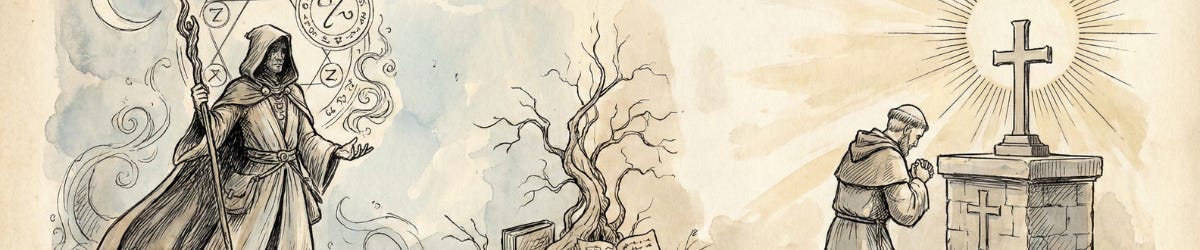
The Catholic Church will tell you that lighting candles and asking for intercession from saints is prayer. Sacred. Holy. Approved by God and two thousand years of tradition.
But if you light the same candles and petition the same forces without routing your request through their approved hierarchy, you’re practicing witchcraft. Demonic. Evil. Worthy of burning.
Same candles. Same intention. Different branding.
The only difference between prayer and spell is who’s selling it.
I practiced chaos magic for about a decade—sigil work, results-focused ritual, belief as a tool rather than a commitment.
I’m not going to tell you it was all real or all bullshit because the truth is somewhere in the middle, which is where most uncomfortable truths live. Some things worked. Some things didn’t. Some things worked so well I stopped doing them because the price of magical thinking turned out to be higher than I was willing to pay.
But here’s what I learned: the mechanics of magic and the mechanics of religion are identical.
You state an intention.
You perform a ritual.
You invest belief in an outcome.
You wait for results.
Whether you call it prayer or spellwork, whether you’re petitioning Jesus or drawing sigils, the structure is the same.
So why does one get you a tax exemption and the other gets you called a Satanist?
Control. Always control.
Pre-Christian Europe was crawling with folk magic.
Herbalists who knew which plants cured fever and which ones induced visions. Diviners who read bones and patterns in nature. Village healers who performed rituals older than anyone could remember, passed down through oral tradition and direct experience.
Then the Church showed up and realized it had a competition problem.
If Grandma down the road can cure your child’s illness with a poultice and a whispered charm, why do you need a priest?
If the local cunning woman can tell your fortune by reading smoke, why do you need confession?
If people can access the divine directly through their own rituals and practices, why do you need an institution?
You don’t. And that’s the problem.
The Church needed a monopoly on the supernatural.
So it did what every institution does when faced with competition: it declared the competition illegal, immoral, and evil.
Witch hunts weren’t about protecting souls from demonic influence. They were about eliminating market rivals and consolidating power under a single brand.
The only difference between prayer and spell is who’s selling it.
Burn the herbalists. Call them witches. Torture them until they confess to consorting with demons. Make an example so horrific that nobody else dares to practice folk magic without the Church’s permission.
Then repackage the same damn rituals—blessings, exorcisms, holy water, laying on of hands—and sell them back to the population as sanctioned miracles.
It’s a brilliant business model if you’re a sociopath.
Let’s talk about evil for a second. Real evil.
The kind that leaves bodies and broken families and generational trauma.
The Crusades killed hundreds of thousands in the name of God.
The Inquisition tortured confessions out of heretics and burned them alive for disagreeing with doctrine.
Missionaries destroyed entire cultures, enslaved populations, committed genocide while waving crosses and singing hymns.
Residential schools in Canada stole Indigenous children and tried to beat the native out of them, all sanctioned by the Church.
And we’re not even talking about the modern stuff yet.
Priest abuse scandals. Covering up pedophilia for decades. Moving predators from parish to parish instead of turning them over to the law. Prosperity gospel preachers buying private jets with money stolen from desperate believers.
More children have been harmed by so-called holy men than witches.
More suffering has been caused by missionaries than magicians.
More evil has been done in the name of God than in the name of any demon you can name.
But guess which one has the bad reputation? (Although, most have that rep for a good reason, not gonna lie there.)
The only difference between prayer and spell is who’s selling it.
I’m not saying all religion is bad. I’m not saying all magic is good.
I’m saying the tool is neutral and the wielder determines the morality. A hammer can build a house or crack a skull. The hammer doesn’t care. The person holding it makes the choice.
Magic is a hammer. Religion is a hammer. Both can be used to help people or hurt them.
Both can be wielded with integrity or corrupted for personal gain.
Both can connect you to something larger than yourself or trap you in someone else’s control system.
The difference is that religion built institutions, claimed divine authority, and declared themselves the only legitimate path to the supernatural. Then they spent two thousand years demonizing anyone who dared to access spiritual power outside their approved channels.
From a Gnostic perspective—and I’ve spent enough time with Gnostic Christianity to find it more honest than the orthodox version—the Archons control through religious institutions.
They keep people from direct spiritual experience by making them dependent on intermediaries. You can’t talk to God yourself; you need a priest. You can’t interpret scripture yourself; you need a bishop. You can’t access the divine yourself; you need the Church.
That’s not spirituality.
That’s gatekeeping.
That’s making sure you never realize you had the power all along.
That’s control.
Here’s the modern version of the same scam: New Age practices get dismissed as woo-woo nonsense, crystals for gullible hippies, astrology for people who can’t think critically.
But prosperity gospel—literally the belief that God wants you rich and if you just pray harder and tithe more, He’ll make you wealthy—gets tax-exempt status and fills megachurches with people donating their rent money.
Same magical thinking. Same petition for material gain. Same belief that the right ritual will manifest abundance.
But one is laughable and the other is legitimate because institutions decide what’s acceptable and what’s fringe.
I practiced magic long enough to know that results matter more than belief.
You can believe whatever framework helps you get the outcome you want. The universe doesn’t care if you’re praying to Jesus, casting sigils, or talking to yourself in the mirror.
The mechanism is the same: focused intention plus ritual action plus belief investment equals outcome.
Call it magic. Call it prayer. Call it manifestation or law of attraction or neurolinguistic programming.
The name changes but the process doesn’t.
The only difference between prayer and spell is who’s selling it.
So when someone tells you magic is evil but their religious practice is holy, ask yourself: who benefits from you believing that? Who profits from your dependence? Who gains power from your fear of accessing the divine without their permission?
The answer will tell you everything you need to know about who’s actually practicing evil.
📚 CURRENTLY CONSUMING
Book: Reading Chuck Palahniuk’s Consider This: Moments in My Writing Life after Which Everything Was Different.
Newsletter: Really digging Nicole’s Permission to Weird. I love it’s mix of fiction, vulnerable poetry, and experimentation.
Watching: Can Something Come From Nothing? I’m a documentary nerd and I found this one really interesting.
🧠 ON MY MIND
With AI really booming now, I think the turn to analog creativity is going to be huge in the coming years.
I’ve been trying to shop local more often lately.
Why aren’t there any cool places to just hang out anymore unless you happen to live near a college or something? Where have all the “3rd Places” gone?
Until next week,
~ Joe
P.S. In the process of formatting You’re Already Infected: A Survival Guide for the Memetic Warzone for Amazon KDP to print, but if you want the digital version on the cheap, you can get it now at my store.
Please note some links may lead to affiliate offers and if you purchase from these links I may receive a small amount of compensation at no extra cost to you.
Woah, you've got all my wheels turning!
The entire part about writing as your true self was so inspiring. This is the second time I'm reading the same message. The last Substack I read (just a few minutes ago) said the same thing. Is that a sign from the cosmos? 😆
This part: "Here’s the modern version of the same scam: New Age practices get dismissed as woo-woo nonsense, crystals for gullible hippies, astrology for people who can’t think critically." versus religious institutions and what they teach...yes! Thank you!
My sister-in-law is a devout Catholic. And she gets so excited telling stories about how Saints performed these miracle healings. Meanwhile, I try to tell her about Dr. Joe Dispenza's work and how he has intense meditation workshops where people are cured of all kinds of horrible diseases and she just looks at me like I have two heads. Hello?! It's the same thing!!
People are cured because they have a belief that they can be cured, no matter who or what the catalyst is.
I am not religious, but as you said, religion can be good or bad depending on how you use it. I see way too many people out there who could use some religion to fill that spiritual gap that's missing in their lives. They're usually out in the streets protesting something.
Brilliant. This connects so well with your earlier thoughts on digital identity. Truely, we are holding the map, and it's ours to take back.