

Make It Nasty, Baby.
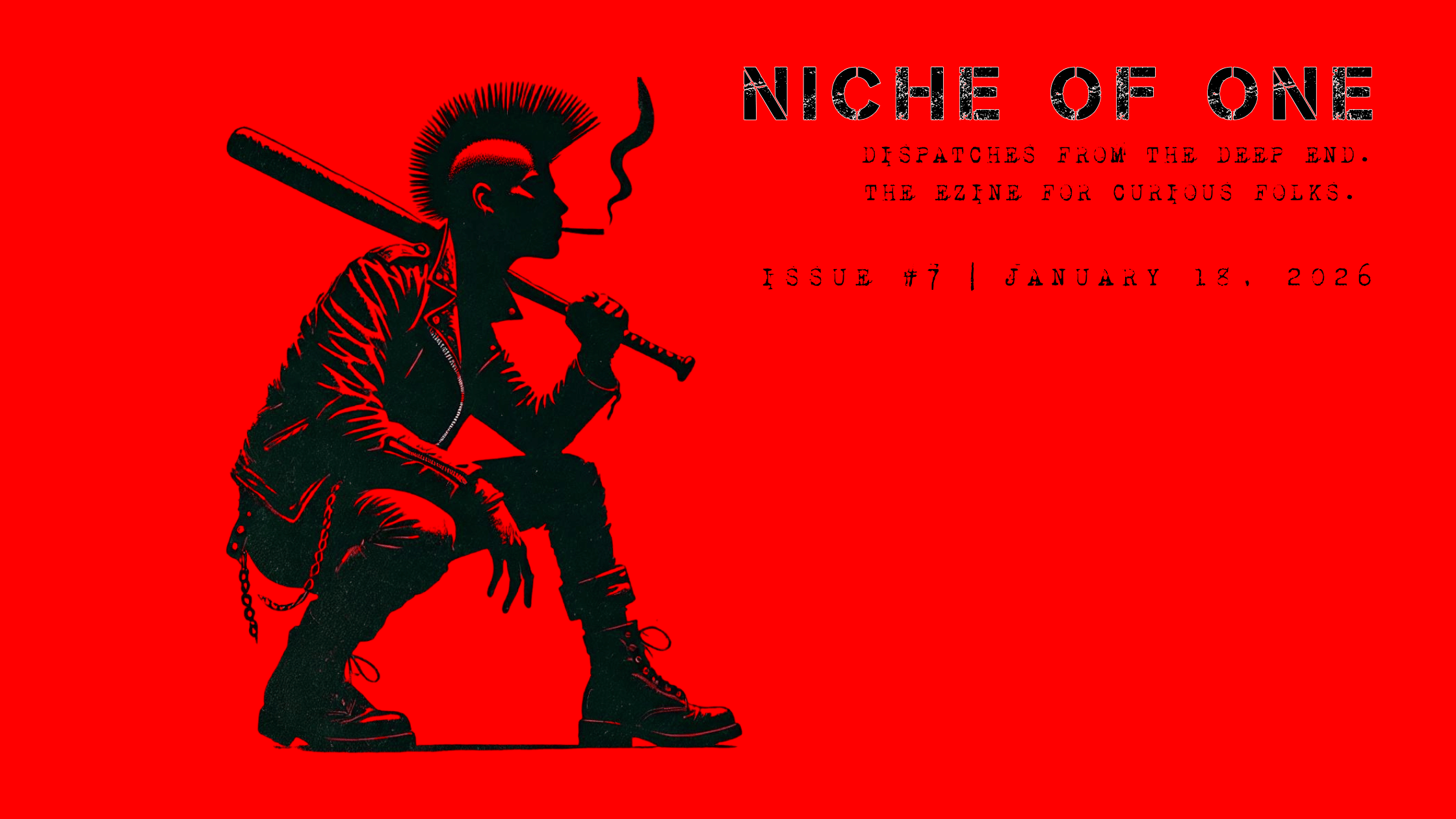
Punk ins't an aesthetic. It's a state of mind.

We are afraid to be who we are. Why?
Deep down, it was programmed into your brain by the time you made it to elementary school.
If you’re weird, they’ll make fun of you. If you’re not like them, they won’t let you play. You have to conform to be accepted.
It gets compressed and filed away in your head like a prime directive you can’t override because OmniCorp is a bunch of dicks!
But, I bet if you look real hard, deep down, you can find your inner punk. And that’s what this issue is about.
In this issue:
🫠 Make it ugly…
😵💫 Copy This:Free The Signal
🫨🕳 RABBIT HOLE: A Crash Course in Psychogeography
We’re going to talk about the things the gurus tell you to ignore. That society says is bad. And that the people that design the places we live don’t want us to know.
This is about being the punk and giving your middle finger to the establishment.
Let’s do the things…
CUE THE BEST DAMN NEWSLETTER THEME SONG EVER!
🫠 Make it ugly…
It was a Friday.
The sun was coming through the window like a sick dog’s breath, all yellow and weak and apologetic.
I was scrolling through my feed—the scroll of the damned—and everywhere I looked there were experts.
Polished headshots with ring lights that made their eyes look like dead fish on ice. Canva templates breeding like roaches in a tenement wall. Perfect color schemes. Perfect fonts. Perfect hooks designed by perfect machines to separate you from your money.
They were the modern snake oil salesmen, except instead of wagons full of bottles that promised to cure everything but were really just opium and cocaine, they had $1K courses teaching you to be just like them.
How to “optimize your funnel.”
How to “leverage your personal brand.”
How to sand yourself down until you fit perfectly into the machine that grinds everyone into the same smooth paste.
And I sat there in that weak sun and realized something simple and obvious and completely liberating: I didn’t need to compete with robots by becoming a better robot.
I needed to be the alternative.
The weird one. The raw one.
The one that doesn’t look like it came off an assembly line in Shenzhen stamping out identical parts.
Fuck it, I thought. What if I just made things?
The problem is the voice in your head.
The one that whispers “it’s not good enough yet.” That voice is a liar and a coward and it will kill everything you try to make.
You can always make it better. That’s the trap.
One more revision. One more font choice. One more color scheme. One more “expert” opinion on whether your hook is optimized for maximum engagement and conversion metrics and all the other bullshit that turns creation into a science experiment where nothing ever gets published because the methodology isn’t perfect yet.
While you’re polishing, they’re shipping.
While you’re optimizing, they’re connecting with actual humans.
While you’re making it “professional,” they’re making money.
While you’re choosing between two shades of blue that look exactly the fucking same, your brilliant idea is rotting in a Google Doc somewhere, growing mold.
It’s never going to be good enough. That’s not how brains work. There’s always something to fix. Always room for improvement. Always one more thing. The perfectionism is a prison and you’re the warden and the inmate and the only way out is to stop caring about the bars.
Polish forever and ship nothing, or ship imperfect and fix it later. Those are the choices.
Here’s how it actually works for me: When I’m doing something, all my attention pours into it.
Total focus. Complete immersion.
But I’m a Gemini and my attention is fleeting at best. Also, I have shit to do.
Life doesn’t pause for content perfection. The dog needs walking. The bills need paying. The world keeps spinning whether or not your font choice reflects your authentic brand voice.
So when it’s ready, it’s fucking ready. Not perfect. Ready. There’s a difference.
I don’t care about the typo. I ship it. Clean up the mess later if I feel like it. Usually I don’t feel like it. And the secret nobody tells you is nobody actually cares about the typo except you. Your readers are skimming anyway. They’re looking for the idea, not the punctuation.
Compare this to the “professional” creator—the one spending three hours choosing fonts, running everything through five draft cycles, getting feedback from their mastermind group of other people who also never ship anything, agonizing over whether to use “leverage” or “utilize” like there’s some cosmic difference between two words that both mean the same boring thing.
Meanwhile their ideas are rotting. Dying. Turning into compost in the filing cabinet of should-have-beens.
My reality is simpler:
Make the thing.
Ship the thing.
See if it works.
Make another thing.
Repeat until interesting.
The operations are lo-fi intentional.
Simple tools. No complex systems. No elaborate workflows with seventeen steps and three automation tools and a virtual assistant in the Philippines.
Google Docs to Substack to done. Maybe there’s a typo. Maybe there’s a rough edge.
Definitely it’s shipped.
The creator economy wants you smooth.
Sanded down. All edges removed so you fit in the machine. Process efficiently. Look like the others so the algorithm knows what to do with you.
The polished creator looks like everyone else. Sounds like everyone else. Gets lost in the feed like a single grain of sand on a beach made entirely of sand.
They attract people who want what everyone else has—which is nothing, really, just the performance of having something. They burn out maintaining the performance because performance is exhausting and you can’t keep it up forever.
But smooth means nothing catches. Nothing grips. Nothing sticks. It’s aerodynamic and efficient and completely forgettable.
Raw has edges. Rough spots. Places that catch light wrong. That’s where the interesting lives.
The raw creator looks like nobody else because nobody else looks like you.
Sounds like actual human speech instead of corporate-speak translated through three layers of marketing optimization. Stands out because everything else is smooth and you’re not. Attracts weirdos who want something different, who are tired of the polished bullshit, who can smell authenticity even when it’s covered in typos.
And here’s the thing… you can’t burn out on being yourself unless you’re one of those melodramatic types.
Burnout comes from maintaining a performance. From trying to be “professional” when you’re not. From polishing everything until it gleams like a showroom floor that nobody actually wants to walk on.
They’re 24/7 reality show that’s scripted for optimization.
Eventually, the wheels fall off.
The payoffs are real and immediate and nobody talks about them because they’re too busy optimizing.
First: you did the thing. That’s it. That’s first. Most people never ship. You did. That alone puts you ahead of everyone agonizing in their draft folders.
Second: real connections with actual humans. People respond to raw. They can smell performance from a mile away and they’re tired of it. When you show up unpolished, the right people notice. The weirdos. The pattern-seekers. The ones allergic to guru culture. Your people.
Third: no burnout. You just show up. Make things. Ship them. Some work. Some don’t. Make more things. It’s sustainable because it’s actually you, not a performance you have to maintain.
Fourth: real audience. Not “followers.” Not “subscribers” inflated by some growth hack. People who actually give a shit about what you make because it’s different from the sanitized creator economy garbage.
Fifth: yeah, you’re probably making some cash. Turns out people pay for authentic over polished. They can get polished anywhere. Authentic is rare.
Sixth: freedom. You’re not faking it. Not performing. Not trying to be the next whoever. You’re doing your thing. They like it or they don’t. Either way, you’re not changing it.
The sun’s still coming through the window.
The feed’s still full of polished robots. You’re still shipping rough shit.
The difference is you don’t care that it’s rough anymore. That’s the point.
Somewhere out there, someone’s agonizing over a font choice right now. Their brilliant idea is dying in a draft folder, suffocating under the weight of one more revision. Meanwhile, you’re hitting publish.
Maybe your thing has a typo. Maybe it’s not perfect. But it exists.
And that’s more than most people can say.

3 Cool Things:
My favorite man-made religion by far: The Missionary Church of Kopmism
My favorite Subreddit: Piracy!
My favorite economic theory: The Grand Unified Theory On The Economics Of Free

😵💫 Copy This:Free The Signal
Mickey Mouse is ninety-six years old and still under copyright because every time that cartoon rodent gets close to entering the public domain, Disney lobbies Congress to extend copyright law just a little bit longer. Funny how that works.
Seems like the Golden Rule in full effect: Those Who Have the Gold Make the Rules.
Copyright was supposed to last fourteen years when this country started. Now it’s life of the author plus seventy years. The math gets worse every time Mickey’s about to become free.
Meanwhile, academic researchers—the ones whose work your tax dollars funded—put their papers behind forty-dollar paywalls owned by publishers who contribute nothing except the paywall itself.
Scientists do the research. Peer reviewers work for free. The journal adds a PDF and charges you for the privilege of reading it.
Pharmaceutical companies patent insulin, a drug discovered in 1921, and charge three hundred dollars a vial. People die rationing it.
EpiPens cost six hundred dollars for two injections of a drug that costs dollars to manufacture.
And somewhere in America right now, a grandmother is being sued for eighty thousand dollars because she downloaded a Metallica song fifteen years ago.
This is the system.
Knowledge locked behind gates. Information treated like property. Ideas owned by corporations that will outlive you and your grandchildren and probably your grandchildren’s grandchildren if we don’t burn it all down first.
What if we just didn’t participate in that bullshit?
This isn’t new. Punks figured it out in the seventies.
Zine culture understood: photocopy machines are revolution. “Steal this zine.” “Copy and distribute.” Raw information with no gatekeepers. If someone wanted to reprint your zine in another city, good. That meant more people read it. More people got the information. More people joined the conversation.
Tape trading built entire music careers. Metal bands and punk bands nobody would sign spread through bootleg cassettes. Trading live shows. Passing tapes hand to hand. Nobody got rich. Everybody got heard. That was the deal. Make something worth copying and people will copy it and that’s how you grow something real instead of something owned.
Go back further. Samizdat in the Soviet Union. Dissidents risking prison to photocopy and distribute banned books. They understood something essential: information IS resistance to power. Knowledge sharing IS mutual aid. When the state controls what you’re allowed to know, the revolutionary act is making copies and passing them around.
The principle is simple. Make things that can be copied. Expect them to be copied. Hope they get copied. That’s how ideas spread. That’s how movements grow. That’s how you build something that can’t be killed by shutting down one source.
Here’s where I land: Creative Commons is the reasonable compromise.
Information gets to be free. But attribution is required. Simple social contract. You got this cheap or free. Don’t be a pig, nerd. Don’t claim you made it.
I’m starting to release everything under Creative Commons licenses. Want to print the PDF? Do it. Want to sell physical copies? Don’t charge more than I would and I don’t care. Want to remix it and add new things? Fine with me. Just give me a nod in the acknowledgments. Maybe a link to the website. That’s the whole ask.
Why this works: I really don’t feel like suing anyone, to be fucking honest. Lawsuits are expensive. Time-consuming. They’re the domain of corporations with legal departments and teams of lawyers who bill by the hour. I’m one person making things. I don’t have time to chase down every person who uses my work. I don’t want to spend my life in courtrooms arguing about whether someone violated terms of service.
And here’s the practical reality: if someone steals your work and claims they made it, your audience will notice. They’ll call it out. You don’t need copyright enforcement. You need people who give a shit about honesty. That’s different. That’s community, not law.
What I’m protecting isn’t the money. It’s the attribution. The connection between maker and thing. “Joe made this.” Not hard. That’s it. That’s the whole requirement. Give credit where it’s due and we’re good.
Some things should never be copyrighted. Period. No exceptions. I will die on this hill.
Academic research. Your tax dollars funded that study. Now the journal wants forty dollars to read it? Fuck that. The researchers do the work. The peer reviewers work for free. The journals add nothing except a paywall and some formatting. Academic publishers are parasites feeding on publicly funded knowledge.
Life-saving medicine. Insulin. EpiPens. Cancer drugs. If it saves lives, it should be free or cost of production. Patents on medicine are murder with paperwork. Slow murder. Policy murder. But murder. People die because they can’t afford the drug that costs pennies to make but sells for hundreds because some company owns the formula.
Education and knowledge. The one thing that should absolutely be a mutual aid priority. These two things—education and knowledge—are responsible for the best things we enjoy in modern life. Teach people and they don’t need to be told what to do. Give them information and they can figure out the rest. Lock it behind paywalls and you create a permanent underclass who can’t afford to learn.
Entertainment can cost money. Art can cost money. I’m not arguing for total communism of everything. But knowledge that keeps you alive? Knowledge that makes you educated enough to participate in society? That should be free. Always.
We live in a world where you can watch ten thousand hours of Netflix but can’t afford the textbook required for class. Where prescription drugs bankrupt families. Where academic knowledge is locked behind institutional paywalls that cost thousands per year. This is violence. Slow violence. Policy violence. But violence nonetheless.
The answer is simple: share the knowledge anyway. Fuck their paywalls. Information wants to be free.
I keep my prices affordable.
Could I charge more? Yeah. Could I slap on a shiny corporate-looking cover, deliver half of what you need to figure it out, then charge again for an exclusive online course with the rest? Absolutely. That’s the model. That’s what everyone does.
But that’s bullshit.
I don’t NEED your money. Sure, it buys a larger basket of groceries. Allows a little to be saved for emergencies.
But I do okay with money. I don’t need yours. When people buy a lot of stuff from me, that’s the week we get pizzas for the family. For real.
(BTW, thanks to anyone who’s bought anything from me. I love you long time.)
The model is simple: accessible pricing. Full content. No upsells. No bait and switch. If you can’t afford it, wait for a sale or find it somewhere else. I’m not going to chase you down. I’m not going to guilt you. I’m not going to create artificial scarcity to force you to buy now.
The freedom in this approach is real. I’m making things because I want to make them. The money is nice. The pizza is nice. But I’m not dependent on squeezing every dollar out of every person. That’s the difference between making things and extracting value. One is sustainable. The other is parasitic.
I’m going to keep making things.
Keep pricing them affordably. Keep releasing them under Creative Commons. Keep not suing anyone because who has time for that shit.
The bet is simple: sharing works better than hoarding. Mutual aid builds more than gatekeeping. People will pay fairly when treated fairly.
Somewhere right now, Mickey Mouse is still locked up in copyright. Somewhere, someone’s dying because they can’t afford insulin. Somewhere, a student is choosing between textbooks and food.
And me? I’m hitting publish.
Copy this if you want.

📰 Articles I Enjoyed This Week:
🫨🕳 RABBIT HOLE:A Crash Course in Psychogeography
The mall wants you to walk clockwise.
Did you know that? The grocery store puts milk in the back corner so you have to pass everything else. The parking lot funnels you toward the main entrance. The benches downtown have armrests in the middle so homeless people can’t sleep on them.
Every space you move through has been designed to make you do something specific.
Psychogeography is the study of how spaces affect emotions and behavior.
The Situationists—French radicals in the 1950s—figured out that capitalism doesn’t just sell you things. It builds the environment that makes you want to buy them. The city itself is an advertisement. The architecture is a command.
They called their resistance “the dérive”—the drift. Walking without destination. Ignoring the designed paths. Turning left when the space wants you to turn right. Sitting where you’re not supposed to sit. Lingering where you’re supposed to keep moving.
The city is a script and you’re refusing to read your lines.
Watch what happens when you don’t follow the flow.
Stand still in a crowd.
Walk against foot traffic.
Sit on the ground in a space designed for standing.
Security appears. People get uncomfortable. The space itself pushes back because you’re not performing correctly.
Every public space is actually private. The commons were enclosed centuries ago and now even the sidewalk has rules. No loitering. No soliciting. Keep moving. Don’t make eye contact. Buy something or get out.
Hostile architecture is everywhere once you see it.
Spikes under bridges. Benches designed to be uncomfortable. Bright lights and loud music to drive away teenagers. The message is clear: this space is not for you unless you’re consuming.
The practice is simple. Walk differently. Take the path that doesn’t make sense. Enter through the exit. Sit in spaces designed for standing. Stand in spaces designed for sitting. Notice what the space is trying to make you feel. Then feel something else.
This isn’t tourism. This isn’t flânerie—that bougie Parisian bullshit about strolling and observing. This is deliberate resistance to designed behavior. This is recognizing that every space is trying to program you and choosing to run different code.
The Situationists wanted to transform everyday life through these practices. Make the familiar strange. Break the automatic movements. Become conscious of how you’re being moved through space like a piece on a game board.
You don’t need permission to walk wrong.
You don’t need a permit to sit where sitting isn’t encouraged. You just need to notice the design and refuse to cooperate.
The city wants you to move in straight lines from transaction to transaction. So drift. Wander. Get lost on purpose.
Walk wrong. The space will tell you when you’re doing it right.

🧠 ON MY MIND
You might not think it, but this works.
I think more people should stop worrying about what might happen and focus on what is. Yesterday is lost and tomorrow ain’t here yet.
That’s it for this week. Let me know you thoughts in the comments. Until next time…
~ J.D.
Please note some links may lead to affiliate offers and if you purchase from these links I may receive a small amount of compensation at no extra cost to you.
Appreciate the link to the field notes.
This is something I've been working through with Percept Index - the tension between systematic documentation and the guru-industrial complex that wants everything productized. Your "make it, ship it, see if it works" cycle is exactly right. The alternative to becoming a better robot is staying weird enough that the optimization frameworks don't apply.
The psychogeography section connects to something I've been tracking in altered states - how physical spaces program behavior, but also how consciousness exploration requires deliberately breaking those programs. Walking wrong in physical space, thinking wrong in mental space. Same resistance to designed control.
You articulate what had been bothering me since I started this entire thing, and it's why I haven't offered anything.
Something about the whole things just felt...off. where's the line of enough? It feels weird to put a price on something you're trying to figure out yourself. I like the "build in public" philosophy, and it would be nice to be recognized and to make a profit...but not fame and fortune level. That's stupid and counterproductive.
Also, Ikea and Costco are great examples. It's terrifying to go against the flow in the US and suicide in Asia! But I like shopping at these places.