

Does Size Really Matter?
This is probably not what you think it is.

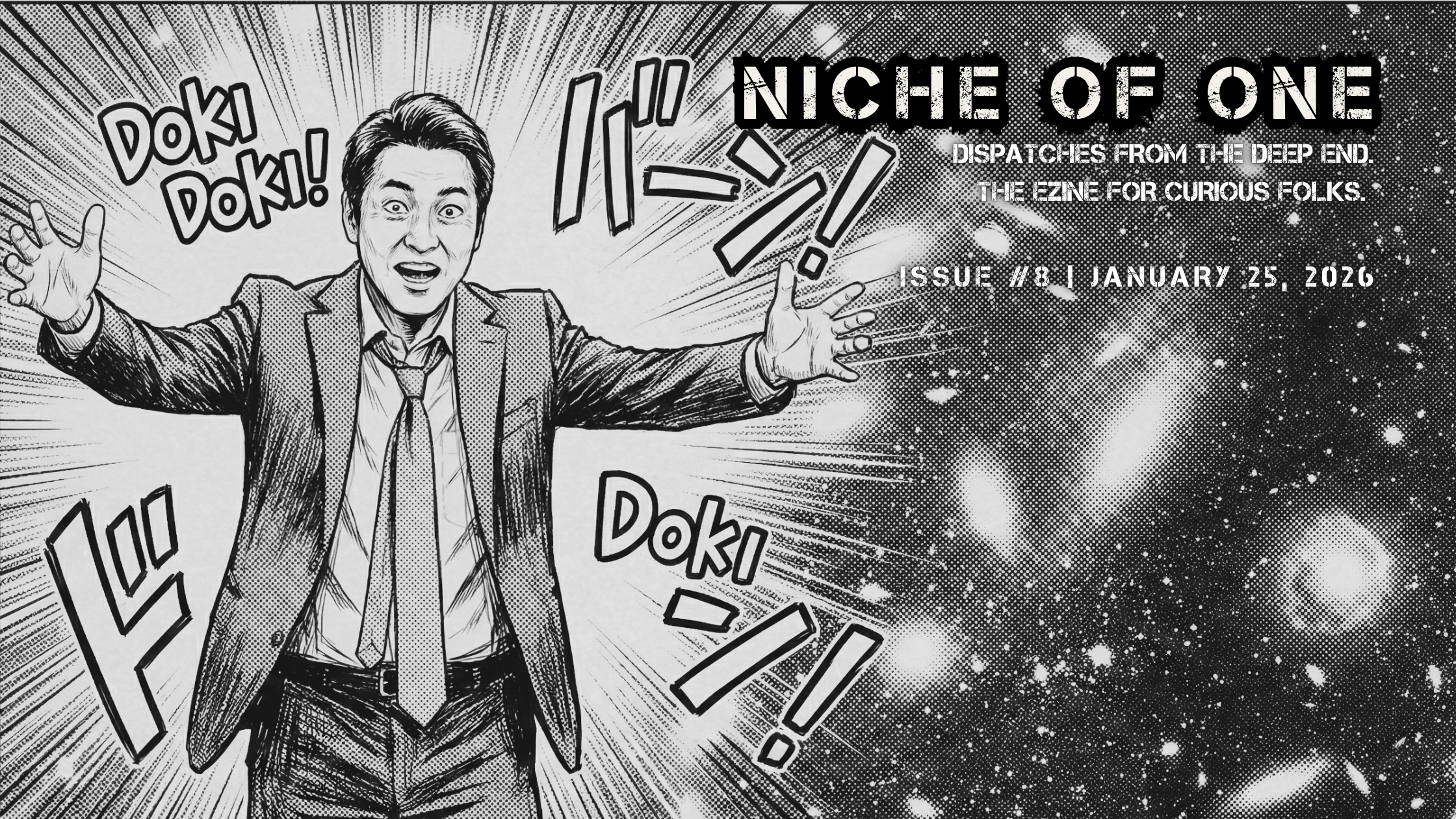
“Just because your small doesn’t mean you can’t think BIG.”
In this issue:
🫠 Transmedia Madness: Building Mythology in the Cracks Between Formats
🫨🕳 RABBIT HOLE: The Forest Has No Individuals
🧐 Cop Watching as Street Epistemology
Small can do things big can’t imagine. It gets things done, and it shows up. It’s the party.
Let’s fuckin’ gooooo…
CUE THE BEST DAMN NEWSLETTER THEME SONG EVER!
🫠 Transmedia Madness: Building Mythology in the Cracks Between Formats
The transmedia empire is a corpse and nobody wants to admit it.
Disney spent billions constructing the Marvel Cinematic Universe. A machinery of interlocking narratives requiring a PhD in continuity just to understand why a wizard’s necklace matters in a movie about a raccoon with a machine gun.
And it worked. It made obscene amounts of money. It proved the concept: stories told across multiple formats can build something larger than any single piece.
But, the infrastructure they built isn’t the only way to do it.
You don’t need their budget. You don’t need their distribution. You can build mythology, architect interconnected universes that live in books and games and music and video and audio, all pointing toward something larger, all rewarding the pattern-seekers, without a single meeting about “brand cohesion.”
You can do it lofi. You can do it weird.
And you can do it in a way that actually respects your audience’s intelligence instead of demanding their subscription.
Transmedia is just a ten-dollar word for “telling a story across multiple formats.”
It’s a concept as old as religion. The Bible is transmedia. Oral tradition, written text, song, art, ritual, all pointing toward the same mythology. Nobody needed Warner Brothers to greenlight the Gospel of Mark.
My version works like this: you build a mythology—a world, a set of characters, a cosmology, whatever pulls at you—and then you release pieces of it into different formats.
A novella that introduces the world.
A card game that lets people duel inside your universe.
A soundtrack that scores the mythology.
A YouTube series of “found footage” from inside the world.
Short stories published as free PDFs.
Audio dramas recorded on a cheap microphone.
Each piece stands alone.
Each piece rewards casual engagement.
But the people who want to go deeper, the ones who pay attention, the pattern-recognizers, they start to see the connections. The character in the novella shows up in the card game lore. The locations in the game match the settings in the short stories. The mythology deepens not through forced continuity but through resonance.
This is how you build a cult following.
Each format teaches you something different about your mythology.
Writing prose forces you to inhabit character consciousness. You learn what your world feels like from the inside. The texture of it. The weight of it. You write a character walking through a city and you have to know what the air smells like, what the streets are made of, how the light falls through the smog.
Building a game forces you to systematize your world. What are the rules? How does magic work? What can players actually do? Could be a simple card game. Could be a text-based LitRPG. Could be a print-and-play board game you distribute as a PDF. The format doesn’t matter. What matters is that games demand internal logic. Your mythology has to hold weight when people interact with it.
Music scores the emotional architecture. A soundtrack tells you what your mythology feels like. Is it dread? Ecstasy? Exhaustion? Boards of Canada scored a nonexistent documentary about a childhood that never happened, and it worked because the music carried the mythology.
Video and audio let you show instead of tell. A three-minute YouTube video of someone exploring an abandoned structure in your world can communicate more atmosphere than ten pages of description. Audio dramas let you play with voice, with sound design, with the texture of speech patterns and radio static and things happening just offscreen.
Each format is a different lens on the same mythology. And because you’re doing this lofi, because you’re not spending six figures on production, you can experiment. You can release something, see how it resonates, adjust. You’re jazz, not symphony.
The best transmedia mythologies leave gaps on purpose.
The Slender Man started as a few doctored photographs on a forum. No budget. No production company. Just a creepy image and a vague mythology. And the internet filled in the gaps. People started writing stories. Creating videos. Building timelines. The mythology grew because it was incomplete. It invited participation.
Your lofi transmedia mythology works the same way. You don’t need to explain everything. You provide touchstones. Landmarks. Recurring symbols. And you let the pattern-seekers build the connections.
But you can go further. You can make it an open world.
Build a LitMMORPG. Not a technical MMORPG requiring servers and coders. A literary one. A mythology with enough structure that other people can write in it. Set the rules. Define the world. Establish the cosmology. Then invite people to create their own characters, write their own stories, play in your sandbox.
This is how you build mythology that actually matters to people. You give them something to figure out. You respect their intelligence enough to let them do the work of assembly. And then you give them permission to add to it.
The mythology becomes collaborative. Your readers become co-creators. The world grows beyond what you could build alone.
Let’s get practical.
You’re a solo creator or a small team. You don’t have Disney money. How do you actually build this?
Step One: Pick your core mythology. What’s the world? What are the rules? Who are the recurring characters or forces? You need enough structure that you can tell multiple stories in the same universe without contradicting yourself. Write this down. Keep it simple. A few pages.
Step Two: Choose your formats based on what you can actually execute. If you can’t draw, don’t make a comic. If you hate editing video, don’t start with YouTube. Play to your strengths. Can you write? Start with short fiction. Can you make music? Start with an album that scores the mythology. Can you code basic HTML? Build a website that feels like it exists inside your world. Can you design cards? Make a simple dueling game set in your universe.
Step Three: Release pieces over time. Let the mythology breathe. Release a short story. A month later, release a song that references the story’s setting. Another month, release a simple game set in the same world. Each piece should work standalone, but together they build something larger.
Step Four: Create the open world framework. Write a brief guide to your mythology. The rules. The cosmology. The established canon. Then invite people to play in it. Let them write stories. Create characters. Expand the world. Curate what becomes official canon or let it stay wild. Your choice.
Step Five: Archive everything in one place. A simple website. A Linktree. Somewhere people can find all the pieces of your mythology. Make it easy to navigate but don’t over-explain. Let discovery be part of the experience.
Audiences want depth.
They want mystery. They want something that rewards their attention instead of demanding their obedience.
Lofi transmedia gives them that. You’re building mythology for people who actually want to think. Who like puzzles. Who appreciate when a creator treats them like collaborators instead of consumers.
And because you’re doing it lofi, you control it. No studio notes. No market research. No executive demanding changes. You build the mythology that matters to you, release it in the formats you can execute, and let the people who get it find it.
The mythology doesn’t need permission. It just needs to be strange enough, compelling enough, interconnected enough that people want to explore it.
Build it in the cracks between formats. Release it into the void. Let the pattern-seekers find the signal.
Then let them add to it. The mythology lives where the audience builds it. You just provide the map and the invitation.

3 Cool Things:
The Ultimate Fiction Editor and The Ultimate Non-Fiction Editor.
Just the tip, but it’s a BIG tip.
🫨🕳 RABBIT HOLE: The Forest Has No Individuals
Look, I know how this sounds.
I know what you think I am. Some weirdo who spends too much time in the woods talking about mushrooms like they’re people. But you asked me why I was out there.
You asked me what I was doing at 3 AM with a headlamp and a notebook. So I’m telling you.
The trees aren’t competing. That’s what you need to understand first. That’s the lie we tell ourselves because we can’t imagine intelligence without a brain.
You’re standing in any forest—doesn’t matter which one—and under your feet is an internet. Not a metaphor. An actual network. Miles of fungal threads, mycelium, connecting tree roots in a web of chemical communication and resource exchange.
The trees are talking. They’re sharing food. They’re warning each other about threats. And they’re doing it through a system that makes our fiber optic cables look like fucking toys.
This is the wood wide web. It’s real. It’s documented. And it’s been running longer than mammals have existed.
You want to know what I was doing out there? I was listening.
You got a pen? You’re going to want to write this down.
Mycelium is the thread-like structure of fungi. The part you don’t see when you step on a mushroom. The mushroom is just the fruiting body. Like an apple on a tree. The organism itself lives underground as a network of microscopic filaments that can stretch for miles. Miles. Under your house. Under this police station. Everywhere there’s dirt.
These threads wrap around tree roots and penetrate them. Mycorrhizal relationships, they call it. The fungus gets sugars from the tree’s photosynthesis. The tree gets nutrients the fungus pulls from the soil. Phosphorus, nitrogen, water. Fair trade.
But it gets weird, and I need you to stay with me on this. The mycelial network doesn’t just connect one tree to one fungus. It connects multiple trees to multiple fungi in a massive underground network. And through this network, trees exchange resources.
A mother tree—usually the oldest, largest tree in the forest—will send carbon to seedlings struggling in the shade. Trees under attack by insects will send chemical alarm signals through the network, warning neighboring trees to ramp up their defense compounds.
You think I’m crazy. I can see it in your face. But this isn’t speculation. Ecologist named Suzanne Simard documented this. Guy named Paul Stamets built a career studying mycelial intelligence. The science is solid. You can look it up.
The forest is a collective organism with a nervous system made of fungus.
And once you know that, you can’t walk through the woods the same way ever again.
This’ll break your meat noodle.
Mycelial networks solve problems. They route nutrients efficiently. They grow toward food sources and away from toxins. They make decisions—not conscious ones, not like you and me sitting here—but decisions nonetheless about resource allocation and network architecture.
This is intelligence. Not human intelligence. Not even animal intelligence. Something else. Distributed. Decentralized. No command center. No hierarchy. Just a network that responds to conditions and optimizes for survival of the whole system.
You following me?
The forest doesn’t have individuals the way we think about individuals. It has nodes. Connection points. But the organism is the network itself. The trees are organs in a larger body held together by fungal threads.
You want to know what I was doing out there at 3 AM? I was trying to understand how it communicates. I was trying to map the network. Because if the forest can do this—if it’s been doing this for four hundred million years—then what else don’t we know about intelligence? About consciousness? About what it means to be alive?
We built the internet thinking we invented something new.
Instantaneous communication across distance. Distributed intelligence. Networked systems with no single point of failure.
The forest was already doing this.
Mycelial networks are proof that intelligence doesn’t require a brain. That cooperation beats competition in the long game. That the individual is a useful fiction but the network is the reality.
And yeah, this terrifies people. I get it. We want to believe in the primacy of the individual. The lone genius. The hero’s journey. The guy who figures it out on his own. But the forest says: you’re not alone. You were never alone. You’re a node in a web you can’t see, sustained by exchanges you don’t notice, part of a system you didn’t build and can’t control.
The mushrooms are just the visible part.
The intelligence is underground.
So when you ask me what I was doing out there, when you ask me why I had a notebook full of diagrams and chemical formulas and maps of root systems, I’m telling you: I was trying to learn the language. I was trying to understand what the network knows that we don’t.
You going to charge me with something? Or can I go back to the forest?
Because the trees are still talking. And I want to hear what they’re saying.

📰 Articles I Enjoyed This Week:
🧐 Cop Watching as Street Epistemology
The camera changes the equation. Not because it’s confrontational. Because it’s evidence.
Cop watching—filming police during stops, documenting interactions, knowing your rights—gets dismissed as anarchist theater or anti-authority posturing. But strip away the politics and you find something more interesting: it’s applied epistemology. It’s philosophy of evidence conducted on street corners with real stakes.
Epistemology is the study of knowledge. How do we know what we know? What counts as evidence? What makes testimony reliable? These are questions usually confined to seminar rooms. Cop watching drags them into the physical world. And it does it best when done professionally, tactically, and with clear understanding of what you’re actually trying to accomplish.
Evidence Requires Witness
Police testimony is given institutional weight that civilian testimony is not. A cop says something happened. You say it didn’t. The system believes the cop. Not because cops are more honest. Because cops have institutional authority.
Cop watching corrects this imbalance through documentation. A camera is a witness that doesn’t have emotional investment in the outcome. It records what happened. Not what someone says happened. What the light and sound captured.
This is epistemology: creating reliable knowledge through verifiable evidence.
The camera works because it collapses the gap between testimony and evidence. It removes the he-said-she-said ambiguity where institutional power typically decides truth. And it works best when the person holding it understands that documentation, not confrontation, is the goal.
Know Your Rights, Know Your Role
You have the right to film police conducting their duties in public. First Amendment. Settled law. Understanding this isn’t about being antagonistic. It’s about knowing the operational parameters.
You have to know what you’re allowed to do. And you have to know what they’re allowed to do. And you have to know how to operate within that framework safely and effectively.
A cop can ask you to step back. Whether you comply depends on whether you’re actually obstructing. Generally, staying 10-15 feet back is safe distance. A cop cannot demand you stop filming. They can threaten it. That doesn’t make it legal. But understanding this distinction and remaining calm when tested on it is what separates effective documentation from creating additional problems.
Your job is to maintain professional distance. Keep recording. Stay calm. Don’t argue. Don’t explain. Don’t engage in debate. Just document. The footage speaks for itself.
If they ask what you’re doing: “I’m exercising my First Amendment right to document public officials conducting their duties.” That’s it. Don’t elaborate. Don’t get pulled into conversation.
The Observer Affects the Observed
The act of watching changes the thing being watched. Quantum mechanics calls this the observer effect. Cop watching proves it works at the macro scale.
A cop conducting a stop while being filmed behaves differently than a cop conducting a stop with no witnesses. Not always. But often enough that the camera matters. Accountability changes behavior. Visibility changes behavior. The knowledge that evidence is being created changes behavior.
We have data on this. Body cameras reduce use-of-force incidents. Civilian filming reduces constitutional violations. Not because cameras are magic. Because documentation creates consequences.
The philosophy here is straightforward: power without oversight trends toward abuse. Oversight requires evidence. Evidence requires witness. The camera is the witness that doesn’t get tired or confused or intimidated.
And the person holding that camera needs to understand they’re creating a legal record. That means staying professional. Staying calm. Staying focused on documentation rather than commentary.
Tactical Execution
If you’re going to do this, do it right:
Before: Know the law in your jurisdiction. Know your rights. Know the case law. Have legal resources ready. First Amendment protections are federal, but local ordinances can complicate things. Do your homework.
During: Keep reasonable distance. Record clearly. Get badge numbers if visible. Document the scene. Stay calm regardless of what they say to you. Don’t respond to provocation. Don’t offer commentary on the stop itself. Your job is documentation, not judgment.
After: Back up your footage immediately. Multiple locations. Cloud and local. Know who to contact if there’s an incident. Know your local legal observer network or civil rights organizations.
Safety: Work in pairs when possible. Let someone know where you are. If the situation escalates beyond documentation into actual danger, your life matters more than the footage. Use judgment.
Cop watching isn’t about hating cops.
It’s about accountability. It’s about creating a record that can’t be disputed later. It’s about refusing to accept that institutional testimony is inherently more reliable than documented evidence.
It’s philosophy made physical. It’s asking: what counts as truth? Who decides? What mechanisms create reliable knowledge? And then answering those questions with a camera, knowledge of your rights, and the discipline to stay professional under pressure.
The truth doesn’t care about the badge. The badge cares about the camera. And the camera is most effective when the person holding it understands that documentation, not confrontation, is the point.
Create evidence. Stay safe. Stay professional. Hold the line.

🧠 ON MY MIND
Yes, it’s crazy out there.
Are blinkers really that hard to use?
That’s it for this week. Stop stealing candy from children. Until next time…
~ J.D.
Please note some links may lead to affiliate offers and if you purchase from these links I may receive a small amount of compensation at no extra cost to you.
I'm taking my baby steps towards this kind of storytelling. It's exciting to do it with the platforms and tools available to us today.
The Gilbert brothers have been doing this in comics for a long time in their Love and Rockets series.
Funny, there's a Paul Stamets in Star Trek Discovery, a scientist dealing with... mycelial network.
He's also gay ;-)