

Jung and Tomatoes
Fighting back from the comfort of your couch.

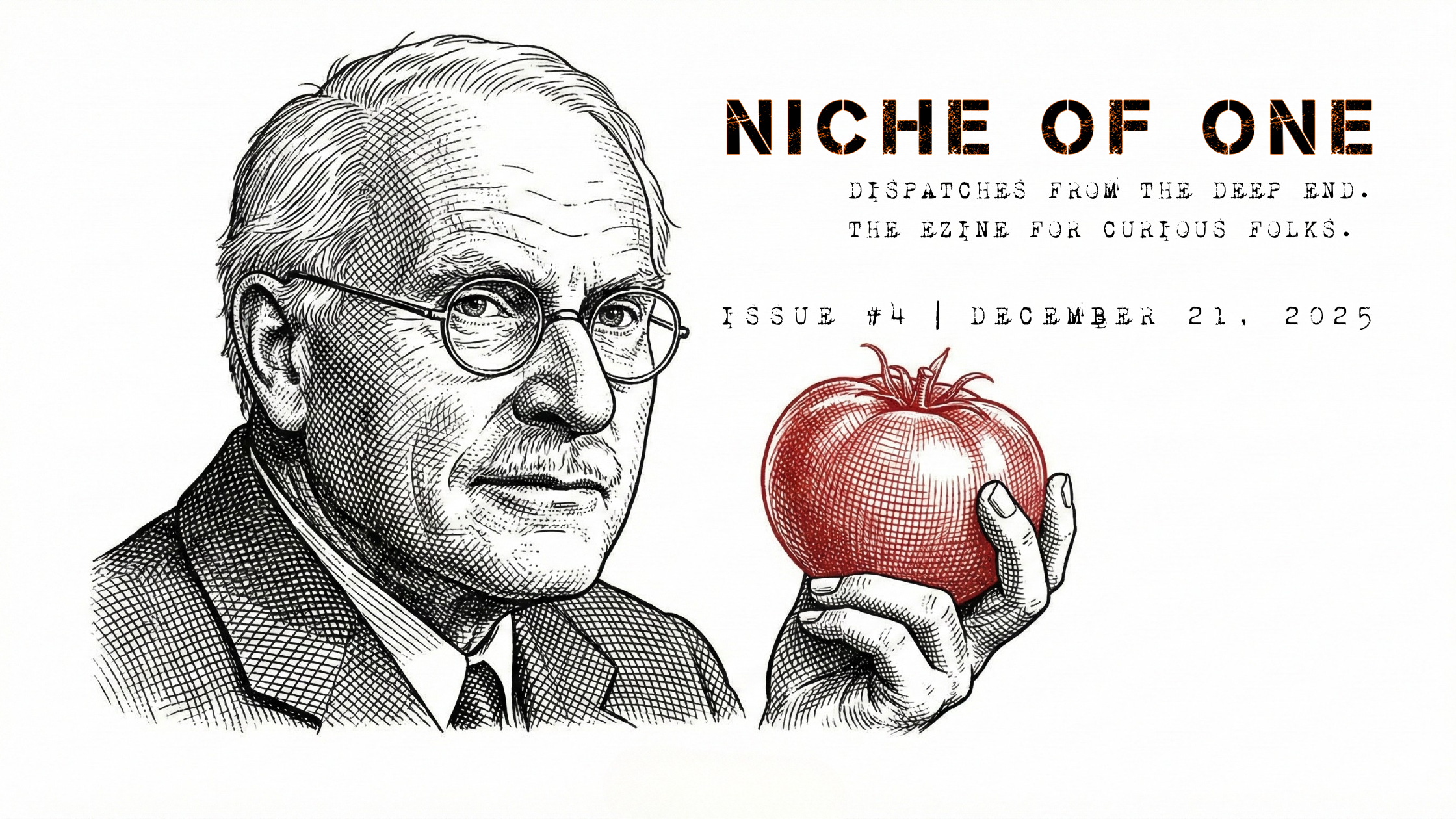
Four Ways to Stop Being Sold (Without Leaving Your Apartment)
They want you scrolling. They want you buying. They want you believing the narrative and never asking who wrote it or why.
Your attention is the product. Your compliance is the goal. Your confusion is the strategy.
This issue is four survival tactics for people who refuse to be managed by algorithms, platforms, institutions, or the consensus reality they’re selling.
First: how to build and create without asking permission from investors, platforms, or gurus who want a cut. The indie solo guerrilla manifesto for people who’d rather own something small than rent something big.
Second: how to grow real things in fake spaces. Apartment gardening that doesn’t suck. Dirt under fingernails as reality check when everything else is digital and abstract.
Third: Jung’s shadow work applied to daily life. How to stop absorbing other people’s projections. How to recognize when someone’s yelling at themselves and you just happen to be in the room.
Fourth: finding truth and making meaning when institutions lie, consensus reality is manufactured, and you’re not sure what’s real anymore. Pattern recognition without paranoia. Navigation tools for post-truth simulation.
Four ways to fight back. None of them require leaving your apartment.
Let’s go.
🏴☠️ THE INDIE SOLO GUERRILLA CREATOR MANIFESTO
You’re in a war and nobody told you.
The platforms want your audience so they can sell it back to you in CPM rates and algorithm updates.
The investors want your equity so they can strip-mine your idea for an exit.
The gurus want your $297 a month so they can teach you their “system” that only worked because they were early and you’re late.
Everybody wants a piece. Nobody’s asking permission.
You can fight back or you can get eaten. Those are the options. There’s no third choice called “staying neutral” or “just creating.”
You’re either building something that’s yours or you’re building someone else’s empire.
The choice isn’t between “creator” and “entrepreneur.”
It’s between owned and owner. Between building what you want and building what makes the quarterly numbers look good. Between answering to yourself and answering to everyone else.
Most people pick owned without realizing they had a choice. They take the funding, join the platform, follow the playbook, and wake up five years later wondering why they hate what they built.
This is the manual for the other option.
Indie 4 Life: Why You Don’t Take The Money
Funding comes with handcuffs.
Pretty handcuffs, maybe. Rose gold handcuffs with a good story about “partnership” and “growth.”
Still handcuffs.
The minute you take money from someone who wants it back with interest, you’re not building what you want anymore. You’re building what gets them their return. Your job becomes making the investors happy. Their job is extracting value.
You think those incentives align. They don’t.
VC money means building what scales. What scales isn’t usually what’s interesting or weird or true. It’s what appeals to the most people in the blandest possible way. It’s McDonald’s, not the taco truck. Both sell food. Only one has a soul.
You take funding, you’re building an exit strategy. Not a life. Not a body of work. A financial instrument that needs to return ten times what they put in. That changes everything about what you build and how you build it.
Own your IP. Own your audience. Own your time. All three or you own nothing.
This sounds extreme until you watch someone with funding try to pivot.
They can’t. The investors won’t let them. The board has opinions. The stakeholders need to be consulted. The people with money have veto power over your ideas.
You wanted freedom. You bought a committee.
Small and yours beats big and borrowed every single time. You make $5,000 a month on your own? That’s real. You make $50,000 a month but owe investors $45,000 of it? That’s makes you an employee with delusions of control.
The difference between independence and “influencer”: one answers to themselves, one answers to brands. One makes what they want, one makes what gets sponsored. One builds equity, one rents attention.
Bootstrap or die trying. The third option is a slow death and creative emptiness.
Solo Ops: Leverage, Not Labor
One person with AI and automation beats a team of ten. Not sometimes. Always.
The team of ten has meetings. Status updates. Coordination overhead. Personality conflicts. Someone’s on vacation. Someone’s sick. Someone’s quiet quitting. Someone’s updating their resume.
You have none of that. You have tools that do what you tell them without having opinions about it.
Your “employees” are LLMs for first drafts and research, Zapier for connecting the boring shit, Python scripts for the repetitive garbage, no-code tools for the stuff you don’t want to learn to code.
They don’t take breaks. They don’t need motivation. They don’t schedule meetings to discuss the meeting about the project timeline.
They are a force multiplier for the solo operator.
Speed becomes your competitive advantage.
While they’re scheduling the meeting to discuss the new feature, you’ve already shipped it.
While they’re doing stakeholder alignment, you’ve already tested three versions and killed two of them.
While they’re building consensus, you’ve made a decision and moved on.
Decision paralysis only happens with committees. Solo, you just decide. Good decision or bad decision, you’ll know fast. You course-correct in an afternoon, not a quarter.
What this actually looks like:
AI writes the first draft. Terrible first draft, usually. You fix it. Still faster than staring at a blank page for three hours.
AI does research. Pulls sources. Finds patterns. Summarizes documents. You verify and synthesize. Still faster than doing it yourself.
Automation handles distribution. Email sequences. Social posting. File organization. You set it once, it runs forever or until it breaks.
Code handles the boring repetitive shit that eats your time. Data entry. File conversion. Batch processing. Whatever makes you want to quit entirely.
You handle strategy. Voice. Vision. Final say. The things that actually matter.
The solo creator isn’t alone.
They’re just not managing people. Delegation to machines, not humans. The machine doesn’t care if you’re harsh in your feedback. It just processes and waits for the next instruction.
Why hiring is often hiding:
You don’t need a VA to schedule your social posts. You need Zapier and the discipline to actually use it.
You don’t need a video editor. You need to make simpler videos.
You don’t need a community manager. You need to stop building things that require community management.
Most hiring is outsourcing problems you created by overcomplicating your business.
Simplify first. Automate second. Hire last, if ever.
Guerrilla StratOps: Unconventional Tactics
You can’t out-spend them. Accept this now.
The giants have ad budgets bigger than your yearly revenue. They have teams. Distribution deals. Existing audiences. Institutional credibility. Every advantage except one: they’re slow and you’re not.
Speed and weirdness. Those are your weapons.
They build on Instagram and pray the algorithm likes them. They chase trends. They A/B test thumbnails. They optimize for engagement metrics that change every quarter.
They’re playing the platform’s game by the platform’s rules.
You build on owned infrastructure and use platforms as loudspeakers.
Your website. Your email list. Your RSS feed. Things you control.
Platforms are distribution channels, not foundations. When TikTok changes the algorithm or Instagram bans your account or Twitter becomes whatever the hell it is now, you’re fine. Annoyed, but fine.
Platform arbitrage vs platform dependence. They’re dependent. You’re arbitraging. You take value from the platforms without giving them your entire business model.
Constraints as creative fuel.
You don’t have a budget for fancy software or design templates or professional video equipment.
Good. That limitation forces better ideas. The scrappy weird thing you make with free tools and genuine personality beats the polished forgettable thing they made with a production team.
The lo-fi aesthetic isn’t poverty. It’s tactical. It signals: this person isn’t performing. This person is making things.
Guerrilla tactics that actually work:
Zine distribution instead of algorithm gaming. Make a PDF. Email it directly. Put it on your website. No platform required.
Direct sales instead of funnel theater. “Here’s the thing. It costs this much. Buy it or don’t.” No webinar. No countdown timer. No false scarcity.
Email over ads. Costs nothing. You own the list. No algorithm deciding who sees your message.
PDF guides instead of course platforms. No monthly fees. No tech support. Just download and read.
One-page websites instead of complicated funnels. Everything you need on one page. No navigation menu. No multi-step journey. Just: here’s what this is, here’s why it matters, here’s how to get it.
ASCII art instead of Canva templates. Lo-fi intentional ugliness. Looks like nothing else out there because nothing else looks like that anymore.
Why “professional” often means “looks like everyone else.”
The corporate aesthetic is designed to signal legitimacy.
You don’t need legitimacy. You need differentiation. Weird beats polished when polished is everywhere.
Ugly and real beats polished and forgettable every time. The punk rock DIY ethos applied to digital products: make it, ship it, move on.
Don’t wait for perfect. Perfect never ships.
What this actually looks like day-to-day:
Morning: Check email. Write for two hours. Publish. Done by noon.
No status meetings. No stakeholder updates. No HR compliance training. No performance reviews. No company all-hands where someone talks about quarterly objectives while you wonder if you left the stove on.
Tools you actually use: Google Workspace for everything. LLMs for thinking out loud. Maybe Ghost or Substack for publishing. Maybe Gumroad or Stripe for selling. That’s it. Five tools maximum.
Where you can’t compete: paid ads (no budget), SEO wars (no patience), influencer collaborations (no network). Fine. Don’t compete there.
Where you dominate: speed (you ship this week, they ship next quarter), weirdness (you can be strange, they have brand guidelines), actual personality (you sound like a human, they sound like a marketing department).
When to break your own rules: when the rule gets in the way of shipping. The rules are principles, not commandments. If “use only five tools” means you can’t ship, use six tools. Just don’t use sixty.
Why most “solopreneurs” are still playing by corporate rules: They’re building the same business structure, just smaller. They’re doing the same funnel tactics, just cheaper. They’re following the same playbook, just alone. That’s not independence. That’s being understaffed.
This isn’t a lifestyle. It’s survival tactics for people who refuse to be managed.
Most won’t do it.
They’ll take the funding because it feels like validation. They’ll hire the team because it feels like progress. They’ll build what investors want because it feels safer than building what they want.
That’s fine. More oxygen for the rest of us.
🌿 APARTMENT GARDENING THAT DOESN’T SUCK
You live in a box. 600 square feet if you’re lucky. 400 if you’re not.
The landlord won’t let you paint the walls. The HOA has opinions about everything you do including breathing too loud on Tuesday. Your neighbors can hear you sneeze. You can hear them fight about whose turn it is to take out the trash.
But you can grow things. Real things. Living things that don’t require WiFi or a subscription model or permission from anyone.
This isn’t about becoming a homesteader. You’re not going off-grid. You’re not buying land in Montana and learning to can vegetables.
You’re putting your hands in dirt and watching something that isn’t a spreadsheet actually grow.
That’s it. That’s the whole thing.
Here’s what actually works in small spaces.
Herbs save you $4 to $8 every time you don’t buy that sad plastic container at the grocery store. The one that goes bad in your fridge three days after you buy it because you only needed two tablespoons for the recipe.
Basil grows like a weed if you give it light and don’t drown it. Tastes better than anything you’ll buy at the store. Smells like summer even when it’s February and you hate everything.
Cilantro needs less light than you think. Reseeds itself if you let it go to flower. Some people think it tastes like soap. Those people are wrong but whatever.
Parsley comes in flat-leaf or curly. Both work. Neither dies easily. Makes you feel like a competent adult when you snip some fresh parsley onto literally anything.
Thyme is almost unkillable. Almost. You can kill it if you try hard enough by drowning it or putting it in a dark closet. Don’t do those things and it’ll outlive your houseplants and most of your relationships.
Rosemary needs more light than the others but it’s worth it. One plant lasts years. Survives neglect better than most friendships. Smells like you know what you’re doing in the kitchen even when you don’t.
Scallions are the infinite vegetable. Buy them once at the grocery store. Cut off the green parts. Use them in whatever you’re making. Put the white roots in a glass of water on your windowsill. They grow back in a week. Cut them again. They grow back again. Repeat forever or until you kill them, which is hard to do unless you forget they exist for a month.
This is as close to free food as you’re getting under capitalism.
Cherry tomatoes are the only tomatoes worth growing in containers. Full-size tomatoes need more space than you have and more light than you’re getting and more patience than you possess. Cherry tomatoes in a 5-gallon bucket with decent light will give you summer salads that taste like actual food instead of the grocery store lie that’s been picked green and gassed with ethylene.
Lettuce grows faster than you can eat it. Cut-and-come-again varieties mean you harvest leaves, not whole plants. You cut what you need for tonight’s salad. It grows back. You cut more next week. It grows back again. Grows in partial shade better than most vegetables. Fresh salad greens that didn’t travel 2,000 miles in a refrigerated truck.
What doesn’t work: Full-size tomatoes unless you have a balcony with serious sun. Peppers are possible but finicky and not worth the effort if you’re just starting. Anything labeled “full sun” when you don’t have full sun. Vegetables that need deep roots when you’re working with shallow containers.
Don’t fight reality. Reality wins.
The Practical Setup
Containers: Cheap works fine. Dollar store plastic bins with holes drilled in the bottom. 5-gallon buckets from the hardware store. Anything that holds soil and drains water.
You don’t need fancy terracotta pots or self-watering systems or whatever Pinterest says you need. You need a container with a hole in the bottom.
Bigger is better for root growth. But work with what you have. A small pot of basil beats no basil at all.
Soil: Don’t use dirt from outside. It compacts. Drains poorly. Has weed seeds. Has bugs. Has regrets.
Buy potting mix. Not garden soil. Potting mix. Looks expensive per bag. Lasts longer than you think. One bag grows a lot of basil.
Light: South-facing window is ideal. East or west-facing works for herbs and lettuce. North-facing means buy a cheap LED grow light or stick to shade-tolerant stuff like lettuce and some herbs.
LED grow lights are cheaper than they used to be. Still not free. But cheaper than therapy or whatever you’re spending money on to cope with living in a box.
Six or more hours of light for fruiting plants like tomatoes. Four or more hours for leafy stuff like lettuce and herbs. Less than that and you’re fighting biology.
Watering: Stick your finger in the soil. If it’s dry an inch down, water it. If it’s wet, leave it alone.
More plants die from overwatering than underwatering. People love their plants to death. They water on a schedule instead of checking the actual soil. The plant drowns. They’re sad. They buy another plant. Repeat.
Drainage holes are mandatory. Not optional. Not negotiable. Mandatory. Water has to go somewhere or the roots rot.
When to give up: If it’s been dead for two weeks, it’s dead. Don’t keep watering the corpse hoping for resurrection. It’s not Jesus.
Compost it. Try again. Killing plants is how you learn not to kill plants. Everyone kills their first basil plant. Most people kill their second one too.
Dirt under fingernails is a refreshing reality check.
Everything else in your life is digital, abstract, theoretical. The blog post. The email. The Zoom meeting. The spreadsheet. The bank account number that represents money you can’t hold. The followers who are numbers on a screen. The engagement metrics that mean nothing and everything.
The tomato plant is real. It needs water or it dies. It grows or it doesn’t. No algorithm to game. No optimization strategy. No growth hacking. No A/B testing the soil pH.
The tomato doesn’t care about your follower count. It doesn’t know you’re behind on the project. It doesn’t give a shit about your quarterly goals or your five-year plan or whether you’re “crushing it” this month. It just grows or dies based on whether you did the basic things.
Living things in dead spaces. A basil plant on a windowsill in a rental apartment where you can’t even paint the walls. Proof that you can make something real in a place designed to feel temporary.
The act of growing something with your hands while everything else you do happens through screens. The smell of fresh basil instead of the smell of recycled air. The taste of a tomato you grew instead of a tomato that traveled from California in a truck.
It’s a small rebellion.
A $3 basil plant that saves you $100 a year in grocery store herbs. A scallion that grows forever in a glass of water on your windowsill. A cherry tomato that tastes like summer in March.
It’s not homesteading. It’s not self-sufficiency. You’re not getting off the grid or sticking it to Big Agriculture.
But it’s yours. And it’s alive.
And in a world where everything else is increasingly fake, abstract, and optimized for engagement, that matters more than you think.
🔗 3 Cool Things:
Finally got You’re Already Infected in paperback format for those who would like something other than the PDF. Here’s the landing page for both.
This is my favorite Chicken and Dumplings recipe.
Really interesting article from the beginnings of computer music.
🌚 JUNG IS DADDY
Someone’s yelling at you.
Could be your boss. Could be your partner. Could be some stranger on the internet who doesn’t like your face or your opinion or the way you phrased that one sentence in that one post.
Your first instinct is to yell back. Defend yourself. Destroy them with logic and facts and a detailed explanation of why they’re wrong and you’re right. Build your case. Present your evidence. Win the argument.
Don’t.
They’re not mad at you. They’re mad at themselves. You’re just the screen they’re projecting onto. The convenient target. The person who happened to be standing there when their shadow exploded out of the basement where they’ve been keeping it.
Carl Jung figured this out a hundred years ago. Your therapist knows it. But nobody taught you how to actually use it in real time when someone’s screaming at you about something that makes no sense.
Here’s how.
The shadow is everything about yourself you pretend doesn’t exist.
The parts you’ve shoved into the basement of your psyche because they’re not acceptable.
Not acceptable to your family, your culture, your religion, your self-image, your Instagram feed, your carefully curated personal brand.
Everyone has a shadow. The person screaming at you definitely has one. Probably a big one. The bigger the reaction, the bigger the shadow.
Jung’s concept without the mystical bullshit: You contain multitudes.
Some of those multitudes scare you. The angry part. The selfish part. The sexual part. The ambitious part. The lazy part. The parts that don’t fit the story you tell yourself about who you are.
So you repress them. You decide they don’t exist. You build a personality that excludes them.
“I’m not an angry person.” “I’m not selfish.” “I don’t care about money.” “I’m always positive.”
Lies. All lies. Necessary lies to function in society, maybe. But lies.
Integration vs repression:
Repression: “I’m not angry. I’m never angry. Anger is bad. Angry people are bad. I’m not bad therefore I’m not angry.” The anger doesn’t go away. It just operates from the basement. It leaks out in passive aggression. Explodes randomly. Runs your life without your permission.
Integration: “I have anger in me. Everyone does. I can acknowledge it exists. I can choose what to do with it. I can use it or set it aside. But I’m not pretending it’s not there.”
Why “being positive” creates bigger shadows: The more you deny a part of yourself exists, the more power it has over you. Toxic positivity creates toxic shadows.
The people who insist they’re “always happy” and “never negative” are usually rage bombs waiting to explode. Or they’re so disconnected from their actual emotions they’ve become hollow.
The shadow doesn’t go away because you ignore it. It doesn’t die from neglect.
It just runs your life from the basement while you’re upstairs pretending you’re in control.
When people attack you, they’re showing you what they hate about themselves.
The specific insult is a map of their shadow. A self-report. A confession disguised as an accusation.
How this actually works:
Someone calls you arrogant. Interesting.
They’re suppressing their own confidence. Their own self-assertion. They learned somewhere that putting yourself forward is bad. Conceited. Selfish.
So they crushed that part of themselves. Killed their own ambition. Now when they see you doing it, they hate you for it. You’re living the part of themselves they murdered.
Someone says you’re too sensitive. They won’t acknowledge their own feelings.
Emotions are weakness in their worldview. Probably learned it from a father who never cried or a mother who said “stop being so dramatic.”
So they’ve repressed every feeling that isn’t anger or numbness. You expressing emotion makes them uncomfortable because it reminds them of the parts they killed to survive their childhood.
Someone accuses you of being selfish. They’ve spent their whole life people-pleasing.
Ignoring their own needs. Martyring themselves for others. They can’t say no. Can’t set boundaries. Can’t ask for what they want.
You setting boundaries looks like selfishness to them because they’ve never allowed themselves to have boundaries. Your self-care is their accusation.
More examples:
“You’re so judgmental“ = they judge themselves constantly, brutally, without mercy. The voice in their head is a prosecuting attorney. They see you judging others because that’s what they do to themselves every waking moment.
“You think you’re better than everyone“ = they feel inferior. Less than. Not good enough. They measure themselves against everyone and always come up short. Your confidence looks like superiority because they don’t have any.
“You’re always causing drama“ = they suppress conflict until it explodes. They won’t address problems directly. They let resentment build. Then they accuse others of being dramatic when really they’re terrified of confrontation.
“You’re so cold“ = they’re terrified of vulnerability. Of being seen. Of emotional intimacy. They’ve built walls so high they can’t feel anything anymore. Your boundaries look cold because they have no boundaries at all.
It’s never about you. It never was.
The accusation is a confession. The attack is a self-report. They’re telling you exactly what they’ve repressed.
You just have to listen.
Don’t react with anger.
The moment: Someone’s attacking you. Meeting at work. Comment thread online. Family dinner. Doesn’t matter where.
Your heart rate spikes. Your face gets hot. Your hands might shake. You want to destroy them with words. Prove them wrong. Make them see how wrong they are.
Stop.
Count to three. Not in your head. Actually count. One. Two. Three.
Not meditation. Not deep breathing. Not visualization.
Just pause. Create physical space between stimulus and response.
Your brain needs three seconds to get out of amygdala hijack and back into prefrontal cortex where rational thought lives.
Tactical responses that actually work:
“That’s interesting.“ Said flatly. No sarcasm in your voice. No edge. Just flat observation. Like you’re noting the weather.
“Tell me more about that.“ Make them explain their projection. Most people can’t. They’re reacting, not thinking. Making them articulate it often deflates the whole thing.
Silence. Just look at them. Wait. Say nothing. Let them fill the space. Most people can’t handle silence. They’ll keep talking. Usually they’ll talk themselves into a corner.
“I’ll think about that.“ Then don’t. Or do, but later, when you’re not in fight-or-flight mode.
These responses drive people crazier than arguing because you’re not feeding the projection.
They’re screaming at a mirror and the mirror isn’t screaming back.
The projection needs your reaction to survive. Without it, it just hangs there, awkward and obvious.
Watching their shadow without absorbing it:
You can see what they’re projecting without taking it on. “Oh, they’re showing me their fear of inadequacy right now. Interesting.”
You’re not inadequate. They’re just afraid they are. You can observe that without internalizing it.
It’s like watching someone throw a ball at you. You can see the ball.
Acknowledge the ball. Not catch the ball. Just let it bounce off and fall to the ground.
Traffic as practice ground:
Someone cuts you off. Your immediate thought: they’re an asshole. They did it ON PURPOSE. They saw you and decided to ruin your day because they’re a terrible person who hates you specifically.
Reality: They didn’t see you.
They’re late for work. They’re thinking about their own problems. Their kid is sick. They’re worried about money. They’re distracted. It has nothing to do with you.
Every time you get cut off in traffic and don’t rage, you’re training yourself to not absorb other people’s projections. You’re building the muscle that lets you see someone’s anger without taking it personally.
Most of life is traffic. People cutting you off without seeing you. People projecting their shit onto you without meaning to.
It’s not personal. It’s just their shadow looking for a place to land.
What pisses you off reveals your shadow.
Not mild annoyance. Not rational disagreement.
Deep visceral rage. The kind that stays with you. That you think about later. That you bring up in conversations days afterward. That’s your shadow talking.
Examples:
The coworker who “takes credit for everything” - Are you suppressing your own ambition? Do you refuse to advocate for yourself because you’ve decided self-promotion is gross? Have you made a virtue out of staying small? That coworker is showing you the part of yourself you’ve killed: the part that wants recognition.
The friend who’s “always so dramatic” - Are you terrified of expressing emotion? Have you decided that feelings are weakness and dramatic people are embarrassing? Did someone shame you for crying once and you never cried again? That friend is showing you the part you’ve repressed: the part that feels things deeply.
The person who’s “so lazy” - Are you grinding yourself to death? Have you made rest and relaxation morally wrong? Is your entire identity built on being productive? That “lazy” person is showing you what you won’t allow yourself: the part that needs to stop sometimes.
The person who’s “always bragging” - Have you made humility your entire personality? Do you downplay your accomplishments? Deflect compliments? Make yourself smaller to make others comfortable? They’re showing you the part you won’t let out: the part that’s proud of what you’ve done.
Strong reactions mean unintegrated parts of self. The button gets pushed because the button exists. No button, no reaction.
Integration process:
Notice the strong reaction. You’re raging about something. Okay. That’s data.
Ask: What part of me am I seeing in them? What are they doing that I won’t let myself do? What are they expressing that I’ve repressed?
Acknowledge it exists in you. This is the hard part. Admitting you have the thing you hate. You’re not as patient as you think. Not as humble. Not as selfless. You have anger, ambition, laziness, vanity. Everyone does.
Accept that it’s there. Not the same as acting on it. Just accepting it exists. “Yes, I have ambition. Yes, I want recognition. Yes, I get lazy sometimes. These are facts.”
Decide what to do with it. Use it. Channel it into your work. Transform it into something useful. Or acknowledge it exists and set it aside for now. But stop pretending it’s not there.
Shadow work isn’t therapy. It’s maintenance. Like cleaning your apartment or changing your oil. You do it regularly or things break down.
Jung called it shadow work. Your therapist calls it projection. I call it: stop fighting other people’s inner demons and focus on your own.
Next time someone’s yelling at you, remember - they’re not talking to you. They’re talking to themselves. You just happen to be in the room. You just happen to be showing them the parts of themselves they won’t look at.
Let them have their projection.
You don’t have to catch it.
📰 Articles I Enjoyed This Week:
Really enjoyed this list of prompts from Mia Kiraki 🎭 and friends.
You never know what to expect from The Last Honest Broker, which is the reason I read him. This one: the time he almost became an arms dealer.
🕳 RABBIT HOLE: FINDING MEANING IN POST-TRUTH SIMULATION
The institutions lied. Not theory. Documented fact.
WMDs that didn’t exist. Mass surveillance they denied until Snowden. Opioids they said weren’t addictive. Tobacco that wasn’t harmful for fifty years. Climate change the oil companies knew about in the 1970s while funding denial.
Your employer lied when they said “we’re a family” before the layoffs. The banks lied about mortgage securities. The food industry lied about sugar.
So what’s true? Does truth even exist? Or are we just picking which lies taste better?
The Pattern Recognition Problem
Your brain evolved to see patterns. It’s survival. See pattern, avoid tiger, live another day.
Now you’re seeing patterns everywhere. Institutional corruption following the same playbook. Economic systems concentrating wealth. Media narratives benefiting the powerful. Educational systems suppressing critical thinking.
Some patterns are real. Some are paranoia. How do you tell the difference?
The conspiracy theorist and the pattern-seeker use the same process. Both question narratives. Both see connections. The difference is verification.
The conspiracy theorist sees pattern, assumes causation, ignores contradicting evidence. Everything connects. “They’re all in on it.” Dead-ends in delusion.
The pattern-seeker checks sources, changes mind with new evidence, distinguishes coincidence from causation. “This is probably connected, here’s why, I could be wrong.” Finds signal in noise.
Epistemic Humility Without Relativism
You can hold two thoughts: “I could be wrong” and “This is probably true based on evidence.”
Not all narratives are equal. Some things are provably false. Earth isn’t flat. Vaccines don’t cause autism. Moon landing happened.
But consensus reality is often manufactured. Manufacturing Consent is an operational manual.
The balance: Skepticism questions claims, demands evidence, follows money. Cynicism assumes everything is lies, trusts nothing, refuses answers.
Skepticism is healthy. Cynicism is corrosive.
What Gets Suppressed and Why
Information gets suppressed when it threatens power.
MKUltra. COINTELPRO. Gulf of Tonkin. Enhanced interrogation. Operation Paperclip. All dismissed as conspiracy theories. All documented now. The paranoid people were right.
Medical research threatening pharmaceutical profits gets buried. Energy innovations threatening fossil fuels get shelved. Academic research challenging paradigms gets rejected.
Why? Threatens profit. Threatens power. Threatens paradigm. Usually all three.
When someone says “that’s been debunked,” ask: by whom? Who funded the debunking? Who profits if you believe it?
Truth-Seeking as Survival
You can’t navigate reality if you don’t know what reality is.
Read primary sources, not summaries. Follow the money. Cross-reference everything. One source is interesting. Five sources is probably true. Trust your gut but verify. Ask who benefits.
Making Meaning Anyway
Maybe truth is dead. Maybe we’re in a simulation. Maybe everything is manufactured. Maybe it’s worse than you thought.
Make something anyway.
Meaning isn’t discovered. It’s forged. In the work. In the making. In the things you create that didn’t exist before.
The act of making is the only truth you can verify directly. You wrote it. You built it. You grew it. That’s real at the level that matters.
Nobody’s giving you permission or purpose. The institutions that provided meaning are broken or lying. Build your own. From primary sources. From direct experience. From patterns you can verify.
The algorithm wants you broke, stupid, and scrolling. The institutions want you compliant. The simulation wants you asleep.
Make something real. Grow something living. Think something dangerous. Find your own truth.
Not with grand gestures. With small acts of creation and verification. With refusal to accept comfortable lies. With discipline to question everything.
The pattern-seekers survive. The truth-seekers navigate. The makers build something worth building.
The rest just scroll.
📚 CURRENTLY CONSUMING
Book: Still reading Chuck Palahniuk’s Consider This: Moments in My Writing Life after Which Everything Was Different. Excellent book so far.
🧠 ON MY MIND
Since I accidentally made a band, I’m now thinking of purposely making an online radio station.
I hate having to take out images to make sure I can get in more story, but that’s life.
I’m not sure what it is about the holiday season, but it makes nice people nicer and shittier people even more shitty.
Until next week,
~ Joe
Please note some links may lead to affiliate offers and if you purchase from these links I may receive a small amount of compensation at no extra cost to you.
Love your newsletter. Still, it would benefit with one story at a time, I think ;-)
Been married a master gardener for the past 26 years. She's awesome. Few observations from the garden this year:
* Peppers: Found them to be a PITA to grow. No luck this year. Maybe next year.
* Tomatoes: Was still getting them last month from the vines we container started this spring.
* Cilantro: You either have the gene where it tastes like soap, or you don't.
* Basil: The absolute *best* Pesto comes from Basil you grow yourself. Pesto is a good substitute to tomato-based sauces in many Italian-style dishes.
* The cheap Harbor Freight greenhouse was one of the best investments I ever made.