




Have questions? We have answers → The Gumroad Solution Guide.
The checkout screen loaded and I stared at it like a man watching his own autopsy.
Zero sales. Third week running. The storefront sat there humming its little digital hum, doing absolutely nothing, because I’d made the same mistake every new seller makes.
I thought Gumroad was a store.
It’s not a store. It’s a cash register. A very good cash register with some clever tricks built into the guts of it, but a cash register nonetheless. Nobody walks into a cash register. You walk into a store, grab what you need, and the cash register handles the transaction. Gumroad handles the transaction. You handle everything else.
Gumroad is a cash register.
Once that distinction clicks in your skull, the whole thing gets simpler and meaner and more honest.
Here’s what I’ve learned treating Gumroad like what it actually is.
Gumroad has this internal discovery feature.
Sounds promising. It’s not. Not at first. The algorithm rewards momentum you already have. It amplifies existing signals. It does not generate them.
Before that algorithm even looks at you, there’s a gauntlet. Three weeks of what amounts to a background check on your account. Ten dollars in real sales from real humans, not you buying your own stuff to game the numbers. Proper category tags. Ratings turned on.
That ten-dollar threshold sounds like nothing. It isn’t nothing when you’re staring at zero and wondering if the internet swallowed your product whole.
The traffic comes from everywhere else. Your newsletter. Your blog posts that rank on search engines six months after you wrote them. Your social media posts that catch someone at 2 AM when they’re looking for exactly the weird thing you made. You build the audience elsewhere. Gumroad collects the money.
That’s the deal. Accept it or don’t.
Most advice about pricing digital products comes from people who sell courses about selling courses.
They’ll tell you to charge more. Always more.
“You’re undervaluing yourself.”
“Premium pricing attracts premium clients.”
“If nobody’s complaining about the price, it’s too low.”
Horseshit.
I price my books and guides between $2-$10 because I want people to actually buy them. Not aspirational buyers who drop $297 on a course and never open it.
Real people. People with rent and car payments and kids who need shoes. People who’ll spend nine bucks on something weird because nine bucks is a beer and a tip, and if the guide is half as interesting as the title suggests, that’s a better deal than the beer.
The creator economy has this disease where everything has to be premium.
Premium pricing. Premium positioning. Premium audience.
What they mean is exclusive. What they mean is keep the normal people out so you can extract maximum dollars from the desperate few who think spending more means getting more.
I’d rather sell a thousand copies at nine dollars than fifty copies at two hundred. The math works out roughly the same and a thousand people read your work instead of fifty. A thousand people who might tell a friend. A thousand people who come back for the next one because you didn’t try to empty their wallet the first time they walked through the door.
Here’s the thing about Pay What You Want with a suggested minimum. About 20% of people will pay above the floor. Not because you manipulated them with anchoring tricks. Because you gave them something worth more than you asked for and they wanted to say so with their money. That’s not a pricing strategy. That’s basic human reciprocity. You treated them like adults. They responded in kind.
Price your stuff so the person working the night shift at a gas station can afford it without thinking twice. That’s your audience. That’s my audience. The weirdos and the curious and the people who read on their lunch break because nobody around them wants to talk about the things they actually care about.
Gumroad is a cash register. Set a fair price. Let people pay it. Move on.
There’s a parameter you can slap on the end of any Gumroad product link.
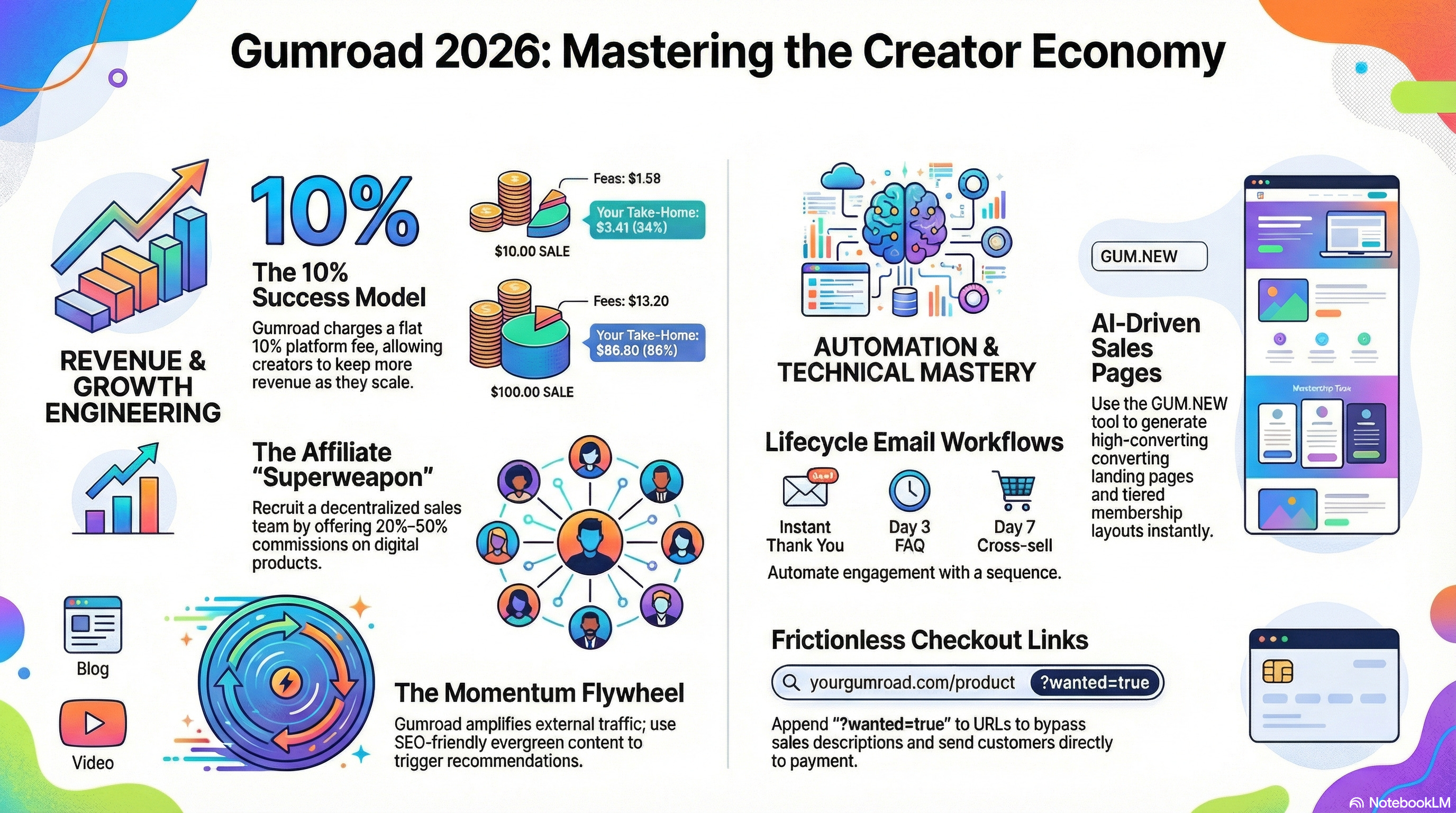
?wanted=true
What it does is skip the sales page entirely and drop the buyer straight into checkout.
Think about that. Someone clicks your link from an email where you’ve already made the case. They’ve already decided to buy. The last thing you want is another page between their decision and their credit card. That extra page is where doubt lives. That’s where the little voice says maybe I should think about it and then they close the tab and you never see them again.
?wanted=true kills that pause.
You can stack other parameters too. ?email= pre-fills their email if you already have it. ?variant= pre-selects the tier. ?yearly=true defaults to annual billing on memberships, which means more cash upfront and less monthly churn.
These aren’t secrets. They’re in the documentation. Nobody reads documentation.
Gumroad’s affiliate system lets you hand out commissions to anyone willing to put your product in front of their people.
You set a percentage, 20 to 50 percent, and they do the promoting.
Here’s the honest math on a $100 product with a 50% affiliate commission. Gumroad takes its 10%. Credit card processing eats another 3% and change. Your affiliate gets $50. You take home about $34.
Thirty-four dollars on a sale that wouldn’t have happened otherwise. That’s money you didn’t have yesterday. That’s someone else doing the work of finding the right eyeballs while you’re writing the next thing.
One thing worth knowing. Browser cookies get blocked constantly now. Standard affiliate links break. Gumroad has what they call Sticky Affiliate Links. You append &affiliate_id=[id] to the URL and the tracking happens server-side instead of relying on the buyer’s browser to play nice. Your affiliates get credited. Nobody gets screwed.
GUM.NEW is Gumroad’s AI landing page tool.
You connect your account, tell it what you’re selling, and it generates a skeleton. Sales copy, product images, layout. Membership pages. Countdown timers if you’re running a limited offer.
Is it going to produce anything with soul? No. It’s going to produce a functional starting point you can rip apart and rebuild in your own voice. Which is exactly what a tool should do. Give you the bones. Let you put the meat on them.
I’d rather spend twenty minutes editing an AI-generated skeleton than three hours staring at a blank page builder making design decisions I don’t care about. The writing matters. The layout just needs to not get in the way.
Gumroad is a cash register. A good one. With some clever tricks in the drawer.
The platform doesn’t owe you traffic. It doesn’t owe you sales. It doesn’t owe you a goddamn thing except a reliable way to collect money when someone decides your work is worth paying for.
Your job is making work worth paying for and putting it where the right people can find it. Everything else, the URL parameters, the affiliate math, the AI page builder, that’s just making sure the register rings when someone’s already standing at the counter with their wallet out.
Build the thing. Bring the people. Let the register do its job.


