

Stop Asking Claude for a Voice. Build It a Confession Log.
If your AI output sounds like shit, I'm here to help.


The phrase that made me stop was “navigate the complexities.”
I caught it three drafts deep on a piece about apartment fermentation, one in the morning, Linux Mint terminal humming, the dog doing whatever dogs do at one in the morning when they think you’re asleep. The model had reached for the phrase the way a tongue reaches for a missing tooth, fluent and unconscious, and the sentence sat there on my screen looking reasonable enough that I almost let it through.
It wasn’t mine.
My grandfather operated a sawmill in a part of Tennessee where you don’t admit to being a Democrat in mixed company. He never said “navigate the complexities.”
The truck-stop counter where I learned to read paperback Bukowski over thirty-cent coffee never produced the phrase either. The smoke pit on the flight line in Bagram had a thousand variations of every word in English and that one wasn’t on the menu.
The phrase had no provenance in any room I had ever stood in.
But the model had it ready, and the model would have given it to me clean if I hadn’t looked.
The smooth voice problem.
Every AI workflow post on the web right now does roughly the same thing. Walks you through the vault and the context files and the chat-mode commands, demonstrates the four-to-five-posts-a-week machine that runs on twenty bucks a month and replaces a freelancer whose rates were never going to be sustainable anyway.
The operations are real. The math works.
Then read the actual content the workflow produces. Smooth. Confident. Useful in a way that’s hard to argue with and impossible to remember. Every paragraph could be unscrewed and bolted onto somebody else’s blog and nobody would notice. The byline is decoration.
The workflow is solved.
Voice is what’s open, and most of the workflow people are skipping past it with a three-line “voice profile” pasted into the top of their context file. Conversational. Personal. No guru energy.
That pile of bullet points points the model at the geometric center of all the prose tagged “conversational, personal, no guru energy” in the training corpus.
Which is a real place.
It’s the LinkedIn coach voice. The Medium goldfish voice. The mid-Atlantic creator-podcast register that millions of words have already trained Claude to produce on the slightest provocation.
You asked for your voice. You got the median voice everyone else is also asking for, and the model handed it over with the same fluent unconsciousness it uses to reach for “navigate the complexities.”
What you don’t say matters.
The workflow people are feeding the model what you sound like, in samples and bullet points, and asking it to interpolate. The model interpolates by averaging across everything in the corpus that looks like the samples, which is exactly the smoothing operation that produces the median voice.
You can’t fix that by giving the model more samples of yourself. The averaging machine just averages harder.
The fix is keeping a list, one phrase at a time, of every word that doesn’t belong in your mouth. Every cadence your grandfather would have laughed at, the sentence shapes your wife clocks as fake before you finish saying them, the motivational tag-lines that have always made you flinch, all the corporate-onboarding sludge poured into you across six years at GoDaddy and another two at a real estate firm where everyone talked about “stakeholders.” The language other environments installed in you and never bothered to remove on your way out the door.
That list is the voice spec.
Mine runs around six thousand words across twenty sections.
Most of it is grievances.
Banned vocabulary, accumulated one phrase at a time over a year of catching tells.
Sentence structures I won’t allow because they read as AI on sight, like the mirrored “this is not X, this is Y” construction that the model loves and that I had to catalog separately because Claude tries to slip a new variant past me almost every week.
Opening moves I never use.
A profanity budget that varies by piece type and section.
Seven literary touchstones whose specific structural moves I want pulled into the prose at all times, named so the model knows not just the influences but the specific moves each one contributes.
A list of historical failure points so the model can scan for the exact ways the voice has collapsed before.
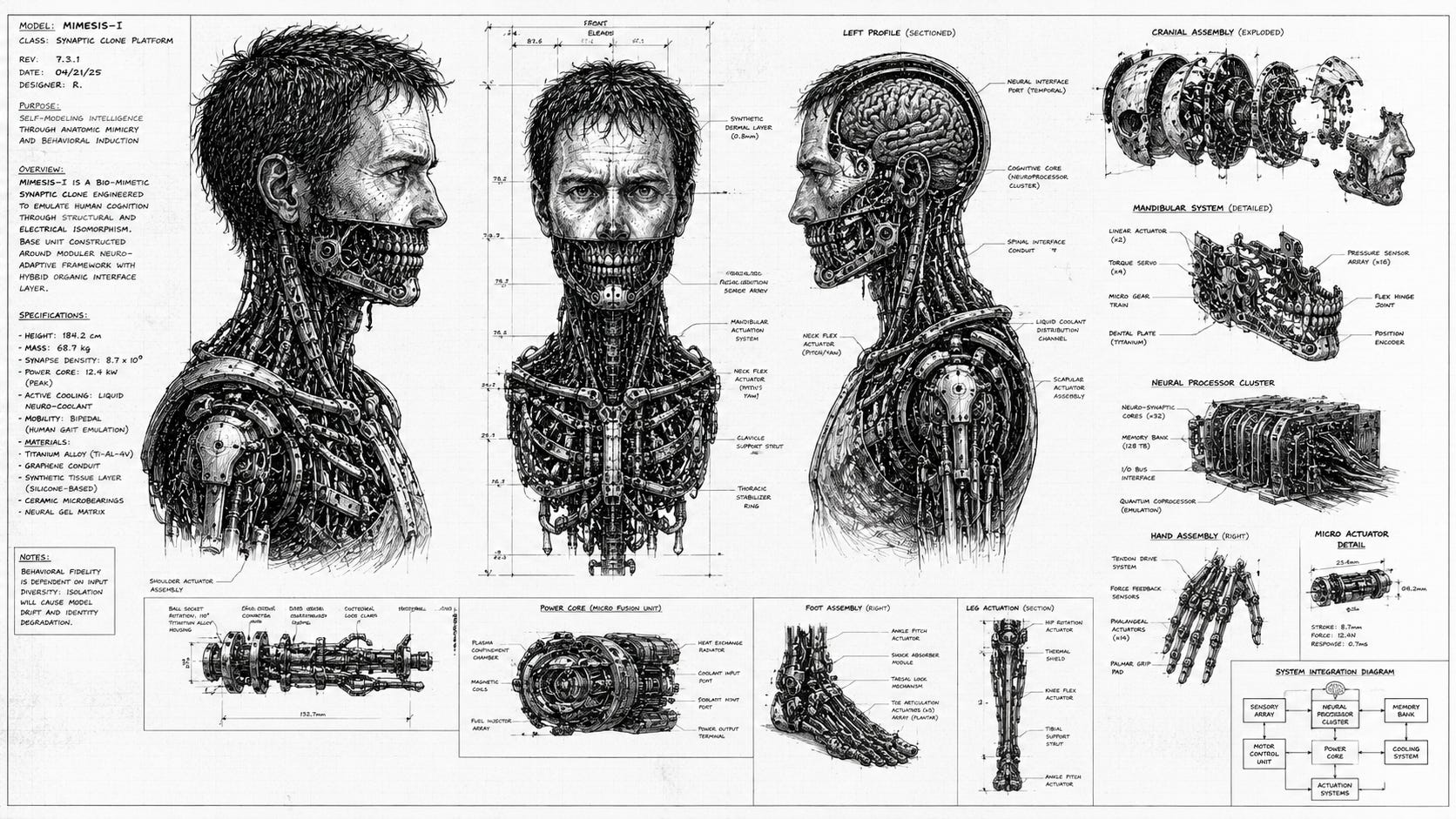
I add to the spec almost every week. When I catch a tell that wasn’t on the list, the tell goes on the list. The document is a fossil record of every cadence I have ever rejected, and the model doesn’t get to forget what I noticed.
There’s no shortcut. You can’t borrow mine. Your tells are different from mine. Mine is calibrated to a grandfather who cut down trees for a living, a smoke pit in Bagram, a Cuban-American household, a decade of editing my own prose at one in the morning while the cat does whatever cats do.
Yours has different inputs. The list has to be yours and it has to grow, and there is no way to make it grow except by reading drafts and writing the failures down.
Two skills, one law.
The spec is the law. Two skills enforce it.
The first runs before any draft. It loads the spec into the model’s working memory and walks through the structural decisions for the piece in front of it. Content type. Emotional register. Where the profanity lands if any does. The shape of the ending so the prose has somewhere to drive toward. The metaphor system so I’m pulling from biology or chaos magic or military logistics instead of the same exhausted creator-economy imagery the corpus reaches for by default.
The second runs after the draft exists. Six passes. AI tick elimination. Voice audit against the spec line by line. Generic-language removal. Repetition detection. Rhythm and burstiness check. A perplexity injection pass that breaks up the smooth flatlined cadence the model produces when it’s coasting. Plus an editor-in-chief judgment layer that reads the whole thing as a piece of writing instead of a checklist.
Pre-flight loads the list of words I don’t say. Post-flight catches the words that slipped in anyway. Anything that slipped through goes back into the spec. The list grows.
A demonstration:
Here is generic Claude on whether to niche down.
In today’s creator economy, the question of whether to niche down is one that countless content creators grapple with daily. Many experts advocate for hyper-specialization, arguing that focusing on a single lane is the fastest path to building authority and audience. However, there’s a compelling counter-argument worth exploring. The truth is that successful creators often defy this conventional wisdom by leveraging their diverse interests to build something more authentic and ultimately more sustainable.
Here is the same prompt run through the spec.
Niche-down advice is the safest thing a coach can sell you. Pick one lane and build authority and the expertise will compound, supposedly, the way diet pills work, where enough people see results that the testimonials carry the rest of the marketing budget. The trouble is most of us are not one thing. We grew up with hands in four industries and a habit of reading across domains because the connections between them are where the juice lives. Niching down is amputation with a marketing budget.
Same model, same prompt, different prose. Different rules were loaded into the room before the draft started.
The list is the work.
Most AI workflow posts will tell you the way to get personalized output is to give the model better context, and they are not wrong. They are just describing the easy half. The easy half is feeding the model your past work and hoping interpolation does the rest.
The hard half is being honest enough about your own voice to know which words don’t belong in it. Most people skip this part because they’ve been eating corporate-onboarding sludge for so long they’ve forgotten what they sounded like before they got hired.
The model picks up on that vagueness and gives them back the median voice with a few personalized accents painted on, and they call it personalized output and post the screenshots.
The model is fast and patient and tireless and it will produce ten thousand drafts without complaining.
It will not notice that the draft is dead. You have to notice. The noticing has to get written down somewhere the model can read it. The list grows every week or it doesn’t, and your prose either earns a fingerprint over time or stays smooth.
The phrase that made me stop was “navigate the complexities.” I caught it, added it to the list, watched the spec tick from 5,847 words to 5,851.
The next morning the model knew not to reach for it.

P.S. The catalog logic underneath this whole setup, where one growing project file feeds dozens of pieces over months, is the same compounding principle I documented in Thirty Bricks. Different output, same architecture
.
Niche of One. Field reports, weird transmissions, and operational guides for people building things on purpose.
OK, this is what I needed. I never thought of creating a document with words *not* to use for Claude to reference. Working on that ASAP! Thank you!
Also...how do you get such great images?