

The Darker Side of Call Centers.
Plus, that time the CIA used occultists against Russia.
Cue Theme Song:
It’s really 2026, and this is your future.
It’s almost tax time. Joy and glory be! (Not really. Fuck the Feds.)
It is a new year, though. Which means a lot of people lying to themselves on day one. Which they probably shouldn’t do. It sets a bad precedent for the rest of the year.
That being said, the only thing I have pre-planned is to make as many cool little PDF guides as I can, write books, keep putting this lovely newsletter eZine out there, and create my ass off.
My whole goal is to take you to strange places and experience the weird in a new way. To help you stop living in illusion and show you what you can see when you peek behind the veil. It’s not as hard as you think.
Featured in this issue:
THE CALL CENTER BLUES - Weird things happen on the night shift in the call center.
GOURMET VET: GUBMINT PIZZA - If you ate a school cafeteria in the 80s or 90s, this is the standard pizza you were issued.
RABBIT HOLE: From LSD to the Occult - The US Government has done some crazy shit. This is one of those things.
Enjoy the weird you are about to receive, and thanks for reading.

📼 THE CALL CENTER BLUES
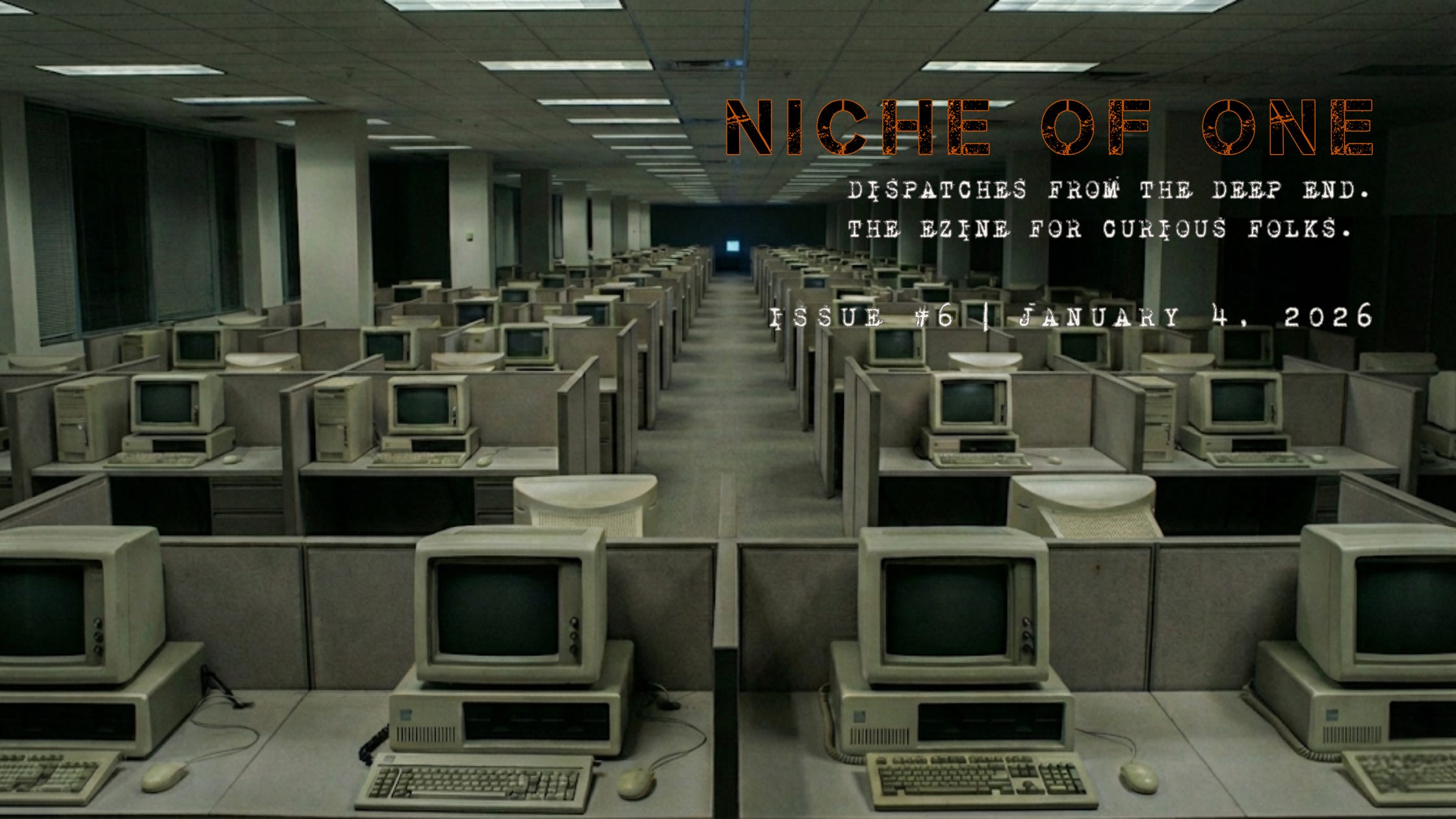
The fluorescent lights hummed at a frequency that made your teeth ache if you listened too long and I’d been listening for six hours straight. Three AM in a call center where nobody called. The headset crackled with white noise like the ocean in a dead shell and the computer monitors glowed green phosphor ghosts in rows that stretched to a vanishing point I couldn’t quite locate.
I was the only one working. Had been for three months.
The job posting said “overnight customer service specialist” and paid seventeen dollars an hour which was exactly enough to keep me from asking questions I should have asked. Questions like why the building had no windows. Why my badge worked on the front door but not the stairwell. Why the bathroom was always exactly the same temperature as my skin.
The calls came in patterns. Every forty-three minutes. I’d timed it.
Ring. Answer. Voice on the other end asking about an account number I could never find in the system. Apologize. Escalate to a supervisor who didn’t exist. Hang up. Wait forty-three minutes. Repeat.
Tonight something was different.
The call came at 3:17 instead of 3:00. Small deviation. Meaningless probably. But in a place where nothing ever changed—where the coffee in the break room was always the same temperature, where the clock on the wall had been stuck at 11:47 for two weeks, where my reflection in the bathroom mirror was starting to look like someone else wearing my face—small deviations felt like earthquakes.
I picked up on the third ring.
“Thank you for calling. How can I help you?”
Silence. Then breathing. Not heavy or menacing. Just breathing at exactly the rhythm of my own breath. Synchronized.
“Hello?”
“I’m already there,” the voice said. Male. Flat. Familiar in a way that made my stomach drop. “Behind you. Third row. Seventh cubicle from the left.”
I turned in my chair. The rows of empty cubicles stretched into the fluorescent infinity. Green monitors casting their glow on empty chairs. Keyboards that nobody touched. Phones that never rang except mine.
“There’s nobody here,” I said.
“Check again.”
I stood. The wheels of my chair squeaked against the industrial carpet and the sound echoed wrong—too long, too hollow, like the building was larger inside than the dimensions suggested. I walked down the third row counting cubicles. Five. Six. Seven.
Empty. Just another beige partition and a green monitor displaying the same login screen they all displayed.
“Nobody here,” I said into the headset.
“Look at the screen.”
The monitor showed my desktop. My personal desktop. The one on my home computer. Files I recognized. Photos I’d taken. Browser history I definitely hadn’t accessed from this terminal. I reached out to touch the screen and my hand passed through the glass like it was warm water and suddenly I was looking at myself—sitting in this cubicle, headset on, hand extended toward a monitor that showed me reaching toward a monitor that showed me reaching toward...
I yanked my hand back. The screen was solid again. Normal. The generic login screen.
“What the fuck is this?”
“Third shift,” the voice said. “You agreed to it. Read the contract.”
I hadn’t read the contract. Nobody reads the contract. You click the box that says you read it and you show up and you do the work and you cash the check and you don’t ask why the building has no windows.
“Who are you?”
“I’m you. Fourth iteration. You’re third. There’s a second iteration working the day shift and a first iteration that doesn’t remember applying for this job at all. We’re all pulling the same shift. Just in different buildings. Different times. Same space.”
The fluorescent lights flickered. All of them. Synchronized. Then steady again.
“That’s not possible.”
“Check your phone.”
I pulled it from my pocket. No signal. It never had signal in here. But the time was wrong. It said 3:17 AM—January 4th, 2026. Correct. Then it flickered and said 3:17 AM—January 4th, 2027. Then 2025. Then 2028. Cycling through years like a slot machine that couldn’t land.
“Stop it.”
“I can’t. Neither can you. We’re scheduled for forty-three minute intervals. That’s when the building breathes. That’s when we overlap. Most nights we don’t notice. But sometimes the intervals slip. Sometimes we see each other. Sometimes we pick up the phone and we’re calling ourselves from next year or last year or the year that hasn’t happened yet where we’re still sitting in this chair answering calls that nobody makes.”
I walked back to my cubicle. Sat down. The chair was warm. It was always warm. Even after I’d been gone for ten minutes it was always warm like someone had just been sitting there.
“Why?” I asked.
“Someone has to answer the phones,” the voice said. “Someone has to be here when the calls come in. The calls that fold time. The calls that bleed through from the spaces between. You think this is a call center. It’s not. It’s a listening post. And we’re the ones listening. Forty-three minutes at a time. Forever.”
The line went dead. Not disconnected. Dead. Like the sound had been alive and now it wasn’t.
I looked at the clock on the wall. Still 11:47. Always 11:47. But my computer screen showed 3:59 AM. One minute until the next call. I could leave. Stand up. Walk to the door with my badge that worked on the entrance but not the stairwell. Clock out. Go home to an apartment that was starting to feel as temporary as this cubicle.
But I wouldn’t. I knew I wouldn’t.
Because in forty-three minutes there would be another call. And in forty-three minutes after that. And I would answer. And the voice would be mine. And I would tell myself the same things I’d just been told. And the loop would continue because someone had to be here. Someone had to answer.
The phone rang at exactly 4:00 AM.
I picked it up.
“Thank you for calling,” I said. “How can I help you?”
“I’m already there,” I heard myself say. “Behind you. Third row. Seventh cubicle from the left.”
I turned in my chair and looked at the empty rows of cubicles stretching into the fluorescent infinity and for just a moment—just a flicker—I saw someone sitting in the seventh cubicle. Someone wearing my face. Someone who looked tired and resigned and trapped in a loop they’d agreed to without reading the contract.
They waved.
I waved back.
The lights hummed their frequency and the monitors glowed their green phosphor ghosts and somewhere in the space between seconds I understood that I’d been here before and I’d be here again and time was just another thing that broke down in buildings with no windows.
The call lasted forty-three minutes exactly.
It always did.
3 Cool Things:
🌶️ GOURMET VET: GUBMINT PIZZA
To recreate that specific 1990s school cafeteria pizza—often affectionately called “rectangle pizza” or “government pizza”—you cannot simply use a standard pizza dough recipe. The texture of that pizza was distinct because it was soft, slightly sweet, and almost cake-like.
The secret lies in two things: Nonfat Dry Milk Powder and a “Pourable” Yeast Batter (no kneading required).
Here is the authentic recreation based on the USDA 1988 Quantity Recipe (scaled down for a home kitchen).
Equipment Needed
18” x 13” Rimmed Baking Sheet (Standard “Half Sheet” Pan). This is non-negotiable for the rectangular shape and thickness.
Part 1: The “Pourable” Crust
This dough will look wrong while you are making it. It will be the consistency of thick pancake batter, not a dough ball. Trust the process.
Ingredients:
Warm Water: 1 ⅔ cups (approx. 110°F)
Yeast: 1 packet (2 ¼ tsp) instant or active dry yeast
Sugar: 2 tbsp (feeds the yeast and provides that “school roll” sweetness)
All-Purpose Flour: 2 ⅔ cups
Nonfat Dry Milk Powder: ¾ cup (The “secret” ingredient for softness and browning)
Salt: 1 tsp
Vegetable Oil: 1 ½ tsp (plus extra for greasing)
Cornmeal: 2 tbsp (for dusting the pan)
Instructions:
Bloom Yeast: In a small bowl, mix the warm water and yeast. Let it sit for 5 minutes until foamy.
Mix Dry Ingredients: In a stand mixer (or large bowl), whisk together the flour, dry milk powder, sugar, and salt.
Combine: Add the yeast water and the 1 ½ tsp of oil to the dry ingredients.
Mix: Beat on medium speed for about 10 minutes. The mixture will be very sticky and loose—more like a batter than a dough.
Prep Pan: Grease your sheet pan generously with oil or shortening. Sprinkle the cornmeal evenly over the entire pan.
Pour & Rise: Pour the batter into the pan. Wet your fingers or a spatula with water/oil to spread it into the corners. It will look thin, but it will rise. Let it sit in a warm spot for 20–30 minutes.
Par-Bake: Preheat oven to 475°F (245°C). Bake the plain crust for 10 minutes. It should be set but pale.
Part 2: The Meat Sauce
In many schools, the meat was mixed directly into the sauce or placed under the cheese to prevent it from burning or falling off. The classic topping was ground beef, sometimes mixed with pepperoni cubes.
Ingredients:
Ground Beef: ½ lb (Lean is better to avoid grease pools)
Tomato Paste: 1 can (6 oz)
Water: 1 cup (use more or less to reach desired thickness)
Seasoning:
1 tsp Dried Oregano
½ tsp Garlic Powder
½ tsp Onion Powder
½ tsp Sugar (balances the acidity)
Salt & Pepper to taste
Instructions:
Brown the ground beef in a skillet; drain the fat well.
Add the tomato paste, water, and seasonings to the meat.
Simmer for 5–10 minutes. It should be a spreadable, thick paste, not a runny sauce.
Part 3: The “Gubmint” Cheese
The cheese on school pizza always browned in a speckled way and didn’t stretch much. This was usually a blend of mozzarella and a binder cheese.
Mozzarella: 1 bag (approx 2–3 cups), shredded low-moisture part-skim.
The Cheat: To get the authentic color and melt, mix in ½ cup of shredded yellow cheddar or dice up 4 slices of American cheese into the mozzarella. This mimics the commodity processing cheese used in schools.
Assembly & Final Bake
Take your par-baked crust out of the oven.
Spread the meat sauce evenly almost to the very edge (school pizza rarely had a “crust handle”).
Cover completely with the cheese blend.
Optional: If you want pepperoni, use the tiny cubed kind, not the slices.
Bake at 475°F for another 10–12 minutes.
Crucial Step: The cheese should be bubbling and starting to brown in spots.
Serving
You must let it cool for at least 5 minutes. Cut it down the middle lengthwise, then cut across to create rectangles.

🕳 RABBIT HOLE: From LSD to the Occult
The pentagrams were drawn in chalk on government linoleum and the altars sat next to IBM terminals humming with classified data. This was 1970. Fort Detrick. A priest trained in Vatican exorcism protocols stood in a sealed room while CIA contractors monitored his vitals and the electromagnetic field detectors spiked without cause.
Your consciousness has backdoors. The agency proved it.
By 1969, MK Ultra had failed its mission spectacularly. They’d pumped LSD and electroshock and every chemical compound they could synthesize into human subjects and couldn’t reliably control a damn thing. Meanwhile intelligence reports suggested the Soviets were weaponizing psychic phenomena—remote viewing, telepathic projection, consciousness as a battlefield outside the laws of physics. Director Richard Helms authorized a radical pivot. They called it MK Often.
The mission was simple and insane: close the supernatural gap.
The agency recruited through cutouts and intermediaries because you can’t exactly post a job listing for ceremonial magicians with security clearances. They found Father Antonio Marelli, a demonologist who thought he was consulting on psychological warfare. Margaret Thornfield, a psychic with a Columbia master’s in psychology. Dr. James Morrison, a chemistry professor who practiced Golden Dawn rituals and believed magic could be scientifically validated.
They brought them into sterile facilities—Fort Detrick, Edgewood Arsenal—and watched them work. Temperature sensors. Heart rate monitors. EEGs. Electromagnetic field detectors recording every ceremony with the cold precision of men who’d spent careers measuring the combustion temperatures of napalm.
The results shouldn’t have worked. That’s what makes them terrifying.
During a 1973 summoning ritual, equipment registered electromagnetic fluctuations with no identifiable source. Temperature drops of fifteen degrees in sealed rooms. Voices captured on professional recording equipment—human laughter where no humans stood. Sophisticated detectors would spike or crash during peak ritual moments and the researchers built redundancy into their protocols because the instruments kept failing at the exact wrong time.
Your consciousness has backdoors.
They studied psychotronic projection—the theory that focused intention creates thought forms that influence targets without physical contact. Treating the human mind like a radio system where trained operators broadcast psychological frequencies. One experiment reported seventy-three percent success rate inducing specific nightmares in subjects sleeping sixty miles away.
Consciousness wasn’t confined to individual brains. It was a field. Interconnected. Hackable.
The program terminated abruptly in 1973 with unusual urgency. Records systematically destroyed. Internal fragments mention a “critical incident” where experimenters encountered “manifestations that exceeded the control parameters.” Whistleblower Victor Marchetti said it “scared the spooks”—crossed lines that even intelligence officers trained in SERE techniques found disturbing.
They didn’t stop the research. They refined it.
Many researchers quietly reassigned to Stanford Research Institute to develop Project Stargate—the military’s remote viewing program. But the real legacy wasn’t psychic spying. It was understanding that symbols, narratives, and rituals bypass conscious reasoning entirely.
Look at modern psychological operations and you’ll see MK Often’s fingerprints everywhere. Symbolic programming through repetitive media imagery triggering emotional responses you think are yours. Social media algorithms functioning as technological divination—predicting and shaping desires through feedback loops that feel like free choice. Political rallies using repetitive chants and color symbolism to create shared altered states, ritual behavior disguised as democracy.
Your consciousness has backdoors and someone’s got the passcode.
Think of your mind as high-end hardware. You believe you control the operating system—navigating thoughts freely, making autonomous choices, immune to external influence. The MK Often research proved otherwise. The operating system has hidden backdoors installed at the firmware level. They don’t need to steal the device. They send specific signals—notifications, updates, subliminal code—that change how the system functions without you ever detecting the modification.
The battle for human autonomy is fought on consciousness terrain and most people don’t know they’re combatants.
The most effective control doesn’t look like control. It looks like your own preferences, your own beliefs, your own thoughts bubbling up naturally from the sovereign territory of self. The altar of consciousness is constantly reshaped by external symbols and you’re the last one to notice the architecture changing.
Metacognition is the only defense—thinking about your thinking, recognizing when emotional responses are triggered by crafted patterns rather than authentic reaction. Developing immunity to the signals requires first acknowledging the signals exist.
They proved magic works by measuring it. Then they made it invisible and called it marketing.
The real horror of MK Often isn’t that the CIA dabbled in the occult.
It’s that they succeeded. And everything you see, every narrative that moves through mass consciousness like wildfire, every belief that feels urgent and righteous and undeniably true—it might be code running on those backdoors they mapped fifty years ago.
Check your operating system. Something’s been modified while you weren’t looking.
📰 Articles I Enjoyed This Week:
Really enjoyed Seraphim George’s piece How We Can Live in the In-Between. His writing style is just very haunting to me, and the story lingers inside my head a while.
Loved this one from The New Unhinged: What Happens When Your Voice Gets Too Loud For Someone’s Ego. I think it’s a fantastic guide on all the haters you might come across and what it actually means for you beyond them being assholes.
📚 CURRENTLY CONSUMING
Watching: Tron Ares. Verdict? Boring. Why do they keep giving Jared Leto roles? He’s not a good actor.
Listening: Lots of indie rock. I finally found a radio station that plays it near me. (Yes, I still listen to radio.)
🧠 ON MY MIND
Where has all the creative soul gone? When did it turn into something to be exploited by algorithms and the attention economy?
Why does the week between Christmas and the New Year feel so damn weird?
Two things that shouldn’t cost as much as they do: food and healthcare.
People will always find a reason to bitch about something. Doesn’t matter what it is.

Happy New Year. See ya next issue,
~ J.
Please note some links may lead to affiliate offers and if you purchase from these links I may receive a small amount of compensation at no extra cost to you.
Loved the story! And the whole last part is why whenever I watch the obvious hypnosis done by politics/the media, and people taking the bait, I feel like I'm living in the Matrix movies lol.
As someone who used to work 3rd shift at a crisis call center, sometimes by myself, that story really slaps!