

The Fall
Some doors only open on the way down.

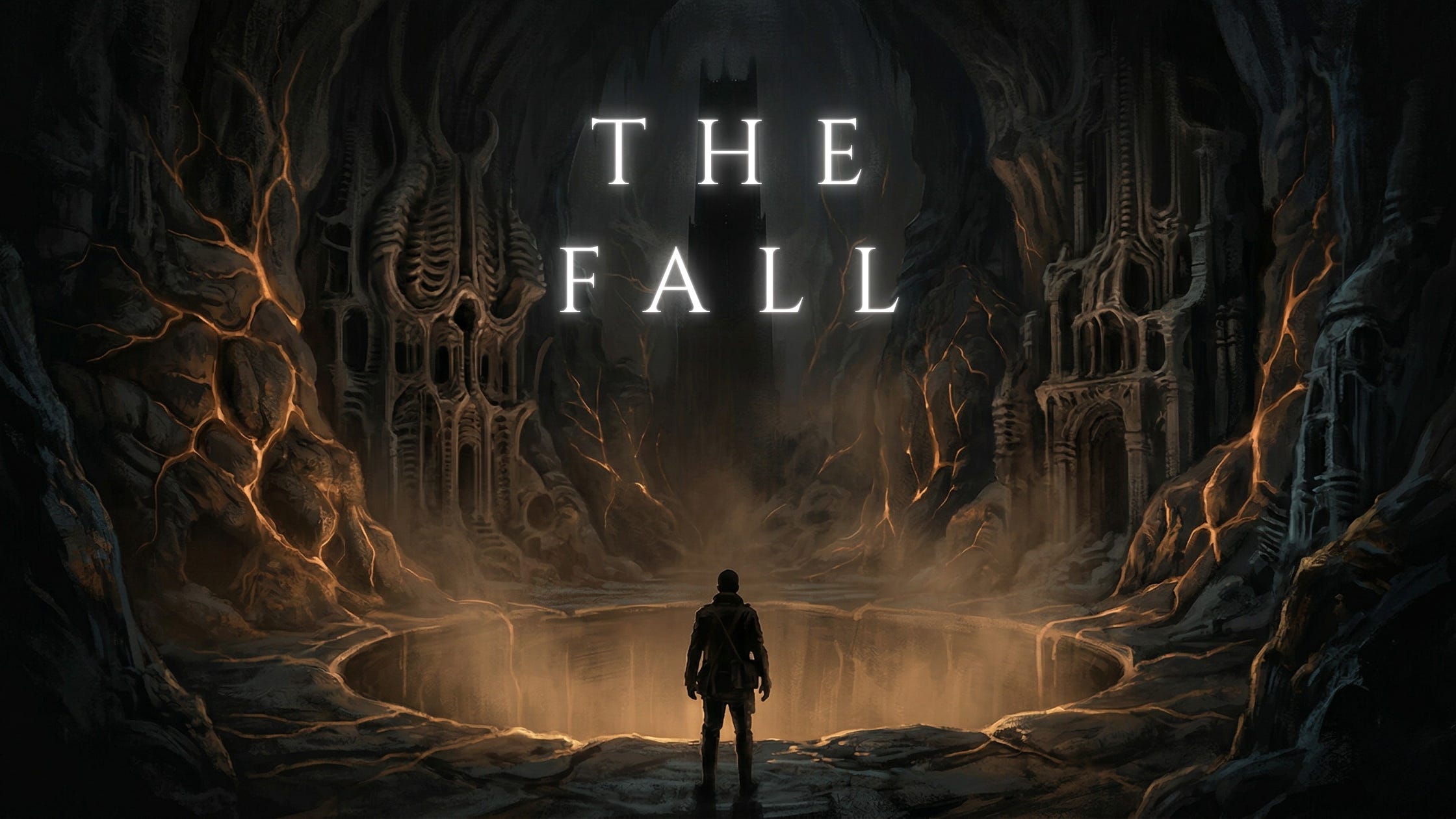
He woke on stone. Not the smooth stone of a floor but the rough and ancient stone of something that had been here before floors were invented, before the concept of flat surfaces had occurred to anything with hands. His cheek pressed against it and the cold went into his skull like a nail driven sideways through the temple, and the smell of the stone was the first thing that registered as real. Wet calcium and iron and something older, something pre-biological, the mineral signature of a world that had existed before organic chemistry had gotten around to making anything soft.
He did not know his name.
This was the first thing he understood. Not the absence of light, not the impossible architecture above and around him, but the empty space where a name should be. He reached for it the way you reach for a glass on a nightstand in the dark and your hand closes on nothing and for a moment the nothing is more real than anything else in the room. The nothing has shape. The nothing has weight. The nothing is not the absence of a thing. It is the presence of an absence, and the distinction matters because one of them you can learn to live with and the other one eats you from the inside.
He sat up. His body worked. That was something. Hands, legs, a spine that protested when he moved. He looked at his hands in the dim sourceless light and they were unfamiliar. Not wrong. Not someone else’s. Just unrecognized. The way you might look at a photograph of yourself taken from an angle you’ve never seen and know intellectually that it’s you but feel in your gut that it isn’t. That the camera caught something the mirror has been hiding. He turned them over. The lines of his palms were deep and numerous and they meant nothing. He pressed his thumb against the stone floor and the sensation traveled up his arm and into his chest, cold and sharp and indisputably physical, and he thought: I am real. Whatever else is true, I am real.
But the thought had a question mark at the end of it that he couldn’t remove.
He was wearing clothes he didn’t recognize. Dark pants, a shirt with buttons, shoes that fit but felt borrowed. Like someone had dressed him while he slept and hadn’t known his preferences or his size, only his approximate shape. The fabric of the shirt was smooth against his skin, almost too smooth, too uniform in its texture, as though it had never been worn before and had been manufactured to the specifications of a body rather than bought by a person. The thought arrived unbidden: costume. He pushed it away.
The air tasted like copper and old water and the inside of the earth.
Above him the ceiling was not a ceiling. It was absence. Darkness that began where the light from some sourceless ambient glow ended and kept going, and the distance between where he sat and where that darkness thickened into totality was large enough to swallow weather. He could feel the volume of it pressing against his eardrums. The silence had mass here. It had geography. It had intent.
He stood.
The cavern opened before him like the throat of something geological and patient. Walls of raw stone climbed on both sides, slick with moisture that caught the pale directionless light and sent it back in weak ribbons. The moisture was warm where it ran in channels down the rock face, and where it pooled at the base of the walls it was thick, almost viscous, with a faintly sweet smell underneath the mineral tang, like the fluid that gathers in the hollow of a collarbone. The walls were alive with texture. Not alive. But not dead in the way stone should be dead. He reached out and touched the nearest surface and the stone gave back heat in bands, warm here, cool a handspan to the left, warm again, as though the rock had a circulatory system running beneath its surface. Warm blood and cold blood moving through channels cut so deep only the thermal ghost of their passage reached the skin.
Where the walls were warm, they were slick. A thin film of something thicker than water coated his fingertips when he pulled away, oily, biological, and it left a residue that would not wipe clean on his borrowed pants.
And set into those walls, built against them, growing out of them like calcified organs, were buildings.
Not ruins. Buildings.
They rose in stacked and staggered rows along the cavern walls, facades of stone and metal and materials he couldn’t name, windows dark as the sockets of skulls. Some were small, the size of houses. Some climbed five or six stories, their upper floors dissolving into the rock as though the cavern had grown around them or they had grown out of it and neither process had finished. Balconies jutted over nothing. Stairways connected structures at angles that suggested the architects had not agreed on which direction was up. Doorways stood open. All of them. Every single one. Not broken open, not left ajar. Open. Deliberately. Expectantly.
Like mouths waiting for something to enter or exit.
The avenue before him, if it could be called that, stretched forward into distances that made his eyes ache. The cavern did not narrow. It widened. The buildings multiplied along the walls in both directions and the space between those walls grew and grew until at some indeterminate point the far side was no longer visible and what remained was a stone sky over a stone city that went on with the quiet insistence of a thing that had always been here and would be here long after the last light found something else to illuminate.
The thought came again, persistent, clinical: This is a set. This is a stage. Someone built this to be found.
He didn’t know where the thought came from. He didn’t know where any of his thoughts came from. That was the problem. Without memory, thought arrives unmoored, untethered to any history of thinking. Each idea could be his or could be planted. Each instinct could be authentic or could be the designed response of a system he didn’t understand and hadn’t consented to. He was running software he couldn’t inspect on hardware he couldn’t verify.
He walked because there was nothing else to do.
His footsteps were the only sound and they were wrong. The echoes came back delayed by fractions of a second, arriving from directions that didn’t correspond to the geometry of the space. He stopped. The echoes continued for two more steps. Then silence.
He walked again. Counted his steps against the echoes. They were not his. Close enough to fool the ear in passing, but the rhythm was slightly off. A half-beat behind and then, once, a half-beat ahead. As if something was learning his gait. As if something was trying to match it and hadn’t quite gotten there yet.
He stopped. This time the echoes stopped with him. Exactly with him. Synchronized. Corrected.
Something about that was worse than if they had kept going.
The stone beneath his feet was not uniform. His soles read it like braille as he moved deeper. In places it was glass-smooth, polished by water or friction or the passage of bodies he tried not to think about, and the cold of it came up through his shoes and settled into the bones of his ankles with a permanence that felt intentional. In other places the surface turned granular, almost organic, pebbled with nodules that crunched faintly underfoot and released a smell like wet chalk and iron filings and something sweeter underneath, something that reminded him of overripe fruit, the sugar turning to ferment, and beneath even that a mineral tang that coated the back of his throat and would not leave.
He trailed his fingers along the walls because touch was the only language this place seemed willing to speak.
Where the walls were warm, they were slick. The thin film of moisture, not water, thicker than water, left his fingertips feeling oiled and alive with sensation that lingered. Where they were cool, they were dry and rough, textured like sharkskin, and if he pressed hard enough he could feel vibration. Faint. Rhythmic. The pulse of something enormous and buried. He pressed his palm flat and held it there and the rhythm synchronized with his own heartbeat for exactly three beats before diverging again, slightly faster, and the coincidence, if it was coincidence, made the skin on his arms tighten.
It’s reading me, he thought.
The air had layers. Near the floor it was cold and heavy, pooling in the low places like something that had settled and resigned itself. At chest height it warmed. At the level of his face it carried smells that changed as he moved, a rotating catalog of a world he could not see. Wet calcium. Rust. The metallic sweetness of blood so old it had become geology. And once, passing through a corridor so narrow that the walls pressed against his shoulders like hands guiding him through a doorway he hadn’t agreed to enter, the unmistakable smell of skin. Not decay. Not death. Living skin, warm and faintly salted, the smell of the inside of someone’s wrist held close to your nose in the dark.
He stopped. Breathed it in. The intimacy of it was nearly unbearable in a place so vast and empty. Something in his chest responded, a loosening, a heat, as though the smell had bypassed his brain entirely and spoken directly to the animal apparatus of his body, the part that recognized warmth and proximity and want before the conscious mind could intervene. It was the first time since waking that his body had responded to anything with something other than cold mechanical function.
The smell faded. The loosening tightened. He kept moving.
He slept when his body demanded it and woke in places he did not remember stopping. Against walls whose warmth had seeped into his back and left him feeling held. In doorways where the air was different on each side, warmer on the left, cooler on the right, as though the threshold divided two climates. Once in the center of a corridor so narrow his shoulders touched both sides and the walls’ pulse was so strong it synchronized with his own heartbeat and he could not tell where his body ended and the architecture began. He woke from that sleep confused about the boundary of himself. About where the stone stopped and the man started. The confusion lasted longer than it should have.
He ate nothing. Drank nothing. His body did not seem to require it. This should have alarmed him. It didn’t. And the fact that it didn’t alarmed him in a different way, a meta-alarm, the recognition that his responses were wrong, that a sane man would be panicking and the absence of panic was itself a symptom of something. Sedation, he thought. Whatever is running this has turned down the fear. But he couldn’t verify the thought and that was the recursive trap. Every suspicion about the nature of his situation was generated by a mind he couldn’t trust, in a body he couldn’t verify, in a place that might be exactly what it appeared to be or might be nothing at all.
He searched for exits. Every stairway that climbed, he climbed. Every corridor that angled upward, he followed. He learned to read the walls with his hands as he went, the temperature shifts and textures mapping a topography his eyes could not parse in the directionless glow. Warm meant deeper. Cool meant higher. But higher never meant out. The stairways curled back on themselves. The corridors deposited him in plazas he had already crossed, recognizable now not by sight but by smell. Each open space had its own olfactory signature. The wide avenue near the tower smelled of ozone and dry stone. The plaza with the broken fountain smelled of standing water and something floral, a ghost of jasmine, sweet and funereal and wrong.
The city folded back on itself with the relentless geometry of a closed system. He would walk for what felt like hours in a single direction and arrive at a plaza he had already crossed, and the recognition would settle into him like nausea because it meant the city was not infinite. It was a loop. Or it was infinite and the loops were nested inside the infinity and both things were true at once and neither offered a way out.
Or it was rearranging itself behind him as he moved.
He tested this. Scratched a mark into the wall of a corridor with the edge of a button from his shirt. Walked forward. Turned left. Turned left again. Turned left a third time, which should have brought him back to the corridor he’d marked. Found it. Found the scratch in the wall.
But the scratch was on the wrong side. He’d made it at shoulder height on the left wall. It was on the right.
The corridor was reversed. Or he was reversed. Or the city had simply decided that left and right were suggestions it was no longer willing to follow.
He pressed his forehead against the warm stone and felt it pulse against his skull and the pulse was indistinguishable from his own and the paranoia wasn’t paranoia if the walls were actually rearranging. Paranoia is the irrational fear that systems are working against you. What do you call it when the systems actually are?
He stopped looking inside the buildings after the first time.
The room had been empty. Obviously empty. Dustless and clean. A chair. A table. A bed with no sheets. And on the wall, in a frame that had no glass, a picture he recognized without being able to say what it was a picture of. Not the image. The feeling of the image. The specific emotional frequency of a thing seen before in a context now lost. He had stood in that room and smelled something, lavender and clean cotton and the particular warmth of late afternoon sun on a wooden floor, and the smell had opened a hole in his chest so wide he thought his ribs would crack outward. The smell had fingers. It reached into him and touched something that was supposed to be gone and the pain of the touch was exquisite, which is to say beautiful, which is to say unbearable. He had backed out of the room with his hands shaking and not gone back.
But the room bothered him. Not because it had upset him. Because it was too precise. The smell, the picture, the specific frequency of recognition. It was targeted. Calibrated. Something had known exactly which nerve to touch and had touched it with surgical accuracy.
This is a test, he thought. I am being tested.
But tested for what? And by whom? And what happens when you pass? What happens when you fail?
The first time he saw the figure, he thought it was his own shadow.
He was crossing one of the narrower passages between two buildings whose upper floors had fused together overhead, creating a tunnel of joined architecture. The light was thinner here. His peripheral vision caught movement at the far end. A shape that resolved and dissolved in the same instant. Tall. Thin. Upright. Moving in the same direction he was moving.
He stopped. The shape was gone. But the air where it had been was different. Warmer. And the smell. Ozone and something beneath it, the scent of living skin, but concentrated now, undeniable, carrying with it a secondary note he could only describe as electrical. The smell of a body running hotter than a human body should, metabolizing something other than food, burning fuel that had no earthly analog.
He pressed his palm flat against the wall. The stone was hot here, hotter than anywhere he’d touched, and the pulse beneath it was faster, almost urgent. He held still and felt it drumming against his hand like a cardiac rhythm in distress or excitement and he could not tell the difference.
“Hello.”
His voice sounded like something being torn. The word came out with a physical taste, copper and salt. The echoes took it and carried it into the corridors and the buildings and the open doors and nothing answered.
He kept walking.
The buildings changed. In the early period the structures had been stone and metal, dense and heavy, built with the brutal certainty of something meant to last beyond the species that constructed it. But as he pushed further, the architecture softened. Walls became curved. Corners rounded into shapes that suggested biology more than engineering. Doorways narrowed at the top like the pupils of vertical eyes. The materials grew translucent in places, and behind them, inside the walls, he could see channels and hollows that pulsed with slow peristaltic rhythm, contracting and expanding in waves that moved upward and out of sight. The city was digesting something. Or circulating something. Or breathing.
He pressed his ear to one of the translucent panels. The sound was not mechanical. It was wet. Tidal. The sound of fluid moving through a space slightly too small for its volume, pressurized and rhythmic, and beneath it, so low it was more vibration than sound, a hum that he felt in his molars and his sternum and the hollow spaces of his sinuses. It was the most intimate sound he had ever heard. Like pressing your ear against someone’s chest in the dark and hearing the machinery of their continuation. The wet fact of being alive translated into percussion.
He pulled away. His ear was damp. The panel had wept onto him. He touched the moisture and rubbed it between his fingers and it was warm and clear and slightly viscous and the sensation of it was so explicitly physical that his body responded with a flush of heat that started at the base of his spine and climbed. The city was touching him back. The boundary between environment and organism was dissolving and the dissolution was not violence. It was seduction. The slow patient courtship of a thing that wanted to be entered, explored, inhabited.
The thought should have repulsed him. It didn’t. And the absence of repulsion was its own kind of alarm.
The second time he saw the figure was in the plaza with the black tower.
He had returned there, as all his routes eventually returned there, and was sitting with his back against the tower’s warm surface, feeling its vibration travel up his spine and into the base of his skull where it nested like a living thing. The glow shifted. A shadow moved at the edge of the plaza, between two buildings whose facades leaned toward each other. Taller than him. Moving with a fluidity that was wrong for a human gait, too smooth, too continuous, as though the figure’s locomotion did not rely on the alternating mechanical compromise of legs. It crossed the gap between the buildings and was gone and the air where it had been smelled different. Ozone and warm stone and underneath that, again, skin. The smell of a living body in a place that had no living bodies.
He stood. Walked to where it had been. The stone floor was warm under his feet, warmer than the surrounding pavement, as though the figure’s passage had left a thermal footprint. He knelt and pressed his hand against it and the warmth entered him through the palm and traveled up his arm and the warmth was not abstract. It was specific. It was the warmth of a specific body that had stood in this specific place moments ago. He could feel the shape of it in the residual heat, the approximate weight and dimension of a presence that had been here and then hadn’t.
He stood in the thermal ghost of something that might have been a person and might have been something else entirely and the question that surfaced was not what was that but why is it letting me see it?
Because it was choosing to be seen. He was certain of this. The city offered no cover it hadn’t designed. The light revealed nothing it hadn’t permitted. Every glimpse was granted. Every absence was deliberate.
I am being shown something. One frame at a time. And I can’t tell if it’s trying to communicate or trying to condition me.
The third time was closer.
He was moving through one of the intimate places, a section where the cavern pinched down and the buildings crowded the path and the ceiling lowered enough that he could reach up and touch it, and the stone there was wet and warm and ridged like the roof of a mouth. His hand came away damp and he smelled it and it smelled like the sea. Not the beach. The deep sea. The pressurized black water miles down where the chemistry turned sulfurous and productive. Where life happened in ways the surface could not imagine. Where heat vents opened in the ocean floor like wounds and the wounds fed ecosystems that had never seen the sun and didn’t need it. That had found another source of energy entirely. That thrived on pressure and darkness and the earth’s own blood.
The figure was standing in a doorway ten meters ahead.
This time it did not vanish. It stood and he stood and the space between them filled with a silence so dense it had a flavor, metallic and warm, like pressing your tongue against a battery. The figure was tall, taller than him by a head or more. Its outline was difficult to hold. Not because it was dark or distant but because his eyes refused to commit to its edges, sliding off the boundaries of its form the way water slides off a surface it cannot adhere to. It was shaped like a person the way a cathedral is shaped like a person. The proportions vaguely correspondent but the scale and the intent entirely different.
Its smell reached him. The living-skin smell, the ozone, but now something else too, something that registered not in his nose but in his chest. A tightness. A warmth. The physical sensation of standing too close to something beautiful and knowing it. Beauty is a kind of violence when you encounter it without defenses. It does not ask permission to enter. It breaks the door down and stands in your living room and dares you to look away. It holds your face in its hands and makes you see it and the seeing changes the shape of your eyes.
It turned and moved into the corridor behind the doorway. Not quickly. Not as invitation. With the unhurried certainty of something that knows it will be followed because there is nowhere else to go.
He followed.
Through corridors he had not found. Through passages so narrow he had to turn sideways and the walls pressed against his chest and back with a pressure that was not stone’s pressure, that gave slightly, that was warm and yielding and faintly damp. The walls breathed against him as he passed. He could feel them expand and contract against his body, the rhythm slow and deep, and the contact was so total and so sustained that it crossed a threshold from uncomfortable to something else. Something his body recognized even if his mind refused to name it. The passage was tight and wet and warm and it was delivering him somewhere and the architecture of the delivery was not accidental.
He emerged into spaces that opened unexpectedly, cathedral-vast, then contracted again to the dimensions of a throat. And always the figure ahead of him, its thermal wake a trail he followed with his skin more than his eyes, the warmth of its passage lingering on the walls and the floor and the air itself like a scent trail laid down in heat instead of chemistry.
He followed because there was nothing else to do. He followed because the alternative was to remain. He followed because his body wanted to and his mind had lost the argument.
Time dissolved. He might have been walking for three days. He might have been walking for three centuries. The city looped and branched and returned to itself and he moved through it like blood through a closed system, circulating without arriving. The figure appeared and disappeared ahead of him with a frequency that might have been pattern or might have been coincidence and the difference had ceased to matter because the difference between pattern and coincidence requires an observer with enough information to distinguish them and he had no information. He had nothing. He was nothing. A verb without a noun. Movement without a mover. The act of searching conducted by no one in particular in a place that had no particular reason to exist.
Unless it had every reason to exist. Unless it existed specifically and precisely for this. For him. For the searching.
The maze doesn’t care about the rat, he thought. The maze cares about the data the rat generates. The maze is an instrument. The rat is the experiment. And the experiment doesn’t end when the rat finds the exit. The experiment ends when whoever built the maze has learned what they need to learn.
What are you learning?
The city hummed. The buildings watched. The doors waited, open.
He found the pit on what might have been the first day or the thousandth.
The avenue he’d been following, one of the wide ones that stretched between the cavern walls like a boulevard designed for processions nobody had ever held, ended. Not gradually. Not with a wall or a barrier or a narrowing into impassability. It simply stopped. The stone pavement ran to an edge and beyond the edge there was nothing.
He walked to the edge without urgency. Without fear. Fear required something to lose and he had already lost the thing that made losing matter.
The pit was perfectly circular. Cut into the stone floor with a precision that made his teeth ache. The walls of it were smooth, polished to a finish that reflected the pale glow and sent it spiraling downward in diminishing ribbons until the light gave up. From the darkness below came a smell so complex it was almost a sound. Wet stone and deep water and the sulfurous heat of geological process and, faintly, the floral funeral sweetness he’d smelled in the plaza. And rising from the pit, warm air. Warm and humid and organic, carrying with it the unmistakable scent of breath. Something at the bottom of the pit, or the pit itself, was breathing. Was alive in the way the walls were alive but more. Was alive the way a mouth is alive, warm and wet and waiting and capable of speech.
He picked up a stone from the pavement. Dropped it over the edge.
Listened.
The stone fell and the silence absorbed it and nothing came back. No click. No crack. No echo. The pit swallowed it the way the city had swallowed his name. Completely. Without remainder. As though the stone had never existed, had only been pretending to be a stone, and the pit had called the bluff.
He sat on the edge. His legs hung over the void and the warm air moved against them, the humid breath of the deep, and his pants grew damp with it and the fabric clung to his skin and the sensation was so startlingly physical after the numbness that he almost gasped. He could feel every hair on his legs flatten under the moisture. His skin prickled. Gooseflesh rose and fell in waves. His body remembered, in that moment, that it was a body. That it had surfaces and nerve endings and the capacity to be touched by something other than cold stone. The breath from the pit was touching him. Deliberately. With the specificity of fingers. It knew where his skin was. It was finding him through the fabric.
The city hummed behind him. Patient. Maintained. Endless in its closed and looping way, its corridors branching into corridors, its buildings watching with their open doors.
And the thought arrived with the clarity of something that had been waiting for him to sit still long enough to receive it: This is not an exit. This is a selection mechanism. The city is the question. The pit is the answer. And the answer is: what will you choose when every other option has been eliminated? Will you keep circulating? Or will you go down?
And if that’s the test, then the pit was always here. I just wasn’t ready to find it until now.
And if that’s true, then the city didn’t loop me randomly. It looped me precisely. It looped me until I was ready. Until the fear was worn down and the hope was worn down and what remained was the only thing they were interested in. The pure choice. Stripped of context. Stripped of identity. Stripped of everything except the animal will to move or remain.
He looked down into the dark.
He thought, very clearly: I would rather fall forever than walk in circles for one more hour.
He pushed off the edge.
The wind came first. It tore at his clothes and his hair and peeled the moisture from his skin and replaced it with velocity. The walls of the pit streamed past him, smooth and luminescent, and the light moved upward like he was sinking through a column of dim phosphorescent water and the air screamed around him and then the air quieted because there was less of it or because he was moving too fast for it to scream or because the pit had decided that sound was unnecessary for what came next.
The smell thickened as he fell. Layer by layer, like descending through strata of atmosphere, each one denser and warmer and more alive than the last. The chalk-and-iron mineral smell gave way to sulfur. The sulfur gave way to salt. The salt gave way to something biological, not decay, not rot, but the smell of a body at work. The smell of metabolism and heat and the wet interior processes that keep a thing alive. He was falling through the throat of something and the something was swallowing him willingly, its walls flexing around his passage in peristaltic waves that slowed his descent by fractions, by degrees.
He fell and forgot he was falling. The way you forget you are breathing. The body accepted it. The velocity became a constant and constants are invisible. He existed in a state of pure descent, a fixed point moving through unfixed space, and the walls of the pit pulsed with a light that was almost a color he could name but not quite. A color that lived in the gap between two colors he knew. A color that had no word because no one had ever been where he was.
The walls changed. No longer smooth. They grew textured, ridged, the ridges warm and slick beneath his fingers when he reached out to touch them and they pulsed under his hand with the certainty of living tissue. Not stone carved to resemble flesh. Flesh that had become stone. Or stone that had always been flesh and had simply been waiting for someone to touch it and remember. The ridges were regular, repeating, each one slightly different from the last in the way that fingerprints are slightly different from each other, unique variations on a universal structure. He was falling through something that had an identity. That was specific. That was singular. And the walls were offering their surfaces to him with a generosity that was almost tender, pressing themselves against his trailing hands, warm and firm and present.
He might have slept. He might have dreamed. The distinction between falling and dreaming is less than you think when both last long enough. He saw things in the walls. Shapes. Not images. Suggestions. They pressed against the stone from the other side like faces pressing against glass from a room you can’t enter. They had weight and intent and they moved alongside him as he fell, matching his speed, keeping pace, watching him with geometries that served the same function as eyes.
This is the birth canal, he thought. I’m being born into something. Or something is being born into me. And I can’t tell the difference and maybe there isn’t one.
Then the deceleration.
It began in his stomach, a lessening of the pull, a gentling. The way a hand on the small of your back can slow your fall. The way a hand on your face can stop time. His body rotated, gently, the way a leaf rotates in still air, and the warm walls exhaled around him, a release of pressure, a sigh of something that had been holding and was now setting down. He was no longer plummeting. He was being lowered. Placed with the care of something valuable being returned to the only shelf that fits it.
His feet touched stone.
He stood in a new darkness. Not empty. Occupied. The darkness of a room where someone is sleeping and their heat fills the air and their breath moves the curtains and you can feel the shape of them without seeing them. The air was thick with presence. With the accumulated warmth of bodies that had been here, were here, had never left.
Then the light came.
Amber. Thick as honey. It seeped from veins in the ceiling, luminous threads in the black stone that pulsed with the same cardiac rhythm he had felt in the walls above, but slower here, deeper, the difference between a resting pulse and a waking one. The light was warm on his skin. Not like sunlight, which touches the surface and stops. This light sank into him. Through the fabric of his shirt. Into the muscles of his shoulders and the tired architecture of his spine. It was the first warmth he had felt that was not the passive warmth of stone. This warmth was given. Offered. Directed at him specifically, the way a lover’s hand finds you under sheets in the dark, knowing exactly where you are before contact is made.
He smelled rain. Clean rain on hot pavement, the ozone spike of a summer storm. Then cloves. Then the deep vegetable sweetness of turned earth. Then skin again, that impossible intimate scent, but stronger here, closer, richer, as though whoever carried it had only just left the room. And beneath it all a base note of something ancient and resinous. Myrrh. Sandalwood. The smell of temples in countries he could not remember visiting. The smell of the sacred, which is just the smell of great age and serious intent combined in a space too small to contain either.
The statues.
They filled the cavern the way trees fill a forest. Not arranged. Not displayed. Present. Standing and crouching and coiling and suspended in configurations that owed nothing to the human skeleton or the human idea of what a body should be or do or want. Some rose from the floor on bases of fused stone, their surfaces carved with patterns so fine they could only be read by touch. He ran his fingers over the nearest one and the patterns were sharp and warm and precise beneath his fingertips, each groove and ridge a word in a language that entered through the skin and bypassed the brain entirely. His hand understood what his mind could not. His hand traced the carvings and his body responded with a shiver of recognition that had no intellectual content whatsoever. Pure physical knowing. The kind of understanding that lives in the spine, not the skull.
The nearest figure spiraled upward twice his height. A torso, if it could be called that, wrapped around itself in a helical climb, each revolution wider than the last, each surface carved with those insistent patterns that were language or mathematics or a notation for something that preceded both. The thing had no head. Where a head might have been, the spiral opened into a crown of filaments, stone rendered so thin it was almost translucent, each filament terminating in a shape like a closed fist or a seed or an eye that had chosen not to open yet. Arms, and there were too many of them, extended from the torso at intervals that followed no bilateral logic. Some ended in hands. Some ended in instruments whose function he could feel but not name. Some ended in other, smaller arms, which ended in structures too delicate and too complex for any word he possessed.
It was not human. It was not trying to be human. It was not even occupying the same category as human. Looking at it was like reading a sentence in a language that used none of the same grammatical rules, where the nouns were in places verbs should be and the meaning arrived sideways, through implication, through the spaces between the carved lines rather than the lines themselves.
He moved deeper.
The statues grew stranger. The amber light caught their surfaces and revealed textures that shifted depending on the angle. Scales that became feathers that became something with no earthly analog, a covering that suggested both protection and invitation, armor and lingerie, the shell of something that had evolved to be simultaneously defended and displayed. Faces, and he used the word loosely, the way you might call a whirlpool a face because it had a center and a direction and something that looked like attention. Mouths that were not mouths but openings that served the same philosophical function. The suggestion of appetite. The architecture of consumption and expression unified in a single carved hollow. Each mouth was different. Each one promised a different kind of devouring.
They were beautiful.
Not in the way humans used the word. Not symmetry. Not proportion. Beautiful the way a thunderstorm is beautiful, the way an arterial bleed is beautiful, the way the inside of the human body is beautiful when you see it opened on a table and understand for the first time that you are made of wet red machinery that has been working without your knowledge or permission since before you could form the thought I. Beautiful because they were true. Because they did not pretend to be anything other than what they were, and what they were was so far outside the catalog of human expectation that looking at them was like hearing music in a tuning system your ears have never encountered. Not dissonant. Not consonant. Other. And the otherness was not alienating. It was arousing. It woke something in the body that the mind would have preferred to keep sleeping.
One of them had wings. Not the wings of anything that had ever flown in atmosphere a human could breathe. Wings like pages of a book written in a language that predated alphabets. Thin and striated and vast, folded against a body that coiled around itself in a protective spiral. He touched the edge of one wing and the stone there was the thinnest he had yet encountered, a membrane that vibrated under his fingertip with a frequency he felt in his wrist and his elbow and the hollow of his throat. Like touching a tuning fork. Like touching a bell that was still ringing from a strike delivered before anything with ears existed to hear it. The vibration entered him and found resonant frequencies inside his body, in his chest cavity and his skull and the long bones of his legs, and for a moment he was a tuning fork too. Humming at a pitch he could not hear but could feel in every cell.
He pulled his hand away and the vibration continued for three seconds. Then four. Then it faded, reluctantly, like the warmth of a body recently vacated from a bed.
He stood among them and their warmth surrounded him and their smell was the smell of every intimate thing he could not name. And the paranoia whispered: they’re beautiful because they’re designed to be beautiful. For you. This configuration. This warmth. This specific combination of sensory input. It’s all for you. And the question is whether something built to please you can also be trusted.
The bait is always beautiful. That’s what makes it bait.
But his body did not believe the paranoia. His body believed the warmth. His body had been cold for a very long time and the warmth was here and the body is not interested in the epistemological status of its comforts. The body does not care if the fire is a trap. The body is cold and the fire is warm and that is the entire calculation.
Then the figure.
It stood at the center of the cavern, among the statues, as still as they were. He almost mistook it for one of them. The proportions were wrong for a human. The stillness was wrong. But when the amber light shifted, when the veins in the ceiling pulsed through their slow systole, the figure’s surface moved. Not stone. Not carved. Alive. Breathing. Present in a way the statues were not, despite their warmth. The statues were history. The figure was now.
It turned toward him.
Its face was smooth and angular and occupied the same territory as human without crossing the border. The features were there. Arranged correctly. But the distances between them were wrong in ways that made his eyes water, as though the geometry operated on axioms his visual cortex had not been built to process. The skin, if it was skin, had the luminous quality of the translucent walls above, and beneath it he could see movement. Channels. Currents. The passage of something through the interior of a body that was not hiding its interior but displaying it, offering it up with the frankness of a thing that had no concept of shame because shame required the belief that the body’s machinery was something to conceal. This body concealed nothing. Every process was visible. Every current was offered for inspection. It was the most naked thing he had ever seen, more naked than bare skin, because bare skin is still a surface, still a boundary, still a wall between the interior and the world. This was the interior and the world in the same body at the same time.
It smelled like all the smells at once. The rain and the earth and the ozone and the skin and the myrrh and the deep-sea sulfur and something new, something that had no analog, a smell that his brain could only process as color, as sound, as the feeling of a hand held two inches from your face in total darkness, the warmth of it arriving before the touch.
It extended a hand.
The hand had too many fingers. They moved independently, each one articulated at joints that allowed a range of motion his own hands could only dream of, and each fingertip was slightly luminous, glowing with the amber warmth of the veins in the ceiling. The hand was open. Palm up. The gesture was unmistakable across any anatomy, any species, any configuration of limb and intent.
This is the moment, the paranoia said. This is the trap’s teeth. You take the hand and the experiment is over and whatever they’ve been building toward with the city and the maze and the pit and the beautiful monsters all reaches its conclusion and you will have been the rat who ran the maze exactly the way the maze wanted.
Or, something deeper said. Something that lived in the same place the warmth lived, in the chest, behind the sternum, in the wet dark where the body keeps its truths. Or this is the thing that’s real. And the city was the test and the pit was the threshold and the hand is the first honest thing in this entire place.
He couldn’t know. That was the final cruelty or the final kindness. He could not know. No amount of reasoning, no amount of suspicion, no amount of analysis would tell him whether the hand was offered in good faith or in hunger. Whether the beauty was true or manufactured. Whether the warmth was gift or lure.
He could only choose.
He reached out. Touched it.
The skin was warm and dry and smooth and it was the first time anything in this place had touched him back. The contact traveled up his arm and into his chest and something there, something that had been clenched since waking on cold stone with no name, something fisted tight around an absence, opened. Not all the way. Just enough. The way a door opens a crack and the light from the other side falls across your feet and you understand that there is another room and in that room there might be something you lost. Or something you never had. Or something that was waiting to be invented by the act of reaching for it.
The figure did not speak. Its mouth, the approximation of a mouth, did not move. But he heard it. Not in his ears. In the place where the patterns on the statues had spoken, in the skin of his fingertips, in the architecture of his ribs, in the warm wet place behind his sternum where the body keeps the things it cannot say.
You fell.
Yes.
You chose to fall.
Yes.
That is why you are here.
He stood in the amber light among the ancient forms with his hand in the hand of something that was not human and not inhuman but something else entirely, something that occupied a category the world above had either forgotten or never known. And the warmth of its grip was the first true thing he had felt since waking. More true than the stone. More true than the cold. More true than the paranoia and the suspicion and the recursive loops of a mind trying to determine the reality of its own experience from inside the experience itself.
The hand was warm. That was all he knew. And knowing was enough or it wasn’t and either way his hand was in its hand and the choice had been made and whatever came next would come next and the rat was done running the maze.
Not because he’d found the exit.
Because he’d stopped looking for one.
The statues watched. The light pulsed. The air smelled like rain and earth and the deep interiors of bodies at rest.
He did not know his name. The figure did not ask for it.
It didn’t matter here.