

What Chaos Magic Actually Is
(Practiced It for a Decade and Walked Away)

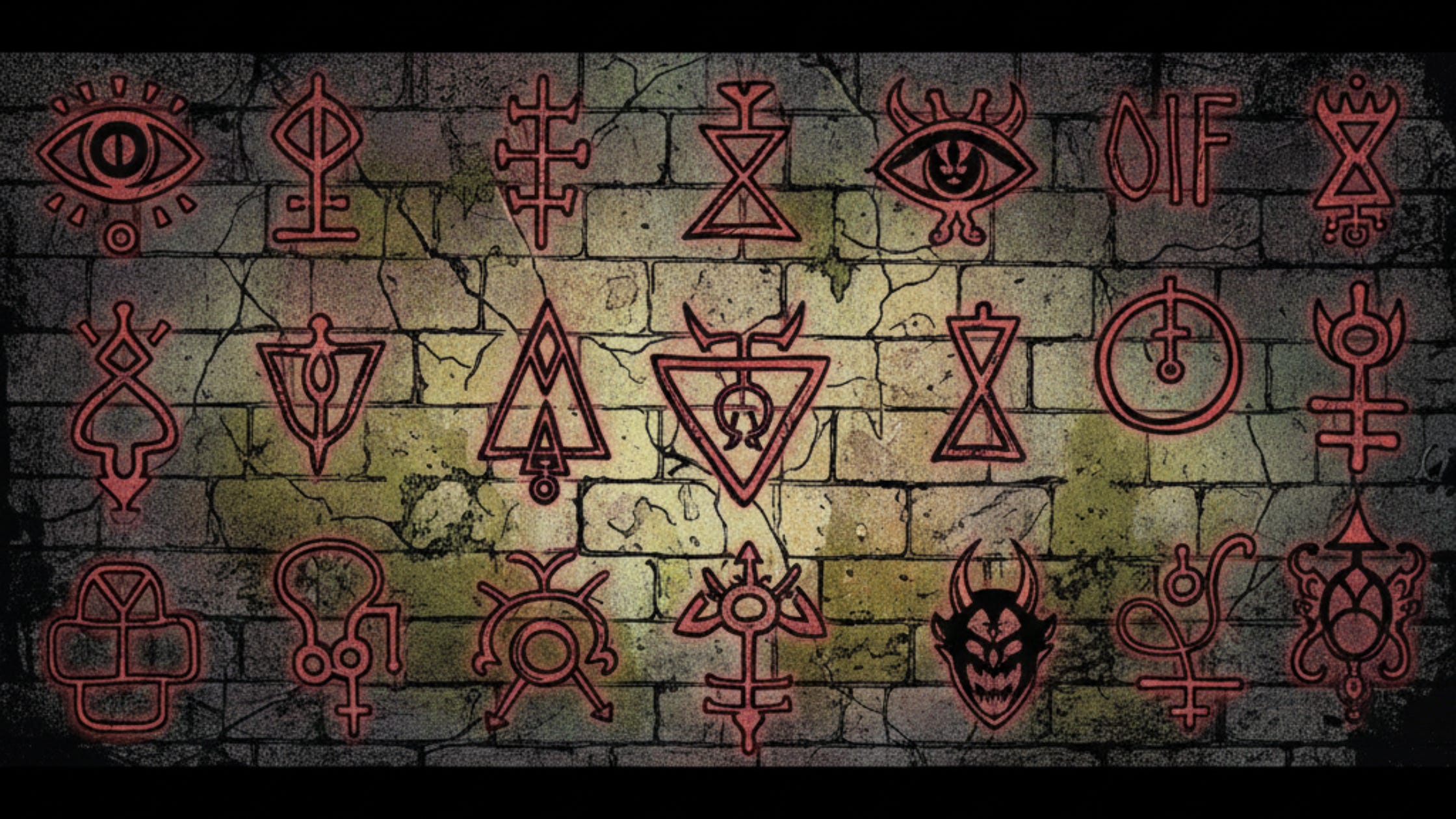
A practitioner’s honest assessment of sigil work, paradigm shifting, and the price you pay for results-based magic
The sigil worked.
That was the problem.
I was sitting in a one-bedroom apartment in Okinawa, three weeks after I’d charged a sigil for a very specific outcome, something unlikely enough that coincidence would’ve had to work overtime, and there it was. Delivered like a package left on the porch by a courier who didn’t exist. The thing I’d asked for, manifested in physical reality, down to details I’d sketched in my notebook while half-drunk on Orion beer.
I should have been ecstatic. Instead I felt something cold move through my chest, like swallowing ice water too fast. Because if it worked, if it actually worked, then either reality was far stranger than the materialists claimed, or I was losing my mind in a way that happened to be convenient.
Both options scared me.
That was Year Two. I had eight more years of practice ahead of me, and the results would only get weirder. I’m going to tell you what happened during those years, what chaos magic actually is beneath the edgelord aesthetics and the Aleister Crowley cosplay, what worked, what didn’t, and why I eventually stopped doing something that, by any reasonable measure, was producing results.
I could be wrong about all of this. That’s the only honest starting point.

What Chaos Magic Actually Is →
Forget everything you’ve seen on TikTok.
Forget the aesthetic witches with their crystals and their Amazon altars. Forget the ceremonial magicians in their robes arguing about which angel governs the third decan of Aquarius.
Chaos magic doesn’t care about any of that.
Here’s what chaos magic is, stripped to the studs: it’s the hypothesis that belief itself is a tool, and that you can use it to produce measurable changes in the physical world without committing to any particular explanation for why it works.
That’s it. That’s the whole game.
A traditional magician says “I invoke Raphael, archangel of healing, because Raphael exists and has power.”
A chaos magician says “I invoke Raphael because the act of belief in Raphael, held with sufficient intensity and then released, produces results. Whether Raphael exists as an independent entity is irrelevant to the operation.”
Peter Carroll and Ray Sherwin formalized this in the late 1970s, drawing from Austin Osman Spare’s work from decades earlier. The foundational texts are Liber Null and Psychonaut.
The core insight is radical pragmatism: results over theory. If praying to Jesus gets you what you want on Monday, and invoking Kali gets you what you want on Tuesday, and charging a sigil to an anime character gets you what you want on Wednesday, then the mechanism isn’t the deity.
The mechanism is you.
This is either the most liberating idea in the history of human spirituality or the most dangerous. I’ve come to believe it’s both.
Belief is a tool. That sentence is the engine of the whole system, and it’s the sentence that will eventually eat you alive if you’re not careful.
How It Works in Practice →
The most basic chaos magic technique is the sigil. It works like this:
You write a statement of intent. “It is my will to receive an unexpected financial opportunity this month.” You remove the duplicate letters. You arrange the remaining letters into an abstract symbol, something that looks like a glyph from a language that doesn’t exist. Then you “charge” it, which means you reach a state of intense focused consciousness, usually through meditation, exhaustion, pain, sex, or some combination, and you burn the image of that sigil into your mind at the peak of that state. Then you forget about it.
The forgetting is the crucial part. The theory, such as it is, says the conscious mind is a bottleneck. The intent has to bypass your rational filters and sink into whatever operates beneath, the unconscious, the quantum substrate, the Akashic field, the morphic resonance. Pick your model. None of them matter. What matters is whether you get results.
I got results.
Not every time. Not with clockwork reliability. But often enough that statistical noise stopped being a comfortable explanation somewhere around Year Four. I tracked everything in notebooks. Dates. Specific outcomes. Probability estimates. I was an Air Force fuels specialist during the day, maintaining accountability of millions of gallons of JP-8 across multiple installations, and a chaos magician at night, maintaining accountability of operations against reality itself.
Belief is a tool. And I was getting disturbingly good at using it.
Beyond sigils, the practice expanded into paradigm shifting, deliberately adopting entire belief systems for operational purposes and then discarding them when the operation was complete. Three weeks as a devotional Hindu. A month practicing Enochian ceremonial magic. Six weeks working with Vodou lwa. Not as a tourist. With full emotional and psychological commitment, because the technique doesn’t work if you’re half-assing the belief.
Then you drop it and pick up the next one. Like changing clothes.
You start to understand why they call it chaos magic.

What Worked →
Sigils worked with uncomfortable regularity for specific, time-bound, measurable outcomes. Not “I want to be happy,” but “I will find a specific used camera lens for under $200 by the end of this month.” The more precise and testable the intent, the better the hit rate.
Paradigm shifting produced genuine altered states and what felt like direct contact with, well, something. I sat in a Zen temple in Okinawa and had my sense of self dissolve for approximately ninety seconds. I did a series of Enochian workings that produced synchronicities so dense and layered that I started keeping a second notebook just for the coincidences.
The practical benefits were real too. Enhanced pattern recognition. A weird but useful comfort with ambiguity. The ability to hold contradictory ideas simultaneously without your brain catching fire. That last one is more valuable than it sounds, especially if you work in military intelligence or corporate operations or anywhere that ambiguity is the native language.
And there’s something else that’s harder to articulate. A perceptual shift. Once you start working with belief as a tool rather than a commitment, you start seeing the machinery behind consensus reality. You notice how institutions manufacture belief. How advertising is just sigil magic with a budget. How political movements charge their symbols the same way you charge yours, through intensity, repetition, and emotional arousal followed by release.
You start to see the puppet strings. Not just on you. On everyone. On the whole show.
That part doesn’t go away even after you stop practicing. I’m not sure it should.
What Didn’t Work →
Long-term psychological stability, for one.
When belief becomes a tool, it also becomes disposable. And something in the human operating system doesn’t handle that well. We’re wired to commit. To anchor. To say “this is true and I stand on it.” Chaos magic asks you to hold everything lightly, permanently, and the psychological cost of that is a kind of low-grade existential vertigo that never fully resolves.
I started having trouble distinguishing between meaningful synchronicity and pattern recognition gone haywire. When you’re looking for signs, everything becomes a sign. The license plate in front of you. The song on the radio. The specific way the barista misspelled your name. It’s a short walk from “I notice meaningful patterns” to “the universe is communicating directly with me through Starbucks cups,” and the difference between those two states is not always obvious from the inside.
Big asks didn’t work. Or they worked in ways that made me wish they hadn’t. Chaos magic has a reputation for delivering results through the path of least resistance, which sometimes means the path you absolutely did not want. You ask for a career change and get fired. You ask for transformation and your life falls apart. The old magicians called this “the monkey’s paw.” The chaos magicians just shrug and say you should have been more specific.
Belief is a tool. But tools don’t care about your feelings.
Community was a mixed bag. The chaos magic scene, such as it was, attracted three types of people: genuine explorers with sharp minds, damaged people looking for power over a life that felt out of control, and edgelords who thought Grant Morrison comics were initiatory texts. The ratio shifted depending on the year and the platform, but the signal-to-noise was always brutal.

Why I Walked Away →
I stopped practicing chaos magic after roughly a decade, not because it didn’t work, but because I didn’t like who I was becoming and I increasingly didn’t like who I was associated with.
The results-over-theory framework sounds clean and pragmatic when you read it in a book. Lived out over years, it does something to your relationship with truth. When belief is a costume you put on and take off for operational purposes, the concept of “what do I actually believe” starts to corrode. Not in a fun, postmodern, everything-is-relative way. In a way that feels like standing on a floor that’s slowly turning to liquid.
Combat trauma didn’t help. I came home from deployments with a nervous system already recalibrated for hypervigilance, and chaos magic’s core insight, that reality is more malleable than institutions claim, layered onto PTSD in ways that were not therapeutic. Questioning consensus reality is intellectually stimulating when you’re stable. When you’re not, it can become a hall of mirrors with no exit.
The price you pay for magical thinking, even disciplined, results-focused magical thinking, is that you erode your own foundation. You gain flexibility at the cost of solidity. You gain power at the cost of peace.
I wanted peace more.
So I put the notebooks away. Stopped charging sigils. Stopped the paradigm shifts. Sat in the quiet for a while and let the ground harden again beneath me.
What I Took With Me →
I didn’t walk away empty-handed.
The pattern recognition stayed. The ability to see how institutions manufacture belief, how advertising operates as mass sigil magic, how political movements charge their symbols. That perceptual shift is permanent, and I consider it valuable.
The comfort with ambiguity stayed. The ability to hold “I don’t know” as a complete sentence rather than a failure state. In a world addicted to certainty, that’s a survival skill.
The radical pragmatism stayed, refocused. I still care more about results than theory. I still test everything. I still don’t trust any system that asks me to commit before showing me evidence. But I apply that framework to business, to writing, to daily operations, rather than to reality itself.
And I kept the humility. Ten years of practicing magic that actually worked taught me that the universe is far stranger than either the materialists or the mystics are willing to admit. The materialists are wrong that consciousness is just meat computing. The mystics are wrong that they understand what it actually is. Nobody has the full picture. Nobody.
I could be wrong about all of this. I said that at the top and I mean it at the bottom. Maybe the results were coincidence and I was fooling myself for a decade. Maybe the results were real and I was a coward for stopping. Maybe the truth is something neither of those options can hold.
What Chaos Magic Is, One More Time, for the People Who Skipped Ahead →
It’s the practice of using belief as an operational tool to produce measurable changes in physical reality, without requiring commitment to any particular cosmological framework.
It works often enough to be unsettling. It costs more than the books tell you. The community ranges from brilliant to broken. The techniques are simple. The implications are not.
If you’re thinking about trying it, I’d say this: keep meticulous records, set a time limit for your experiment, maintain at least one anchor to consensus reality that you refuse to question, and have someone in your life who will tell you honestly if you’re starting to sound like you’ve lost the plot.
And if the sigil works, sit with the fear. Don’t explain it away. Don’t build a theology around it. Just let it be strange.
Belief is a tool. Handle it like one. Which means respect it, maintain it, and know when to put it back in the box.
The box is important. I wish someone had told me about the box earlier.