

Con Men in Linen Shirts
The creator economy is a prosperity gospel. Plus a flywheel that doesn't need your morning routine.

Welcome to the late issue of Dispatches from the Deep End.
In this issue:
The Shovel Sellers
🔄 The Slow Flywheel
📶 The Dashboard
I didn’t make my Sunday deadline at all.
It was a busy week. Lots of family stuff or life stuff in general. It happens and I’ve let my systems slip a bit. I’ll have to correct that. To be fair, though, it’s okay to slip a little and not be a machine all the time.
In the meantime…
Let’s fuckin’ goooo!!!!
The Shovel Sellers
The prosperity gospel never died. It got a ring light and a Substack.
Somewhere on the internet right now, a man in a linen shirt is explaining how he makes $48,000 a month working two hours a day by “being himself.”
The lighting suggests a Scandinavian design studio. Behind him, a bookshelf arranged by color holds volumes he’s almost certainly never cracked.
And the comments underneath are a mass grave of aspiration, hundreds of people typing “this changed my life” with the same fevered desperation you used to see in the eyes of people handing rent money to televangelists on cable access channels in 1987.
Different decade. Same con.
Dan Koe. Alex Hormozi. Justin Welsh. Dickie Bush.
The Mount Rushmore of a movement that turned “follow your passion” into a multi-level marketing scheme wearing a philosophy costume.
They’ve collectively pulled hundreds of thousands of people into something called the “creator economy,” which sounds revolutionary until you realize most of those people are now teaching other people how to teach other people how to create content about creating content.
That’s not an economy. That’s a centipede eating its own tail in a rented WeWork conference room.
These are con men. I don’t care how many followers they have or how slick the production value is or how many times they post that morning routine where they drink cold-pressed something in a kitchen that costs more than your house.
Instead of “God wants you to be rich,” it’s “your unique knowledge is worth millions.” Instead of seed money to Pastor Whoever’s megachurch building fund, it’s $2,500 for a cohort that teaches you what any free marketing textbook at the public library already covers.
The mechanics haven’t changed since Oral Roberts figured out you could monetize hope through a television screen. You take a person who is afraid, a person who hates their commute and their boss and the gray fluorescent light that makes their skin look like something pulled from a hospital drawer, and you show them a life they want.
You don’t sell them that life. You sell them the feeling of proximity to that life.
One is a transaction. The other is a drug. And like any good dealer, they cut the product with filler and move on to the next customer before the high wears off.
The fumes they breathe…
They like the smell of their own shit. Go look at their social media presence and tell me you see humility anywhere in the frame.
These are men who’ve confused wealth with wisdom, audience size with authority, and engagement metrics with truth.
They photograph their home offices with the self-reverence usually reserved for saints and Bond villains. Every caption drips with the quiet insistence that they’ve cracked some code you haven’t, and for the right price, they might let you stand close enough to catch the scent.
Here’s what each one brings to the altar:
Hormozi flexes revenue screenshots like a kid waving the keys to his dad’s car. The numbers are the sermon. The congregation tithes in course fees.
Welsh posts “solopreneur” income reports that function less as transparency and more as recruitment posters for a lifestyle brand. Follow the template. Buy the template. Become the template.
Koe wraps 101-level marketing advice in philosophical language dense enough to make people think they’re ingesting something profound when they’re being told to write tweets and build an email list.
Bush tells you to write online for 30 days and doors will open, without mentioning that the doors that opened for him were already half-unlocked by timing, connections, and a platform algorithm that was rewarding exactly that kind of volume at exactly that moment in history.
None of them are lying, exactly.
That’s the elegant part of the con. They’re telling the truth about what worked for them, then packaging it as a universal formula while knowing damn well it won’t work for most of the people buying it.
By the time the buyer figures that out, the receipt is already cold.
Koe didn’t start by philosophizing about consciousness and self-actualization on YouTube.
He started by learning web development and marketing. He built agencies. He ground through years doing client work that made other people money. Hated it. Did it anyway.
The lifestyle content, the philosophical musings, all of that came after the credibility was established through demonstrable skill applied in the real world over real time.
His followers skip that part entirely. They start posting “find your purpose” content on day one, with zero proof they’ve found theirs or that finding it ever put a single dollar in their pocket.
The copycats are worse than the originals.
Open your feed on any platform and count how many people are posting the same formatted threads, the same “I quit my 9-5 and here’s what happened” stories, the same motivational language dressed up as business advice.
They saw the guru’s marketing and replicated the surface without ever building the engine underneath. Bought the swim trunks and laid down in the snow and wondered why the beach never showed up.
And the gurus encourage every last one of them, because every new voice parroting the message is free advertising for the courses and cohorts that feed the machine.
The recruitment is the product. The followers are the revenue stream. The promise of transformation is the thing being sold, and transformation is the one thing that never has to be delivered because it’s always framed as the buyer’s failure to achieve.
It’s a cult, just one built of personality and flimsy fortune cookie philosophy instead of religion. A pyramid scheme in it’s true form.
I sell creator utility products.
I know how this looks from the outside. Somebody reading this might squint at my Gumroad store and say I’m working the same corner.
Fair enough. Look closer.
Maybe I’m wrong about their intentions. Maybe they go to bed at night genuinely believing they’re helping people. I’m not wrong about the results.
I don’t sell shovels to people chasing gold that doesn’t exist. I show you how to mine. Honest timeframes. Documented processes.
No revenue screenshots designed to make you feel like a failure for not hitting numbers that took somebody else a decade and a staff of twelve to reach. No promises that you’ll pull six figures “being yourself” within ninety days.(You can hit four or five figures, though. Although that does take more work.)
Just how the work works, and how long it takes, and what it feels like when you’re in the middle of it wondering if any of this matters.
The path to making money as an independent creator is boring and ugly and slow. Nobody pays $2,500 to hear that. They pay $2,500 to hear “you’re already enough and I’ll show you the shortcut.”
There is no shortcut. There never was.
The only people getting rich from the shortcut are the ones selling maps to it.

🔄 The Slow Flywheel
So what works?
I’m going to tell you what I’m doing. Not what I think you should do, because I’m not your guru and I don’t want the job.
This is a field report from somebody in the mud, not a TED talk from a guy whose entire aesthetic whispers I’ve transcended the concerns of ordinary people.
Three platforms. Three purposes. One flywheel that turns slow and compounds quiet and doesn’t require you to post motivational content at 6 AM or build a “community” that’s just a customer holding pen with better branding.
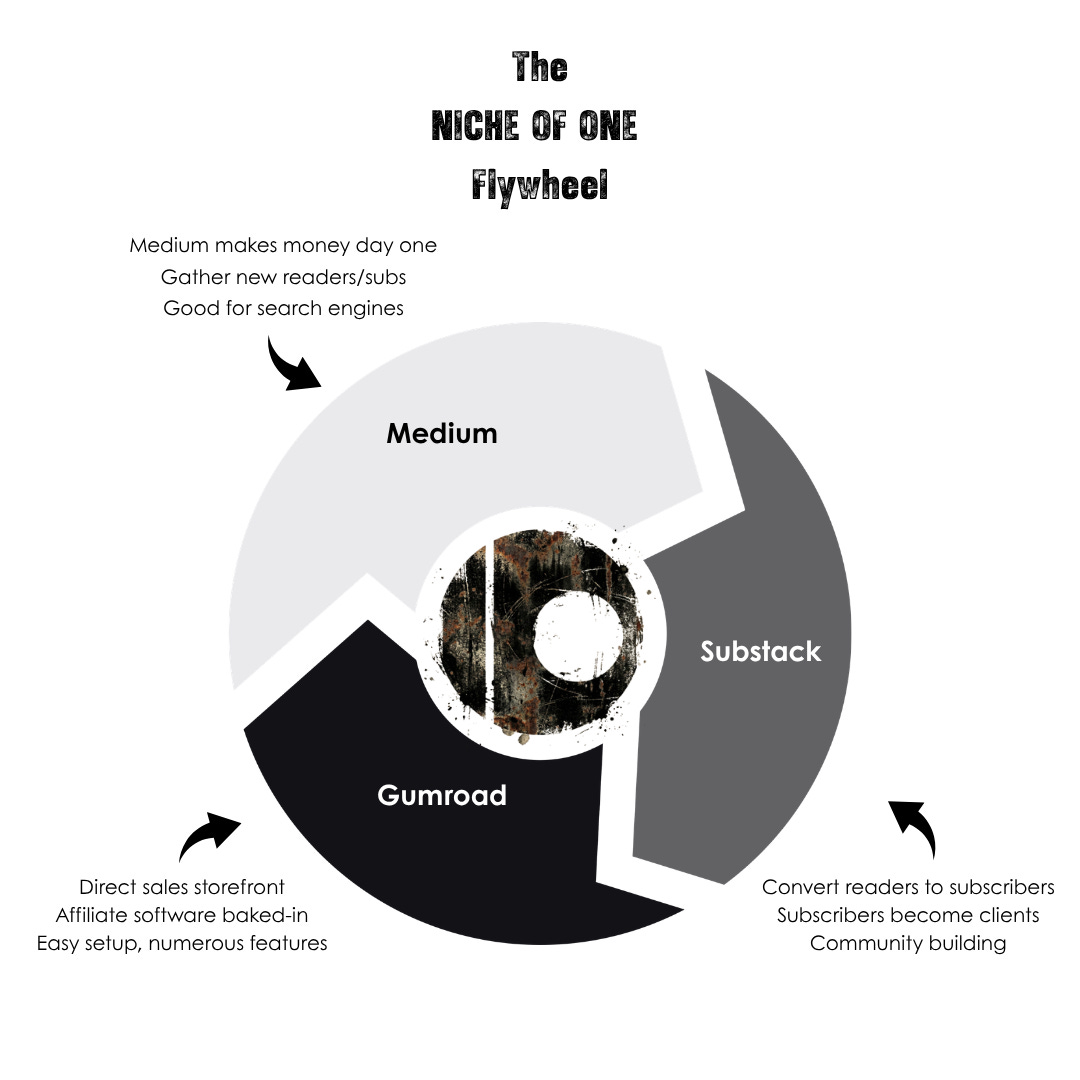
Substack: Home Base
The newsletter. The weekly dispatch you’re reading right now.
This is where the weird lives, where the voice runs unfiltered, where the relationship with you gets built over months and years of writing something worth reading. Free tier does the heavy lifting. Paid tier exists for the people who want to support the work and get closer to the operation.
I’m not going to beg you to subscribe. I’m not going to manufacture urgency around a “founding member” price that expires at midnight.
I’m going to write well enough that you want to stay. That’s the whole pitch.
Medium: The Discovery Engine
Different animal entirely.
Medium has an algorithm, and the algorithm surfaces writing to readers who have never heard of you and never will unless something puts your work in front of their eyes. A piece that pulls 50 reads on Substack might pull 5,000 on Medium because the distribution mechanics are fundamentally different.
The play is simple. Take the ideas percolating in the newsletter, rework them for a wider audience, publish on Medium, and let the platform introduce you to people who would never have stumbled across your Substack on their own. Some of them read the Medium piece, follow the breadcrumb back to the newsletter, and now they’re in the orbit. Not because you tricked them with a lead magnet. Because you wrote something worth following.
Gumroad: The Shelf
Every guide, every field manual, every template, every tool you’ve built sits there and earns while you’re sleeping or cooking dinner or staring at the ceiling wondering if this whole operation is a fever dream. One product this month. Two the next. A year from now you’ve got a dozen things sitting there, each pulling a little revenue, and together they pull enough.
The shelf doesn’t care if you had a bad week on social media. Doesn’t need engagement. Doesn’t need you to perform.
It just sells.
How the Flywheel Turns
Each platform feeds the others:
Substack builds trust and voice
Medium expands reach to new readers
Gumroad converts the relationship into revenue
A newsletter essay becomes a Medium article becomes the seed idea for a Gumroad product. A Gumroad product generates buyer questions that become newsletter content that gets reworked for Medium.
Circular. Slow. Boring to describe. Boring to execute. Doesn’t photograph well for Instagram.
Works anyway.
Not in ninety days. Not in six months. In the timeframe where durable things get built, which is measured in years, not cohort cycles.
I’m talking about a business that runs while you’re doing other things because the catalog is the engine and the catalog doesn’t need you to post a thread about your “creator journey” at peak engagement hours to function.
The catalog doesn’t care about your morning routine.
The catalog just earns.
You don’t need a massive audience. You need the right fifty people who trust you enough to buy what you build.
Then a hundred. Then two hundred.
Each one found you because you wrote something honest and useful, not because you ran a “free course” funnel designed to harvest email addresses from people in survival mode who thought they were getting help and were getting marketed to.
You build slow. You build honest. You build something that keeps working after you stop talking.
No secret module. No premium tier unlock.
Just the work, and the patience to let it accumulate.

📶 The Dashboard
I’ve been building something.
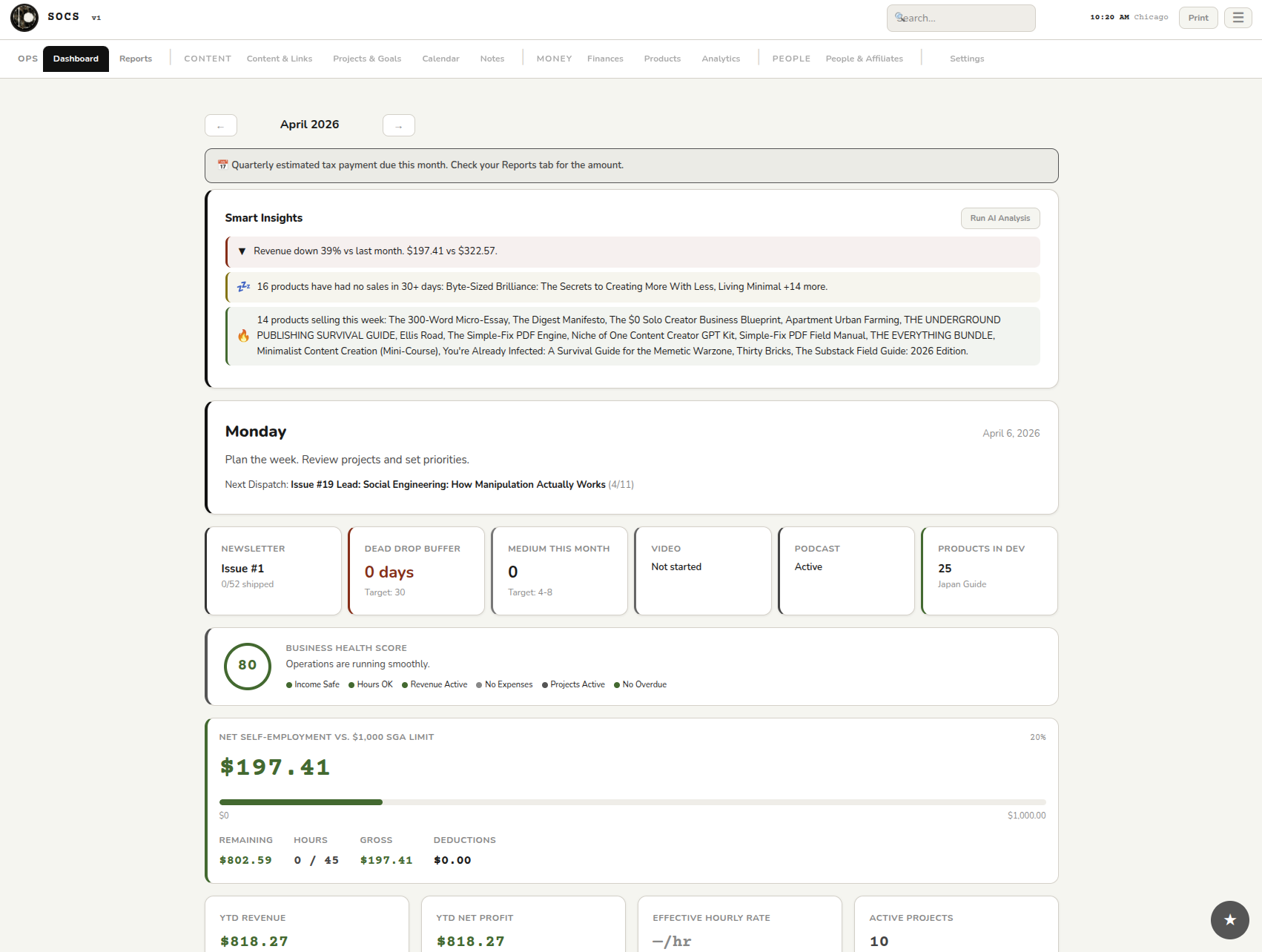
It started as a personal operations dashboard because I was drowning in the usual solo operator mess. Content calendar in one place, product pipeline in another, revenue tracking in a third, Dead Drop scheduling in a fourth, and none of them talking to each other.
Tabs multiplying like roaches. Spreadsheets spawning spreadsheets.
The kind of operational entropy that accumulates when you’re running a multi-platform publishing operation on spit and coffee and stubbornness.
So I built a thing. One screen. Everything I need to see in the morning when I sit down with coffee and ask myself what am I doing today and is any of it working.
Every solo creator I know is buried under the same pile of disconnected tools and dashboards and analytics screens.
Each one shows a single piece of the picture. None of them show the whole thing at once.
The guru class sells you the dream and then leaves you to manage the execution with duct tape and Google Sheets and seventeen browser tabs you’re afraid to close because you’ll never find that one again.
The flywheel I described needs an instrument panel. Something that shows you where you are, what’s producing, what’s stalled, and what needs your hands today. Not a project management tool designed for a team of forty. Not a $200/month SaaS platform built for people who already have revenue to burn.
Something built by a solo operator, for solo operators. Something that assumes you’re doing this alone on a budget closer to ramen than revenue, and you need clarity more than you need features.
I’m not ready to show it yet. I want it right before anybody touches it.
But I’m telling you now because when it comes out, I want you to understand it didn’t drop from a product launch playbook. It grew out of the same mud I’ve been reporting from this whole time. Same operation. Same refusal to buy somebody else’s shovel when I can forge my own.
One screen. The whole operation.
No linen shirt required.

If you made it here, that means you should…
That’s it for this week. Don’t let your dongles dangle. Until next time…
~ J.D.
P.S. I’ve made about $21K in the last 6 months. Here’s how…
Please note some links may lead to affiliate offers and if you purchase from these links I may receive a small amount of compensation at no extra cost to you.
I went through all of them. The time scale is the thing that overwhelms 99% of the people that get pulled in. They all have their points, and the funny part about it is what Koe states that, as you state, seem to miss. The whole system is designed to pull people in, and only those who filter upwards will find their paths that don't require joining the shovel sellers. The problem is that people tend to see the angle as the most compelling.
It's taken me years to deprogram from it all. The perk is that I've started finding the people who have walked the walk of the craft rather than the business.
It takes a heck of a lot longer than the sales pitch.
just found you this week, loving your content. Thank you.