

Failure isn't noble. It never was.
Failure isn't noble. It's physics. Wabi-sabi, kintsugi, the OODA loop, and what solo creators get wrong about planning.

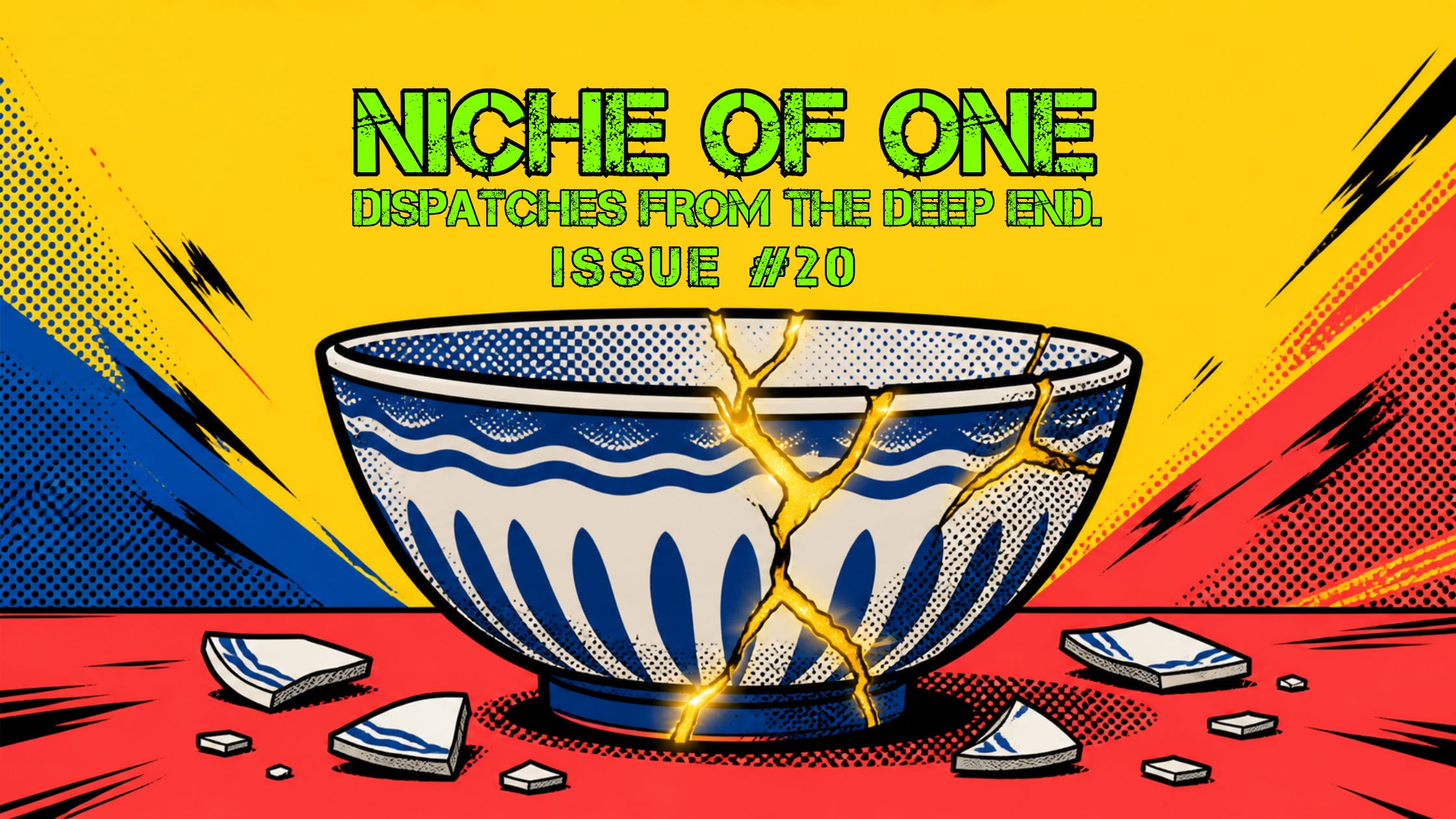
Welcome to Dispatches from the Deep End.
In this issue:
💔 Wabi-Sabi of Failure
🎯 The Loop That Keeps You Moving
📋 Eighteen Things the Creator Machine Won’t Tell You
Two pieces this week about the stuff they don’t put in the brochure.
One is about failure. Not the noble, redeemable, keynote-ready kind. The kind that sits in your chest for years and changes the shape of things.
The other is about planning. Specifically, why your plan is going to fall apart and what you do when it does.
The third is a list. Short. Useful. No frameworks required.
Grab coffee.
Let’s fuckin’ goooo!!!!
💔 Wabi-Sabi of Failure
She wasn’t a bad person. She was just bad for me, and I couldn’t tell the difference for a long time.
I stayed because staying felt like the honorable move. I stayed because every time she did something cruel there was always an explanation, and the explanation always landed the same way, with me at the bottom of it somehow, and I was ground down enough to nod along.
She had a gift for that. A lot of people do.
It took me longer than it should have to understand that staying wasn’t loyalty. It was just being scared of being alone.
There’s no framework waiting at the end of that story. No lesson with a tidy takeaway.
Just a stupid human thing that happened, and I let it happen, and the cost of it lives somewhere in my chest still, small and quiet and not going anywhere.
The Western self-help machine has decided failure is a product.
You can buy a course about it. You can hire a coach who has failed spectacularly and turned the wreckage into a keynote and a personal brand.
They’ll give the failure a name. They’ll make it noble. They’ll hand you the algorithm: fail, learn, fail better, scale the failure, monetize the lesson.
It’s not noble, and it never was.
Failure is not a strategy. It’s not a feature. It’s not a rite of passage the universe designed specifically to sand down your rough edges and reveal the gleaming person underneath.
It’s cause and effect.
You tried something. The conditions weren’t right or your read was wrong or the timing was off or someone lied to you or you lied to yourself.
The thing didn’t work. Now you know something you didn’t know before.
That’s the whole transaction.
The Japanese figured this out a long time ago (and predictably, Western society butchered it.)
The concept is wabi-sabi. Most people encounter it as an aesthetic: imperfect objects, a cracked tea bowl, the asymmetry of something handmade.
They think it’s a design sensibility.
It’s not. It’s a philosophy of existence.
The bowl doesn’t mourn the crack. The crack is filled with gold and the bowl keeps getting used. The damage is part of the object now. Nobody looks at a kintsugi bowl and sees a failed bowl.
They see a bowl that has a history.
That’s the actual thing. Not the gold. The history.
Wabi-sabi is not about celebrating imperfection. It’s about accepting that imperfection is the baseline condition of everything that exists, including you, including your business, including your relationships, including your creative practice.
The crack doesn’t mean the bowl is ruined.
The crack means the bowl was used.
When I finally left that relationship, I wasn’t a better version of myself, polished and improved by the ordeal.
I was the same person with more information. Some of that information was useful. Most of it just sat heavy in me for a while and eventually settled into something I carry without noticing anymore.
The crack is there. It’s filled with something. The bowl still holds water.
Here’s the specific lie the failure industry sells: failure is an event with an endpoint. You fail, you learn, you grow, you arrive somewhere better, scene over. The story has an arc and the arc resolves.
Existence doesn’t work that way.
You are broken and repairing simultaneously, the damage running alongside the repair, neither one waiting for the other to finish.
There is no problem here. There is only the condition.
You can’t have success without failure because they’re the same physics operating in sequence.
One follows the other the way exhale follows inhale.
Trying to engineer a life or a business or a creative practice that skips the failure part is like trying to breathe in without ever breathing out.
You cannot do it. You will not do it. Somebody selling you a system for doing it is selling you something that doesn’t exist.
The failure industry runs on fear.
Specifically, it runs on the fear that your failures say something permanent and definitive about who you are. That they’re a verdict instead of an event. That if you fail at the business or the relationship or the creative project, the failure is evidence of some structural flaw in you, personally, that a better person wouldn’t carry.
This is the con.
Call your failures what they are: a curriculum, not a verdict.
The tuition is high and the coursework is humiliating and nobody hands you a diploma at the end, but you come out the other side knowing things you couldn’t have known any other way.
Here’s the practical end of this, for the creators reading it.
You are going to ship something that doesn’t land. You are going to build something nobody wants. You are going to write something you thought was good and watch it get thirteen views and zero responses. You are going to try a platform and it’s going to be wrong for you. You are going to price a product at the wrong number and sell nothing, then adjust and sell some.
All of that is the catalog. Not the failure catalog. Just the catalog.
The stuff that worked and the stuff that didn’t and the slow accreting knowledge of the difference between them.
The people who keep going are not the people who figured out how to fail correctly. They’re the people who stopped treating failure as an interruption and started treating it as weather. You check the forecast, pull on a coat, and go outside anyway.
And sometimes you get soaked. That’s not failure. That’s Tuesday.
The bowl is on the shelf.
The crack runs from the rim to the base, wide as a finger in some places, hairline thin in others, filled with something that catches the light on certain mornings in a way that makes you stop and look at it.
It holds water just as well as it ever did.

🎯 The Loop That Keeps You Moving
SERE school is Survival, Evasion, Resistance, and Escape.
They put you in the woods with nothing, and then people who are very good at their jobs try to find you, and when they do, things get uncomfortable in ways the paperwork calls training and your body calls something else entirely.
The first thing you learn, before any of the specific skills, is that walking into a hard situation without thinking it through first is how you hand the situation to whoever’s waiting on the other side.
You do not just go. You look. You figure out what you’re looking at. You decide what to do. You do it. Then you look again.
John Boyd called this the OODA loop. Observe, Orient, Decide, Act.
Boyd built the framework for Air Force fighter pilots, but the underlying logic is older than the Air Force. It’s just clear thinking under pressure, formalized into something you can train.
The loop runs in real time. In a fighter jet, you’re cycling through it in fractions of a second. In a one-person creative business, the cycle time depends on the problem.
Most solo creators confuse planning with thinking.
They build elaborate content calendars, product roadmaps, launch sequences, quarterly themes, color-coded spreadsheets describing in confident detail what they will be doing six months from now. All of this activity feels like thinking.
Most of it is avoidance.
No plan survives contact with the enemy. This is not pessimism. It is the most practical thing anyone has ever said about planning.
The plan matters because building it forces you to think through the terrain before you’re standing in it. The plan stops mattering the second the terrain turns out different than you thought, which it always does, because you drew the map in your head and reality doesn’t check your notes.
The skill is the pivot, not the plan.
Boyd’s whole contribution was a faster cycle.
The side that can observe, orient, decide, and act faster than the other side wins. Not because they have the better plan, but because they can adapt faster when the plan stops working. Speed through the loop beats a perfect static strategy every time.
There are two ways solo creators break this.
Too much plan. The content calendar runs to Q4. The product roadmap has dependencies mapped three stages deep. There are twelve approval gates between the idea and the shipped thing, and the person who built those gates and the person approving them are the same person, sitting alone at a laptop. The plan has become a machine for producing reasons not to start.
No plan at all. Pure improvisation. Whatever feels right this morning, ship that. No sense of what came before or what comes after. No orientation to the terrain. Lots of motion, unclear direction.
Both get you nowhere, just at different speeds.
What works is a living framework.
Not a document. Not a calendar. A set of principles that travel with you and flex when the situation liquefies.
For a one-person creative operation, this means: know your throughline, know your next three moves, and hold everything else loosely enough to drop when you need to.
Observe: what’s actually working. Not what you hoped would work. What is demonstrably, in the data, working.
Orient: what does that mean for what you do next. This is the hard one. Most people skip from observation straight to action. The orientation step is where you actually think. It takes longer and most people can’t tolerate sitting with it.
Decide: the smallest move that tests the most important assumption.
Act: do the thing. Actually do it.
Then look at what happened and start again. The loop doesn’t stop. It keeps cycling because the terrain keeps changing and the map you drew yesterday is already wrong.
One more thing, worth carrying with you: not everything needs a plan. Some things you can just make up.
The framework is for the hard problems, the ones where going in headfirst gets you the worst end of the stick. For the easy ones, trust your gut and ship the thing.
The trick is knowing which is which.
You’ll get better at it. That’s the part you can’t shortcut.

📋 Eighteen Things You Should Know
Some things they don’t always put in the creator on-boarding email.
1. Your first version of anything will be wrong. Ship it anyway. The second version needs the first to exist.
2. Consistency beats quality in the early days. A good thing published weekly beats a perfect thing published never.
3. Your niche is weirder than you think. The more specific you get, the more people say “this was written for me.”
4. The catalog makes money while you sleep. The launch feeds the ego. Build the catalog.
5. Nobody is as far ahead of you as their content makes them look.
6. Price things however the fuck you feel like pricing them. Most of the pricing advice is bad advice.
7. Every platform will change the rules. Own your list. Your email subscribers are yours. Everything else is rented.
8. The audience you have now is not the audience you’ll have in two years. Write for who’s coming, not just who’s here.
9. A year of bad output is the prerequisite for good output in year two. There is no shortcut through year one.
10. If you stop when it gets hard, you’ll never know what was waiting on the other side.
11. The product that seems too simple to sell is usually the one that sells. Complexity is for you. Simplicity is for the customer.
12. Reply to every email you get from a reader. Every one. Until you can’t. Then hire help.
13. Your weird interest is a vertical. Your other weird interest is another vertical. The intersection is where nobody else is standing.
14. Burnout comes before you recognize it. Rest is not a reward for finishing. It’s a load-bearing wall.
15. The comparison game is a trap with no exit. You don’t know their numbers, their costs, or what they gave up. Stay in your own lane.
16. Do one thing well before you add the second thing. Then do two things well before you add the third.
17. Bad months happen to good operations. Track trends, not individual data points.
18. Ship the thing. The other thing can wait.

If you made it here, that means you should…
That’s it for this week. Glad to be back. I caught lots of fish and shotguns were fired.
~ J.D.
P.S.
Please note some links may lead to affiliate offers and if you purchase from these links I may receive a small amount of compensation at no extra cost to you.
Excellent advice, as always! I learned something new about Wabi-sabi. I never knew what that was. (But it's sure fun to say!)
My personal vision of Wabi-Sabi is comparable—and in many cases identical—to our own physical scars. They are there, representing what happened. When I look at them, they remind me how I should act.