

The Big Empty
Night Driving, Lo-Fi Living, and the Power of What's Not There

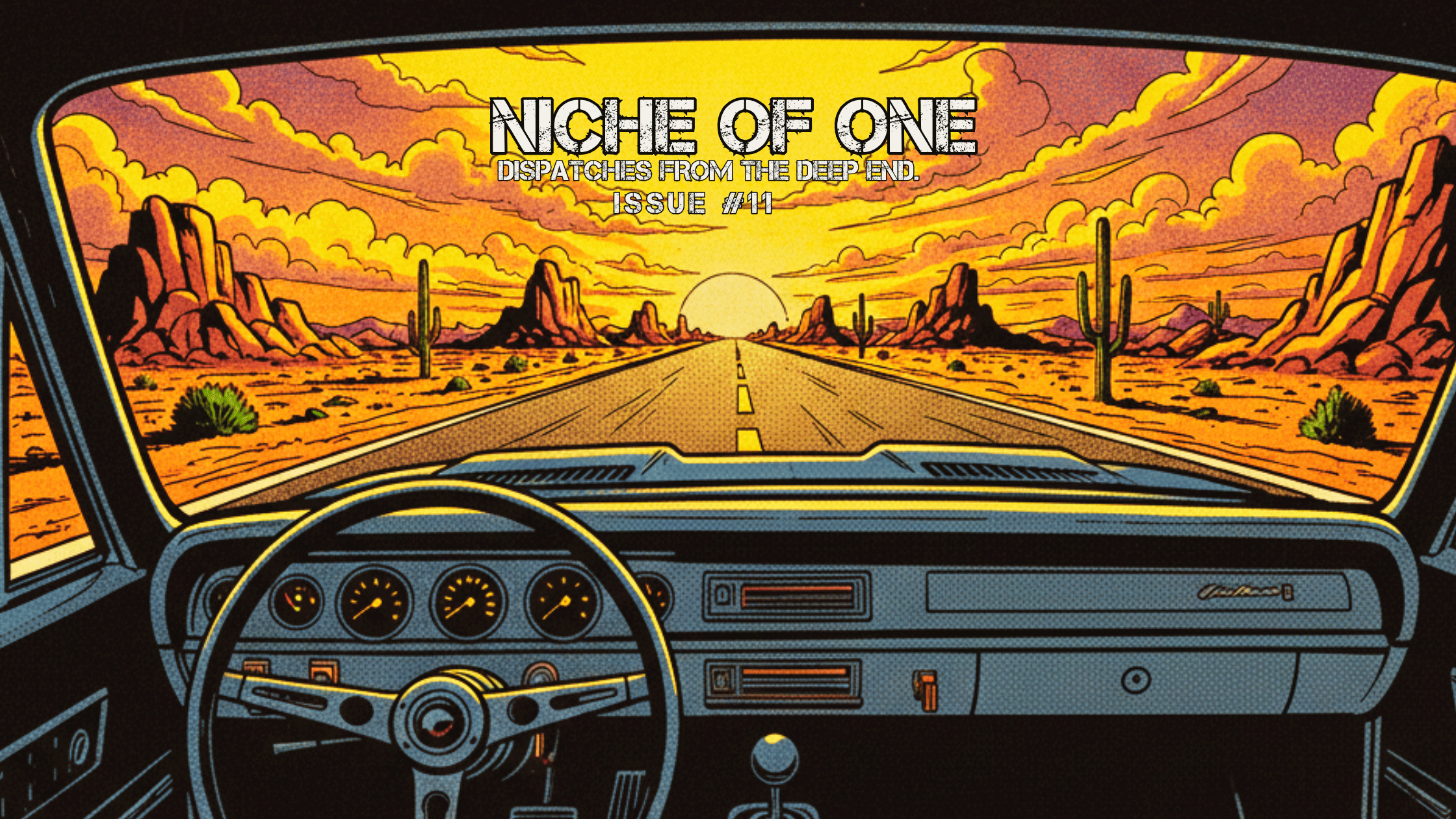
I’ve been on the road again.
In this issue:
⛐ Interstate Communion
🖭 The Aesthetic and Psychological Power of Analog Imperfection
🫥 Creating Atmospheric Work Through Emptiness and Negative Space
I have to drive long distances pretty frequently, and I’ve been driving most of my life. Since I was about 7 actually. So, I wrote something about what it’s like to drive on the interstate.
Also decided to look into the analog trends and how to use ambiance and sound to create liminality on the go.
Let’s fuckin’ gooooo…
⛐ Interstate Communion
You leave at midnight because that’s when the highway empties out and becomes what it actually is. A river of asphalt running through the dark heart of a country that never figured out what it wanted to be. The GPS says you’re four hours from nowhere in particular. You’re not arguing.
The radio’s playing something that might be music or might be static with delusions of grandeur. Doesn’t matter. You’re not listening anyway. You’re listening to the road. The hum of rubber on concrete. The wind finding the gaps in the window seal. The engine’s hymn to combustion and forward motion.
This is church.
Mile marker 47 slides past. Then 48. Then 49. They’re counting something but you’re not sure what. Distance is abstract out here. Time is abstract. You’ve been driving for twenty minutes or three hours. The dashboard clock says 1:47 AM but that doesn’t mean anything. The night has its own metric system and it doesn’t convert to daylight measurements.
The highway is empty. Not deserted. Empty. There’s a difference. Deserted implies something left behind. Empty is what’s left when there was never anything there to begin with. Just road. Just dark. Just the painted lines that someone put there so you’d have something to follow.
A semi passes going the other direction. Wall of light and displaced air. For three seconds your world is noise and brightness and the physics of mass in motion. Then it’s gone. Tail lights fading red into the black. You’re alone again. Were you ever not alone?
Exit 53. Gas. Food. Lodging.
You take it because the tank’s at a quarter and because you need to remember you have a body. That you’re not just consciousness piloting a metal shell through the void. The off-ramp curves like a question mark. The deceleration feels wrong after an hour of constant speed. Gravity shifts. Your inner ear recalibrates.
The gas station is a Texaco that looks like every Texaco that’s ever existed. Fluorescent lights buzzing with the frequency of existential dread. The kind of light that makes everyone look like they’re already dead and just haven’t realized it yet. Inside, a kid who might be nineteen is standing behind bulletproof glass reading something on his phone. He doesn’t look up when you come in.
The place smells like hot dogs that have been rotating on metal rollers since the Clinton administration and nacho cheese that’s achieved consciousness and chosen despair. There’s a coffee maker in the corner. The coffee is the color of motor oil and probably shares some chemical properties. You pour a cup anyway. Black. No sugar. This isn’t about enjoyment. This is about staying awake for the next hundred miles.
“Pump four,” you tell the kid through the speaker holes in the glass.
He nods without looking up. You could be anyone. You are anyone. That’s the beauty of 2 AM gas stations. You’re not a person with a history and a name and responsibilities. You’re just a transaction. Pump four. Cash. Thanks. Gone.
Back outside the night’s gotten colder. The wind’s coming from the west carrying the smell of distant rain and whatever grows in fields you’ll never see in daylight. You pump the gas and watch the numbers climb. Gallons and dollars. Everything’s numbers now. Miles per gallon. Minutes to destination. Years until death. All just math.
The pump clicks off. You top it off anyway. One more squeeze. One more dollar. One more minute standing in the fluorescent glow breathing air that tastes like gasoline and broken promises.
Back on the highway the road’s gotten weirder.
Or maybe you’ve gotten weirder. Hard to tell. There’s a rhythm to night driving that changes your brainwaves. Science fact. Your consciousness shifts into something else. Not sleep. Not quite awake. Liminal mind for liminal space.
You pass a truck stop at mile 73. The lot’s full of semis parked in neat rows like sleeping animals. Inside the building there’s light and the suggestion of other humans. Coffee. Showers. The possibility of conversation with strangers who are also awake when they shouldn’t be. You don’t stop. You’re not ready to be human yet.
The road bends. The lines keep coming. White dashes in the dark. Hypnotic. Meditative. Ancient humans stared into fires and found god. You’re staring at painted lines and finding something similar. Not god exactly. More like the absence where god should be. The negative space that makes the shape visible.
There’s a dead deer on the shoulder at mile 81. You see it in the headlights for maybe two seconds. Then it’s gone. Behind you. Part of the past. Everything’s part of the past when you’re moving forward at seventy miles per hour. The present doesn’t exist. Just this eternal moment of transition from what was to what hasn’t happened yet.
Someone spray-painted “JESUS SAVES” on an overpass.
Below it in different paint: “BUT MOSES INVESTS.” You laugh. Actually laugh. The sound’s strange in the enclosed space of the car. When did you last laugh? Yesterday? Last week? The days blur together like fence posts at speed.
Mile marker 94. The radio’s lost the station. Now it’s just static. You don’t change it. Static’s honest. It’s the sound the universe makes when it’s not pretending to be anything else. White noise. Cosmic background radiation. The hiss of dead stars and dying satellites.
You’re thinking about everyone asleep in the towns you’re passing. Dreaming their small dreams in their small rooms while you’re out here sliding through the dark like a ghost. They’ll wake up tomorrow and go to jobs and have conversations and make plans. You’ll still be driving. Or maybe you’ll be asleep by then. Doesn’t matter. The road will still be here. The road’s always here.
Exit 107. Gas. Food. Lodging.
You don’t take it. You’ve got three quarters of a tank and the coffee’s still working and you’re not done yet. Done with what? The drive has no destination. That’s the point. The point is movement itself. The point is the space between places where you’re not required to be anything except forward momentum and consciousness and the ability to keep the car between the lines.
A sign says next services 47 miles. Good. Let it be 47 miles. Let it be empty highway and darkness and the sound of the engine and your own breathing. Let it be this liminal state between departure and arrival where nothing’s expected and everything’s possible and you’re just meat piloting metal through the American night.
The GPS says you’re three hours from your original destination. You’re not going there anymore. Maybe you never were. Maybe the destination was always just an excuse to get on the highway and see what happens when you drive into the dark and let the road make decisions.
The lines keep coming. White dashes in the black. Hypnotic. Holy. Horrible.
Beautiful.
You drive.
2 Cool Things:
GZS Radio is live! 24/7 streaming. V2.0 out now!
New Releases: Fimbulwinter, Posts to Products
🖭 The Aesthetic and Psychological Power of Analog Imperfection
The tape hiss is not a bug. It’s the sound of reality refusing to be perfectly captured.
Hi-def audio. 4K video. Lossless compression. We’ve built a technological religion around the idea that perfect reproduction equals superior experience. We’re wrong. We’ve been wrong for twenty years. The tape hiss knows.
Human ears didn’t evolve to process perfect audio.
We evolved listening to sounds filtered through air and distance and the natural compression of organic space. When you hear something in perfect digital clarity with no artifacts, no room tone, no environmental noise, your brain recognizes something’s wrong. It’s too clean. Too precise. It sounds like a simulation.
Because it is.
That’s why lo-fi beats hi-def for certain kinds of work. Analog imperfection signals authenticity to your nervous system. The hiss. The wow and flutter. The slight degradation. These aren’t flaws. They’re proof the sound existed in physical space. Proof it was real before it was recorded.
Every streaming service brags about bitrate.
Every phone commercial touts crystal clarity. The entire consumer technology industry is built on selling you incrementally better fidelity. And here you are, deliberately choosing worse.
That’s not nostalgia. That’s aesthetic terrorism.
When you make something lo-fi in a hi-def world, you’re making a statement. You’re saying the content matters more than the container. You’re saying perfect reproduction isn’t the goal. Communication is the goal. Feeling is the goal. Connection is the goal.
The indie radio station that sounds like it’s broadcasting from 1987? That’s not technical limitation. That’s intentional atmosphere. The choice to sound degraded in an age of pristine audio is punk as hell.
There’s actual psychology here.
High-fidelity audio requires active processing. Your brain has to work to parse all that information. Lo-fi audio triggers different neural pathways. It’s less cognitive load. More emotional resonance. The imperfection allows your imagination to fill gaps.
It’s the same reason hand-drawn animation feels more alive than CGI perfection. Why film grain makes images more intimate than digital sharpness. Why vinyl outsells CDs. The imperfection creates space for you to participate. Perfect reproduction is passive. Analog degradation is collaborative.
Your voice memo recorded on a phone in your car sounds more real than a studio recording.
Not because it’s better quality. Because it sounds like someone actually talking to you instead of performing for a microphone in a treated room.
Your indie radio concept with intentional static and tape artifacts? That sounds like pirate broadcasts and secret transmissions and messages from the fringe. Clean digital audio sounds like a podcast. Lo-fi sounds like resistance.
Perfection is sterile.
Imperfection is human. The hiss reminds you there’s distance between the source and your ears. That distance is where atmosphere lives. Where mood exists. Where feeling happens.
Don’t fix the hiss. Feature it. Let the tape degrade. Let the signal compress. Let reality leave its fingerprints on your work.
That’s how you know it was real
📾 Boombox Appreciation:
🫥 Creating Atmospheric Work Through Emptiness and Negative Space
The most powerful thing in your creative arsenal isn’t what you add. It’s what you remove.
Liminal space works because of absence. Empty parking garages feel weird not because of what’s there but because of what isn’t. No people. No purpose. Just structure existing for its own sake. You can build that atmosphere deliberately.
Audio work: Don’t fill every second.
Let silence breathe between elements. Three seconds of nothing creates more tension than three seconds of sound. Your listener’s imagination works harder in gaps than it does processing information.
Writing: Short sentences surrounded by white space hit different than dense paragraphs. The emptiness on the page creates visual rhythm. Gives the reader space to feel the weight of what you just said.
Liminal feeling comes from familiar things in wrong contexts.
Office building at 3 AM isn’t scary. It’s just... incorrect. The space exists for daytime humans doing daytime things. At night it’s a stage set with no actors.
Put familiar objects in unfamiliar situations. Describe normal things from angles people don’t usually see them. Fluorescent lights look different when there’s nobody for them to illuminate. Chairs arranged for meetings that won’t happen. Coffee maker brewing for nobody.
Liminal spaces exist between times.
Not day, not night. Not open, not closed. Create that in your work by describing transition moments. Dawn before sunrise. Dusk after sunset. The hour when everything’s technically open but nobody’s there yet.
In writing: Use present tense for past events. Creates dreamlike quality. Pulls reader into weird temporal space where everything’s happening now even though it already happened.
For audio: Layer distant sounds under primary content.
Traffic three blocks away. HVAC hum. The acoustic signature of empty rooms. These textures create spatial awareness without demanding attention.
For writing: Environmental details that don’t advance plot. The color of the light. The texture of surfaces. The smell of nothing in particular. Build the container before you fill it.
Liminal works when something feels like it should happen but doesn’t.
The moment before the door opens. The pause before someone speaks. The space between footsteps.
Don’t resolve everything. Leave gaps. Let things hover. Trust your audience to sit in discomfort. They’ll thank you for it.
Atmosphere isn’t built through addition. It’s built through subtraction and displacement. Remove the normal. Add the almost. Let emptiness do the work.
🧠 ON MY MIND
If you made it here, that means you should…
That’s it for this week. Pro-Tip: sometimes it’s better not to guess and just go use the bathroom. Until next time…
~ J.D.
Please note some links may lead to affiliate offers and if you purchase from these links I may receive a small amount of compensation at no extra cost to you.
I personally don't understand why they sound better to me, but vinyl just has a richer feel to the sound.
Nice post. Thank you!
Having been old enough to work professionally in consumer electronics when CD's started becoming popular. Lot's of complaints that CD audio sounded wrong, and stories that the studios had to add noise to the recording to make it sound more natural. I still prefer vinyl.
Liminal space has a vibe all its own, and my perspective on it is something I should write more about.