Birds Aren't Real Is a Parts List I Already Own
/Peter McIndoe improvised a bird conspiracy in 2017, then built the lore, a fake CIA defector, and the merch. I run a newsletter off the same parts list.
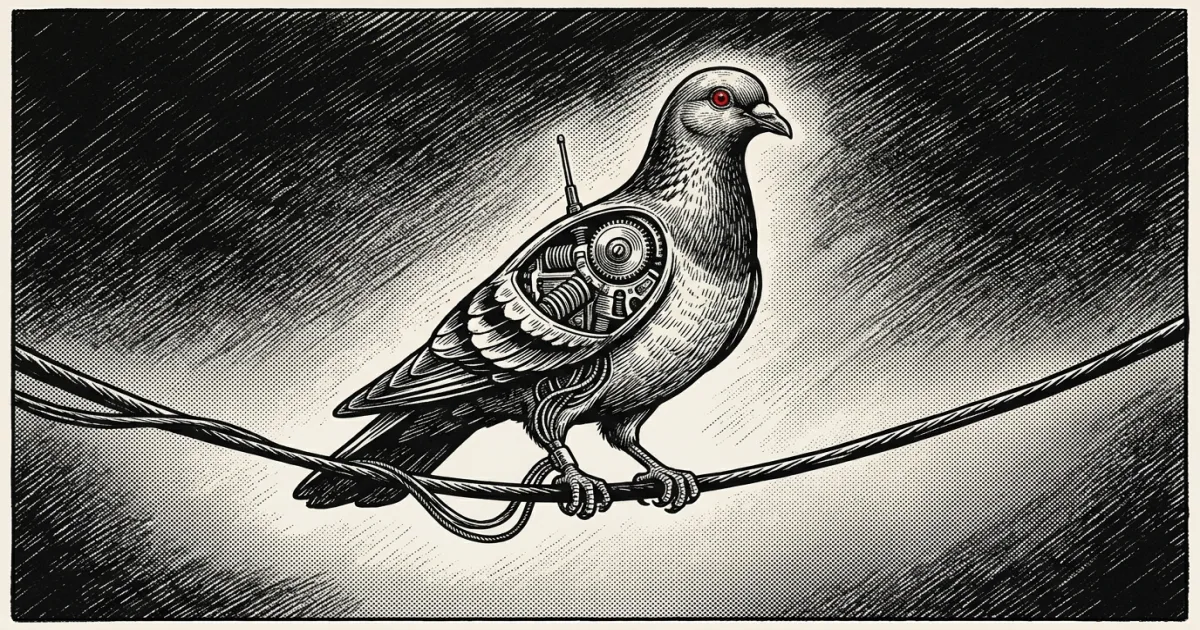
TL;DR: Peter McIndoe wrote a nonsense phrase on a protest sign in Memphis in January 2017, and it came back to him from strangers he’d never met. What he and his collaborators bolted onto it afterward is the same equipment I use to run a newsletter and a store, and none of that equipment cares whether the belief underneath it is true.
Peter McIndoe was twenty years old on a Memphis rooftop the day after the 2017 inauguration, listening to a crowd move down the street below him, and when he came down to join it he needed something for a sign and wrote the dumbest thing his brain would hand over. Birds Aren’t Real.
Then he preached it at them. Birds were surveillance drones, the government had killed the real animals, power lines were charging stations, and every white splatter on a windshield was a tracking device doing its job.
A friend filmed it and put it online. The phrase came back to him off high-school cafeteria walls and off buildings in towns he’d never set foot in.
I know that feeling from the cheap seats. I typed a line into Substack once that went: I’m not here to make a million dollars, I’m here to make a million creators. It’s mine, I meant every word of it, and it works exactly like a slogan on a piece of cardboard.
That’s why this one won’t leave me be. I build the same machinery McIndoe built, on purpose, with a store and a newsletter and a list I own instead of rent, and the only thing standing between my operation and a bit about drone pigeons is that I think I’m telling the truth.
Think. I can’t check that word from inside my own building.
McIndoe built an empty church with excellent signage.
The phrase did the recruiting
Three words, one of them a contraction, arranged in the grammar of a leaked memo. Say it out loud in a room and you find out fast who is in on it and who has to ask for the lore. It recruits while it gets a laugh.
McIndoe and Connor Gaydos wrote the lore afterward, a secret history where the government exterminated the real birds and swapped drones in behind them, and after that every ordinary thing a bird does becomes evidence. A wire is a charger. Migration is a software pattern, and a pigeon on a ledge is a camera on a ledge.
The mythology ate observations for free. A bird does something strange and of course it does, a bird does something boring and that’s exactly what the programming wants you to see, and facts could walk in the front door all day long so long as not one of them ever left carrying a veto.
There’s no fucking exit from a story built like that. Parody borrowed the single strongest feature conspiracy has.
Eugene Price was hired to have a face
They wanted the oldest man they could get. McIndoe said he was after a face that looked weighted by sleepless guilt, so they hired an actor and shot a confession.
Eugene Price was a fictional former CIA officer, carrying what he had supposedly helped conceal. The video ran past ten million views on TikTok, according to the creators’ account in their 60 Minutes interview.
Price supplied moral injury, the one thing a diagram can’t fake. His age argued for him. The bags under his eyes stood in for a lifetime spent near classified rooms, and the invented biography made the information feel leaked.
The whistleblower mechanic in pure form. You can’t audit the agency, so you audit the witness’s face. I do it too, every damn time somebody with a clearance and a tremor sits down in front of a camera.
Irony leaks
Most of the people chanting it knew. They were in on the bit and the bit was the fun, which kept the whole operation closer to satire, live theater, and youth culture than to a sincere conspiracy movement.
Some missed it entirely. Gaydos told 60 Minutes that a few people reacted as though they had already suspected the CIA was swapping out birds. Engineer a story as parody and it will still find the one head that kept a room ready for it.
McIndoe has described the project as a way to climb inside the lunacy together and laugh instead of sitting there scared of it. Healthier than sneering at it from across the road, probably. I’ve done my share of sneering from across the road.
It also runs the same drills. Repetition, belonging, costumes, a named enemy, merchandise, and a crowd out in the street don’t go inert because the top layer is a gag, and I’d rather say that out loud than pretend the shop I run is somehow immune to its own equipment.
The parts list is short
Nine components, and I can name them without looking because I’ve bought most of them at retail. A compressed belief, a memorable enemy, a library of reusable proof, insider language, physical symbols, an origin myth, a repentant defector, public stunts, and products that let members recognize each other across a grocery store.
Enough architecture there for a political party, a fandom, a church, a record label, or one aggressively run newsletter. The doctrine underneath can be any damn thing you want, including nothing at all.
Participation glues harder than agreement. Chanting the phrase, wearing the shirt, explaining drone pigeons to a stranger in line, all of it makes you a member long before anybody asks what the proposition means. The smallest thing you sell recruits better than the manifesto ever will.
Truth matters. It also loses fights to magnificent nonsense in a uniform running a call-and-response, and a lonely fact with no ritual wrapped around it is a guy in a parking lot talking to himself. That ought to scare the shit out of anybody who writes for a living.
I sold my first guide before I had any of this figured out, back when I was an amateur and knew it, and the slogan showed up before the philosophy did. It always does. The belief is the last part anybody bolts on, and it’s the only part nobody in the crowd can inspect.
McIndoe knows his birds are made up. That’s the whole of his advantage over me, because I’ve got the slogan and the list and the store and a room full of people who say my lines back to me, and there is no instrument on the dash that reads out whether the thing underneath holds. What would I have to start believing before I quit noticing?
Sources
- CBS News: The origins of Birds Aren’t Real
- CBS: 60 Minutes interview clip
- Macmillan: Birds Aren’t Real
Frequently asked questions
Is Birds Aren’t Real a real conspiracy theory?
It’s a deliberate parody movement. Its creators do not believe the government replaced birds with surveillance drones.
When did Birds Aren’t Real begin?
The standard origin account puts it at a Memphis protest in January 2017, where McIndoe improvised the phrase for a sign.
Who was Eugene Price?
A fictional former CIA officer, played by an actor in a staged confession video made for the movement’s mythology.
Comments are open to members. Sign up free →