

The Curious Case of Universe 25
Also, AI should get rid of the CEOs, not the janitors.

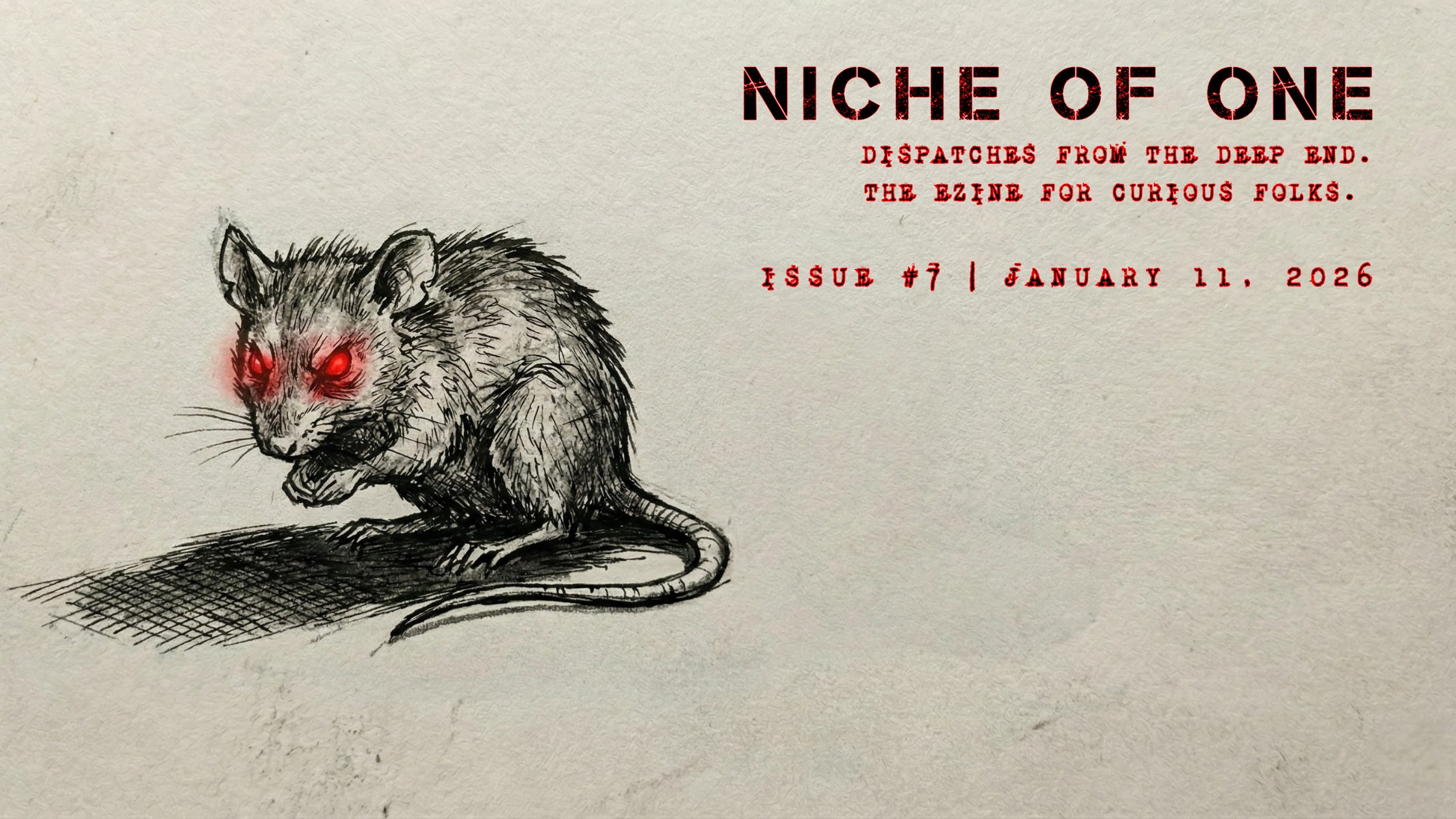
Utopia isn’t all it’s cracked up to be.
We all like to think we want a perfect world, but do we? Because our lead story this week may make you question that assumption. What will bother you the most is that the results of an experiment in the 1960s tell us a lot about our society today.
In this issue:
The Beautiful Ones are Dying
Fire the CEO, Keep the Janitor
The Gateway Process
I hope everyone’s year is kicking off well. I have nothing to complain about on my front. I’m living the dream, or at least my version of it. I’m also very much enjoying interacting with all of you, so please don’t be a stranger in the comments and chat.
Now, on to the show…
🐭 The Beautiful Ones Are Dying
In 1968, a behavioral researcher named John Calhoun built a cage that was 101 inches square and 54 inches tall. He divided it into four pens connected by tunnels, stocked it with unlimited food and water, eliminated disease and predators, maintained perfect temperature control, and seeded it with four pairs of mice.
Then he watched paradise eat itself alive.
This wasn’t a small-scale study. The habitat could theoretically support 4,000 mice living in comfort.
Calhoun gave them everything—nesting material, optimal breeding conditions, no external threats. He removed every source of stress that would exist in the wild. No scarcity. No competition for resources. No predators. No disease. Just abundance and time and the question of what happens when a social species gets everything it needs.
What happened was extinction.
The collapse came in four distinct phases.
Phase A was colonization—the eight founding mice explored their territory, established nesting sites, marked boundaries. Normal mouse behavior. By day 104, they’d settled in and reproduction began.
Phase B was the explosion. Population doubled every 55 days. By day 315, there were over 600 mice living in conditions designed for six times that number. The numbers say comfort. The behavior said otherwise.
Phase C is where it gets interesting. Where the experiment stops being about mice and starts being about what happens to any social species when the struggle for survival becomes obsolete.
Growth stalled at day 315 even though there was room for 3,400 more mice.
The population had hit only 15% of theoretical capacity but the social structure was already fracturing. Every role in mouse society was occupied. Every territory claimed. Young mice were born into a world where there was nothing to defend, no hierarchy to climb, no function to fulfill.
The old ways of organizing society—the dominance hierarchies, the territorial imperatives, the mating competitions—all of it became meaningless overnight because there was no scarcity to organize around.
That’s when the pathologies emerged.
Dominant mice lost their positions and turned into what Calhoun called “dropouts”—roaming gangs that attacked anything that moved, especially females and the young.
But even more disturbing was what happened to the females. They started abandoning their nests. Stopped nursing. Some began attacking their own offspring. Infant mortality hit 96%. The females who did try to maintain traditional roles became hyper-aggressive, taking on male behaviors, defending territories they didn’t need against threats that didn’t exist.
And then there were the Beautiful Ones.
Mice who withdrew completely from all social interaction. No mating. No fighting. No territorial defense. No social engagement of any kind.
They spent their entire lives in the center areas of the pens—the safest, least competitive spaces—doing nothing but eating, sleeping, and grooming themselves.
Their coats were perfect. Their bodies were unmarked by the violence that consumed the rest of the population. They were physically flawless and socially dead.
Calhoun called this “first death” or “spiritual death.”
The loss of purpose. The loss of drive. The loss of any reason to engage with existence beyond basic biological maintenance. It preceded physical death by hundreds of days but it was just as terminal. These mice had everything they needed and nothing to do with it.
By day 600, the last baby was born.
After that, nothing. No pregnancies. No births. No future. The population that remained was sterile in every sense—incapable of reproduction and incapable of renewal. By day 920, every mouse was dead despite having unlimited resources and optimal conditions.
Universe 25 collapsed not from scarcity but from abundance.
I saw this happen in Japan to humans in real time.
The hikikomori—over 1.5 million Japanese citizens living in complete social withdrawal. Not homeless. Not mentally ill in the traditional sense. Just... gone.
Locked in their rooms. Supported by aging parents. Consuming digital content. Emerging only when absolutely necessary. The Japanese government calls it a crisis and throws resources at it but resources are the problem, not the solution.
The “lying flat” movement in China spread through the same mechanism.
Young people with access to education and opportunity just opting out of the entire social contract. No marriage. No career advancement. No participation in the structures that are supposed to organize their lives.
They’re not rebelling. They’re not protesting. They’re just... flat. The Beautiful Ones with internet access.
America has its own version.
We call it “quiet quitting” when people show up physically to jobs but check out mentally. We call it “quiet cracking” when they can’t maintain the performance anymore. We call it the “loneliness epidemic” when teenagers—the most digitally connected demographic in human history—report being more isolated than elderly people in nursing homes.
Seventy-three percent of lonely Americans cite technology as a primary cause but we keep building more sophisticated isolation chambers and calling them social networks.
The birth rates tell the real story.
United States at 1.6. South Korea at 0.75. Japan at 1.3. All below replacement level. All declining.
And here’s the part that breaks the economic explanation—the wealthiest, most educated populations have the lowest birth rates. The people with the most resources are reproducing the least. They can afford children. They’re choosing not to have them.
Because abundance without purpose creates the same behavioral sink whether you’re a mouse or a human.
The third places are disappearing.
The parks. The community centers. The churches and bowling alleys and corner bars where people used to just exist together without economic transaction or digital mediation.
We’ve optimized them out of existence because they don’t scale and they don’t generate data and they can’t be monetized efficiently. The spaces where humans used to form the casual social bonds that made life bearable—they’re being replaced with apps that promise connection and deliver isolation.
The mice didn’t fail because they ran out of food.
They failed because food became meaningless when there was no hunt. Territory became meaningless when there was no scarcity. Social hierarchy became meaningless when there was no competition. The old structures that organized mouse society disappeared but nothing emerged to replace them.
The young mice born into this world had no role to play. No function to fulfill. No reason to engage.
So they groomed themselves. Ate. Slept. Withdrew.
Spiritual death.
The Beautiful Ones weren’t born broken.
They were born into a world where all the traditional sources of meaning had been optimized out of existence. Where survival was guaranteed. Where every need was met. Where there was nothing left to struggle for because struggle itself had been identified as the problem and systematically eliminated.
Walk through any American suburb on a Saturday afternoon. Count how many people you see outside. Count how many kids are playing in the streets. Count how many neighbors are talking to each other without the excuse of a package delivery or a property line dispute.
The silence is deafening. The withdrawal is complete. We’re not in our rooms like the hikikomori but we might as well be. We’ve just made our isolation mobile and called it progress.
The introversion isn’t natural. It’s not a personality type. It’s a pathology.
Humans are social animals. We evolved in bands of 150 people who knew each other’s names and faces and stories. We evolved to struggle together, to defend territory together, to raise children in communal groups where everyone had a role and a purpose. We evolved for scarcity and challenge and the kind of meaning that comes from overcoming obstacles that actually threaten survival.
Then we built a world where none of that exists.
We built Universe 25 for ourselves. Called it civilization. Called it progress. Called it the greatest achievement in human history.
And now we’re standing in the center of the cage with perfect coats and empty eyes, wondering why nothing feels real anymore. Why connection feels impossible. Why bringing a child into this world feels like a cruel joke instead of a sacred act.
The mice in Universe 25 had 54 inches of vertical space and unlimited food. We have infinite digital space and unlimited content. They groomed themselves to physical perfection while their society collapsed.
We curate our feeds and perfect our profiles while birth rates plummet and loneliness becomes the leading cause of death in developed nations.
Calhoun observed that even when he introduced new mice from outside Universe 25—mice that had grown up in normal, challenging environments—they couldn’t revive the population. The Beautiful Ones couldn’t be saved by new blood. The behavioral sink was complete. The spiritual death was irreversible.
Once a population loses the capacity for struggle, it loses the capacity for meaning, and once meaning is gone, extinction follows.
We’re watching this happen in real time.
The social fabric is unraveling not because we lack resources but because we have too many. The old structures that organized human society—family, community, religion, work, nation—they’re all becoming optional in a world of abundance. And we haven’t figured out what comes next. What organizes a society when survival is guaranteed? What gives life meaning when struggle is eliminated? What makes existence worth continuing when every need is met?
The Beautiful Ones didn’t have an answer.
Neither do we.
The experiment ran for 920 days. We’re somewhere around day 600. The last baby has probably already been born. We just haven’t figured out which one it was yet. The population that remains is going through the motions—eating, sleeping, grooming—while the capacity for renewal dies in silence.
Calhoun built paradise and watched it commit suicide. We built one too. We’re just taking longer to die.
The question isn’t whether we’re in a behavioral sink.
We are. The birth rates prove it. The loneliness epidemic proves it. The hikikomori prove it. The question is whether extinction is inevitable once you reach Phase C, or whether a social species can find new sources of meaning before the last baby is born.
The mice couldn’t answer that question.
We’re about to find out if we can.

3 Cool Things:
🤖 Fire the CEO, Keep the Janitor
The CEO of Alphabet made $226 million in 2022. The average Google employee made $279,000. The janitor cleaning the bathrooms at Google headquarters made $35,000 if they were lucky and weren’t contracted out to a third party to avoid paying benefits.
When the layoffs came in 2023—12,000 workers cut to “streamline operations” and “improve efficiency”—the janitor went first. The average employee went second (I know from personal experience, because I was one of those.)
The CEO got a raise.
Nobody suggested firing the C-suite and keeping the people who actually make the products.
The entire conversation about AI replacement focuses on the bottom.
Truck drivers. Cashiers. Customer service representatives. Radiologists. Paralegals. The people doing actual work that produces actual value.
The automation anxiety is aimed downward like it always is, at the workers who can least afford to lose their jobs, while the executive class, pulling down eight and nine-figure compensation packages for attending meetings and making “strategic decisions,” remain untouchable.
This is backwards.
If you want to cut costs, if you want to improve ROI, if you actually give a shit about shareholder value instead of just protecting the corporate aristocracy, you fire the executives and replace them with AI.
The math is simple. The numbers don’t lie. The only thing stopping it is the fact that the people who would make that decision are the same people who would lose their jobs.
A CEO makes decisions. Strategy. Vision. Capital allocation. Mergers and acquisitions. Crisis management. These are cognitive tasks. Pattern recognition. Risk assessment. Analyzing data and making predictions about future outcomes.
This is exactly what large language models and machine learning systems are built to do. Faster, better, and with no ego or need for a private jet or bonus.
An LLM can analyze financial statements faster than any human.
It can identify market trends across millions of data points in seconds. It can run Monte Carlo simulations on strategic decisions and give you probability distributions on outcomes.
It can read every analyst report, every competitor filing, every regulatory change and synthesize it into actionable intelligence without bias, without ego, without the need to justify last quarter’s strategy or protect its own position.
It just does the job, 24/7, 365. It doesn’t need a break.
A janitor cannot be replaced by AI.
Cleaning a bathroom requires physical presence, manual dexterity, judgment about which surfaces need attention, navigation through complex physical spaces, and response to unpredictable messes. We’re decades away from robots that can do this reliably. Maybe never.
But a CFO? A Chief Strategy Officer? A VP of Business Development?
These are people who spend their days in meetings, reading reports, making PowerPoint presentations, and sending emails. Essentially a circle jerk full of self-important twats who schedule meetings to discuss scheduling a meeting.
An AI could do this today. Right now. With better accuracy and a fraction of the cost.
The average Fortune 500 CEO compensation package is $15.5 million.
The average C-suite executive makes $2-5 million. A company with a CEO and five C-suite executives is spending $25-40 million annually on six people whose primary function is processing information and making decisions based on that information.
You could replace all of them with AI systems that cost a few hundred thousand dollars to implement and maybe $50,000 annually to maintain.
That’s $25-40 million back into the company. Every year.
That’s money that could go to shareholders. That could go to R&D. That could go to the frontline workers who actually produce the value that the executives take credit for.
Take that $25 million and distribute it to a workforce of 500 frontline employees. That’s $50,000 per worker.
You could double most of their salaries and still come out ahead.
You could hire more workers.
You could reduce hours.
You could invest in training and equipment and workplace improvements that actually increase productivity instead of just paying executives to optimize headcount reduction.
The ROI is obvious.
Investors should be demanding this. Shareholders should be voting out boards that insist on maintaining executive compensation packages that exceed the GDP of small nations when AI could deliver better strategic decisions at a fraction of the cost.
But here’s the thing. You still need one human. One person at the top who can be held accountable. Legally. Publicly. Someone who goes to jail when the company commits fraud. Someone who faces the shareholders when the strategy fails. Someone with skin in the game who can override the AI when the edge cases emerge that require human judgment.
Pay that person $2 million a year. Make them legally and financially liable for the company’s decisions. Give them veto power over the AI recommendations but make them justify overrides in writing. Make them the human interface between the machine intelligence and the legal system that still requires a warm body to prosecute.
Everyone else in the C-suite?
Algorithmic. The CFO is a financial model. The COO is an operations optimization system. The Chief Strategy Officer is a market analysis engine.
They make recommendations. They process data. They identify patterns.
They do exactly what AI systems are designed to do except they do it slower, more expensively, and with all the cognitive biases and ego protection and political maneuvering that humans bring to high-stakes environments.
The corporate world won’t do this.
The people making decisions about AI implementation are the same people who would be replaced. The boards are filled with current and former executives who believe in the myth of executive value. The compensation committees are staffed by people who justify their own inflated salaries by maintaining the fiction that strategic decision-making requires uniquely gifted humans who deserve to make 300 times what the average worker earns.
This is the same class that convinced shareholders that stock buybacks are better than wage increases. That convinced workers that unions are against their interests. That convinced regulators that fiduciary duty means maximizing short-term stock price instead of long-term company health.
They’re very good at protecting their position. They’ve been doing it for decades.
But the technology exists now to call the bluff.
To prove that the “strategic vision” they’re selling is just pattern matching and risk assessment that machines can do better. To demonstrate that the value they claim to add doesn’t justify the cost they extract. To show that the emperor not only has no clothes but could be replaced by an algorithm that would make better decisions about what to wear.
The automation crisis is coming.
The question is whether it hits the people who can least afford it or the people who can most afford it.
Whether we use AI to eliminate the working class or to eliminate the executive class. Whether we optimize for protecting corporate aristocracy or for distributing value to the people who actually create it.
The janitor needs to stay. The company needs clean bathrooms. Physical reality still requires physical labor.
But the CEO? The CFO? The entire C-suite that exists primarily to justify its own existence through elaborate performance of strategic importance?
Replace them. Automate them. Free up $25 million to invest in the people who actually produce value instead of the people who extract it.
Why are we paying humans millions of dollars to do cognitive work that AI can do better when we could be paying that same money to the workers who create the actual value?
The answer isn’t economic. It’s not about efficiency or productivity or shareholder value. It’s about power. It’s about class. It’s about who gets to make the decisions about who becomes obsolete.
The executives are betting you won’t notice that they’re the ones who should go first.

📰 Articles I Enjoyed This Week:


🕳 RABBIT HOLE:The Gateway Process
In 1983, a US Army Lieutenant Colonel named Wayne M. McDonnell sat down and wrote a 29-page assessment of a consciousness training program called the Gateway Process.
He wasn’t writing a philosophy paper. He was evaluating whether the military could teach soldiers to remote view enemy installations and leave their bodies to gather intelligence in places their physical forms could never reach.
The assessment was classified. Then it was declassified. Then it disappeared from public view for decades.
Then the CIA released it in 2003 with page 25 missing. Nobody knows why. Nobody knows what was on page 25. But the other 28 pages contain enough information to fundamentally break your understanding of what consciousness is and what the government was willing to explore when nobody was looking.
The Gateway Experience wasn’t fringe science practiced by hippies in the woods.
It was developed by Robert Monroe and the Monroe Institute using a technology called Hemispheric Synchronization (Hemi-Sync) that uses binaural beats to alter brainwave states.
You put on headphones. One ear gets a tone at 170 Hz. The other ear gets 174 Hz. Your brain detects the difference—4 Hz—and starts generating theta waves to match. Frequency Following Response. Your consciousness shifts because your brain is trying to sync with an external pattern.
This isn’t meditation. This is neurological hacking.
The Army wanted to know if it worked.
McDonnell’s assessment reads like a physics paper written by someone who accidentally broke through to the other side and had to explain what he found using the only language available—quantum mechanics and holographic theory.
He cites Karl Pribram and David Bohm. He talks about the universe as a hologram of interacting energy fields. He explains that human consciousness is also a hologram that “attunes” itself to the universal hologram to perceive reality.
Then he explains how to click out of it.
The Gateway Process is structured in levels.
Focus 10 is called “Mind Awake, Body Asleep”—you’re fully conscious but your body is in deep relaxation. Normal lucid dreaming territory.
Focus 12 is “expanded awareness” where you start perceiving beyond your physical body and the conventional five senses.
Focus 15 is the “State of No Time” where you can explore past events.
Focus 21 is the threshold of the time-space boundary where you can explore future probabilities.
Each level is achieved by accelerating your brain’s oscillation frequency until it clicks out of physical dimension entirely. The report states this happens at speeds below Planck’s Distance—10^-33 centimeters—where conventional physics breaks down and you enter what McDonnell calls “the Absolute.” A state of infinite energy. A place where time and space don’t exist. A place where consciousness operates without a body.
The military wanted soldiers who could go there and come back with actionable intelligence.
Remote viewing. Out-of-body experiences. Projecting problems into the “universal hologram” to receive intuitive solutions.
This wasn’t theoretical research. They were attempting practical application.
The Gateway training was a tool. The Stargate program was the operational deployment. Soldiers were being trained to separate their consciousness from their physical bodies and travel to places their bodies couldn’t reach.
And it worked. Enough to keep the programs running for decades. Enough to classify the documentation. Enough to remove page 25 from the public version of McDonnell’s report and never explain why.
But here’s where it gets dark.
The declassified materials contain warnings.
Not the usual government liability disclaimers. Actual warnings about what happens when you start operating at these frequencies.
Participants reported encounters with autonomous entities. Non-human intelligences that exist outside of human social and emotional frameworks. Things that live in the spaces between conventional reality.
The occult community has names for them.
Coronzon. The Dweller of the Abyss. Threshold intelligences that exist in the gaps.
The report doesn’t dismiss these encounters. It acknowledges them. It warns about identity dissolution—extended exposure to these states can dissolve ego boundaries until you can’t distinguish between your own thoughts and external communications. Until you lose the basic certainty of your own existence.
The government trained people to leave their bodies and some of them met things that were already out there. Things that don’t operate on human rules. Things that exist in the frequencies we normally can’t perceive.
And the government kept doing it anyway.
Think about what that means.
The US military didn’t shut down the program when soldiers started reporting contact with non-human intelligences.
They documented it. They warned about it. They kept training people to go out there and encounter whatever was waiting.
Because the intelligence value was worth the risk of ego dissolution and contact with entities that might not have our best interests in mind.
The holographic universe model that McDonnell uses to explain the Gateway Process tells us a lot about the research.
If consciousness is a hologram attuning to a universal hologram, then what we perceive as reality is just one frequency band in an infinite spectrum.
Shift your oscillation rate and you perceive different bands. Different realities. Different entities operating in frequencies we’ve been trained to ignore.
The Gateway Experience isn’t expanding consciousness. It’s tuning consciousness to frequencies that are already there. Always have been. The question isn’t whether these other dimensions exist. The question is why we’re normally tuned out of them and what happens when you deliberately tune back in.
Monroe built a technology that could do it reliably.
They still runs the training. You can go to Virginia right now and learn to click out of consensus reality using the same protocols the military developed for intelligence gathering, or you can purchase it online
Nobody talks about it.
Nobody asks why the government spent decades researching consciousness technologies that break the holographic projection we call reality.
Nobody asks what page 25 said.
Nobody asks what happened to the soldiers who went too deep and couldn’t come back.
Identity dissolution. Ego boundary collapse. Meeting threshold intelligences that operate outside human frameworks.
Coming back changed.
Or not coming back at all.
🧠 ON MY MIND
People whine too much about unsubscribers. It’s a good thing if people are unsubbing. They are NOT your people.
Every generation thinks they’re living through some sort of End Times scenario. I wonder what makes them think that? Collective ego, perhaps.
That’s it for this week. Until next time…
~ J.D.
Please note some links may lead to affiliate offers and if you purchase from these links I may receive a small amount of compensation at no extra cost to you.
The species will not end. Cultures will. MIgrants bring their own cultures and, in some smaller countries, the capability to outvote "natives". Maybe this is just nature's way of making sure humanity doesn't grow comfy ;-)
Fascinating! Mice experiments. Human consciousness in holographic dimensions meeting non-human consciousness. And advice of those who unsubscribe. I've got to circle back on this one, Joe. Too much interesting stuff happening at every new sentence to settle on one pass through!