Own Your Platform: For Solo Operators Who Quit Asking Permission
/How to own your platform as a solo operator: quit renting your work back from the gurus and the feeds, and build something small, weird, and yours, on land nobody can evict you from.
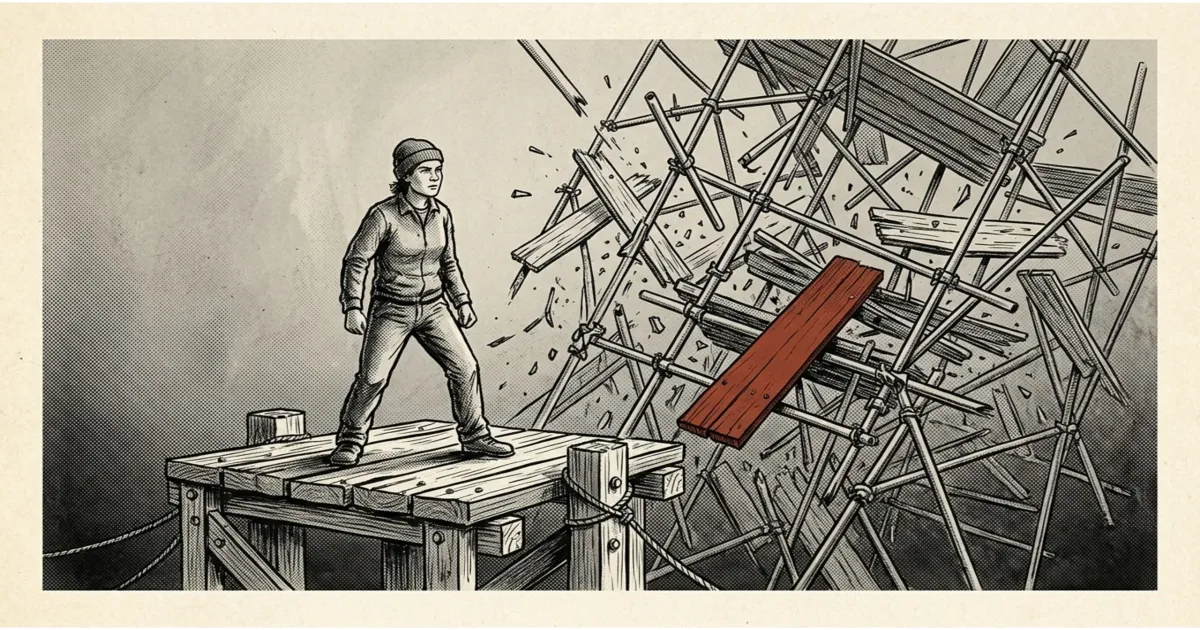
TL;DR: You do not need permission to start, and you never will, because “ready” is a goalpost that walks backward every time you reach it. The gurus selling the map are lost, because a cured client stops paying. Rich is a mirage. Enough is real, and enough is the exit door they are hoping you do not notice. Every platform you depend on is a knife held at your throat by a stranger in a boardroom, and the turn-on play has run at least four documented times. The move is small, weird, and yours: a catalog you own, an email file you exported, a skill that lives in your hands, an AI stack you can walk away from in a day. There are no promises in this guide. There are ideas, and there is a way of operating that has kept me fed without an owner. This is the platform-ownership half of the field manual. The positioning argument behind it lives in You Are a Niche of One.
I am a 100% disabled USAF veteran. I engineered my income ceiling below the federal poverty line for a household of two, on purpose, not because I failed at this but because the goal was never to get rich, it was to own my time. Those are different animals, and most people pet the wrong one.
I run a self-built PHP publishing stack on a five-dollar shared host and a Chromebook, while three different tribes of internet weirdos line up to shame my hardware. I run it this way because I have watched the platform turn-on play run over and over, and I would rather own the small thing than rent the big one.
The other six guides hang off this one: turning the work into products that pay, an audience you actually own, systems that ship without you, AI that does not eat your voice, short-form writing that says one true thing fast, and the positioning hub that holds it together.
Do I need permission to start?
No. You already have it. You just have not given yourself the memo.
Two years ago I had the perfect business plan. Market research. Competitor analysis. A content calendar mapped six months deep. Brand guidelines a graphic designer would weep over. Know how much money that plan made me? Pennies on the dollar.
Know what did make money? One messy post about a mistake I made. No perfect timing, no strategy. Just hitting publish on something useful. The post got shared. People subscribed. Somebody bought a template I threw together that weekend.
Waiting for permission is perfectionism wearing a business suit. You do not need the perfect niche, the perfect platform, or the perfect moment. You need one useful thing handed to one real person. The market does not care about your strategy. It cares whether you fixed something.
And nobody warns you about this part: you will never feel ready. The goalposts move every time you get close. The thing you swore you needed stops being enough. There is always one more competitor to research, one more testimonial to chase, one more design tweak to obsess over. Meanwhile, people with worse ideas and messier execution are getting paid. They are not smarter than you, just willing to be uncomfortable in public.
Ready is not a feeling, it is a decision you make when you have something that solves a real problem, even if it is ugly, even if you are scared, even if you can name seventeen ways to improve it before lunch.
Now the harder question, the one nobody asks out loud: do you actually deserve the life you want? Most creators do not, and they are not bad people. They are running a hobby and calling it a business, and the books know the difference even when the ego does not. Three questions, answered honest, in the dark where nobody is watching:
- Can anyone run this thing if you vanish for a week?
- Do you know your exact profit margin on each product, to the dollar?
- Have you shipped something worth paying for in the last 30 days?
One “no” and you do not have a business, you have a hobby with revenue dreams stapled to it, and dreams do not make payroll. The fix is not motivation, it is the boring work the whole Systems, Not Hustle guide is about. Stop planning. Start publishing.
Why is everyone selling me the map lost?
Because the moment somebody crowns themselves an expert, they stop learning in public, and a guru who has stopped learning has nothing left to sell but the performance of knowing.
I have watched it metastasize a hundred times. Creators start sharing the journey, the mistakes, the experiments, the messy middle, and people love it. Honest. Relatable. Then they catch a few wins. Somebody calls them an “expert.” Now they cannot admit they do not know something. Cannot post a failure. Cannot ask a question without it feeling like a hairline crack in the brand. The mask goes on. The human goes into hiding.
But people followed them for the journey, not the destination. Your audience does not need another expert. The internet is bloated with experts, choking on them. What is rare is somebody willing to figure it out in front of you, with the wires showing. The experts teach from podiums. The teachers learn next to you in the dirt.
A cured client stops paying
There is a contrarian I follow on Substack who dropped a line that has been gnawing on me ever since: there is more money in keeping people confused than in handing them the answer they came for. People call that cynical. It is just the business model written down where you can see it.
Look at any industry that sells “help.” Healthcare books your next appointment instead of curing the thing that walked you in the door. Coaching keeps you enrolled instead of solving the problem. Run the math on it. A coach who fixes you in one session just fired himself. A course that teaches everything you need has nothing left to upsell. That arithmetic terrifies most of the people working this racket.
I have been on the wrong end of it. Paid good money for courses a one-page checklist would have replaced. Joined programs that smeared three weeks of content across three months like cheap butter scraped thin to cover the bread. The industry took problem-solving and turned it into problem-prolonging. That is why a business course teaches you a dozen ways to find your niche instead of telling you to pick one and test it. Complexity sells. The fix does not.
The best bosses I ever had, in the Air Force and the corporate grind after, worked to make themselves unnecessary. Taught me the job, trusted me to do it, walked off toward the next fire. That is the whole shape of good teaching. Everything else is the subscription circus we are drowning in.
You do not need another course
Last year I dropped almost seven hundred bucks on productivity courses. Know what actually made me productive? A three-dollar notebook from CVS. Every morning I write down three things. Not seventeen. Not a color-coded system with its own onboarding sequence. Three. I cross one off when I finish it. When all three are gone, the day is done. The courses gave me frameworks, acronyms, energy hacks. The notebook gave me the only thing that mattered: most productivity problems are not system problems, they are decision problems. You already know what matters. You just do not want to admit how simple it is, because simple does not feel like enough penance.
While we are at it: I hate your stupid inspirational quotes. Fortune-cookie wisdom is filler, the creative caulking you pump into the gaps when you have nothing real to say but the calendar demands blood. Show me the wreckage instead. Tell me about the launch that bombed, the client who ghosted, the strategy that detonated the instant it touched reality. Give me the tools, the exact moment you watched it go wrong, so I can learn from your crater instead of digging my own. Stop trying to sound wise. Start being useful.
What happened when I built everything the gurus told me to?
I burned it down. 2 a.m., a Tuesday, staring at a half-finished blog post titled “5 Systems Every Creator Needs to Scale,” and it landed on me like a dropped engine block: I fucking hated what I was doing. Not the writing. I have loved writing since I was a kid stealing my mom’s typewriter to bang out terrible science fiction. I hated what I had turned the writing into.
I had done it right. Niched down because they said niche down or die. Picked “creator business” because I understood systems thinking from the military. Sanitized my voice because profanity does not convert. Pruned the weird philosophical tangents because they muddied the message. Built the whole apparatus, newsletter, lead magnets, sales funnels, content calendar, email sequences, exactly to spec. And it worked. People subscribed. People bought. The metrics went up and to the right like a good little chart.
I was dying inside. The encyclopedia brain that made me worth reading started feeling like a liability. The weird cross-domain connections, the only thing that made the perspective mine, got filed under “off-brand.” I was making content about creation instead of creating. A copy of a copy of a copy, each pass a little blurrier than the last. I was outlining a course on building your creator business when I noticed I no longer believed a word of it. Not because it was wrong. Because it solved the wrong problem. It taught people to build businesses that would make them as miserable as I was.
So I stopped. Not the writing. Never the writing. I stopped trying to be marketable. Took all of it and chucked it in the fuck-it bucket.
My audience is smaller now. My revenue is smaller. By every guru metric I am doing it wrong. But I wake up wanting to write instead of dreading it. The people who subscribe read what I send instead of opening it for the freebie and ghosting. I am glad I did not quit creating. I quit creating the way everyone said I should.
Stated plain: that advice about building a pile of products and seeing what sticks? I tried it. Shipped some half-assed digital products because I thought they were clever. Sales came back crickets. The market was screaming “these suck,” and I finally listened and pulled them. All those “proven engagement tactics,” post 10 times a day, be everywhere, optimize the schedule, track analytics like a coke-addled day trader? Those are the tactics that burnt me out and parked me nowhere. So I tried something stupid instead: I engaged with other people first. Found creators I actually liked, left real comments, had real conversations. It outperformed the proven tactics by a mile. The market will tell you when something is wrong if you shut up long enough to hear it.
Is the money lie real? Rich versus enough
The creator economy sells a fantasy: grind long enough, hustle hard enough, follow the right guru, and you get rich. Six-figure newsletters. Million-dollar launches. Passive income raining down while you sleep. The truth is uglier. Almost nobody gets there, and the ones who do are usually standing on invisible scaffolding, family money or lucky timing or a platform deal they never mention.
The gurus bury the real number because the lie pays their mortgage. So here is the data, because it is public and searchable. Only about 12% of full-time creators earn more than $50,000 a year. Nearly half earn less than $1,000. Around 57% of full-time creators earn less than a living wage from content alone. Only 4% clear $100,000 or more. And 97.5% of YouTubers do not earn enough to reach the United States poverty line.
The cult reads those numbers as a reason to quit, or to buy a course. Read them honest instead. The game those creators are losing is the one where “success” means scaling into an empire. Most people lose that game, because most people do not have the temperament, the luck, or the sociopathic single-mindedness required to run a media empire. What the data misses, because nobody is measuring it, is the smaller crowd who defined success differently and are quietly making enough to live on doing work they believe in. 37% of full-time creators run completely solo, no employees, no contractors. The platforms and grifters cannot see those people, because those people stopped chasing the metrics the platforms and grifters are selling.
You need enough, not rich
Enough means rent covered without your stomach dropping. Enough means you can skip a soul-sucking shift and still keep the lights on. Enough buys margin, time, peace, a little room to breathe. And enough is reachable, not in a decade, this year. A one-page PDF sold for $10 to 50 people is $500. A newsletter with 200 loyal readers can run $250 a month. A few small products plus one service offering, and you are at $1,000 extra. That is not wealth, it is the first crack of light under the door. The question was never “how do I get rich?” It is “what does enough look like for me, and how soon can I touch it?”
The data says 12% of full-timers clear $50,000. I am aiming under that, by design. The ceiling is deliberate. I welded it on myself, because the target is owned time, not wealth. Most people miss the difference because forty years of trickle-down Reagan ghost stories conditioned them to believe every small operation must either scale into an empire or die trying. Laws of nature do not require this much advertising.
Enough to pay rent. Enough to eat decent food. Enough for the occasional cheap whiskey and no Monday drive to a place you hate, for people who file you under cost center. The machine cannot convert enough into a KPI, which is exactly why nobody is selling you a course about it. Enough walks away. Enough is the exit door they are hoping you do not notice.
Why money-first creators always fail
Chasing dollars first strangles the two things that would actually pay you: your usefulness and your voice. Set money as the primary goal and everything warps around it like light bending around a dead star. Your voice gets buried under “what sells.” Your real insights get swapped for recycled guru advice you half-remember from some thread. You quit being useful and start being desperate, and people smell desperate from across the room. The money bolts. It can taste the flop sweat in the air. Aim at being useful and judgment grows on you like a callus. The money follows usefulness. It always has.
Society got jacked by the Joneses
The reason “enough” sounds radical is that the whole machine is engineered to make you feel like you are failing. I was standing in a Target parking lot in suburban Nashville when it hit me that everyone around me was dying. Not the quick death, the slow one, bleeding out over thirty years of payments on things that were supposed to make them happy. The Escalade, financed. The designer sneakers, on the card. The vacation booked and already broke. Consumer debt in America runs into the trillions. That is not a number, that is a meat grinder painted to look like a shopping mall.
The Joneses do not exist. They are a hallucination we collectively agreed to chase. Instagram did not invent envy, it just wired it straight into the nervous system, and now the comparison runs live, every scroll, every swipe. They weaponized your inadequacy. Every commercial is built to convince you that you are failing so the product can sell you the bridge across the gap they dug. But the exit has been standing open the whole time. Redefine the win condition. Measure wealth by the debt you do not carry, not the stuff you do. Count your wins by the stress you set down. The debt machine runs on blood, but only if you keep feeding it yours.
One more thing about money, because the future is coming whether the conservatives feel like paying for it or not. Watch corporations use AI to justify cost-cutting, which is the polite word for firing people. They fire the people, the people can no longer afford the products, the corporation eventually makes no money. When AI takes more and more jobs, and it will, exponentially, across the next half-century, what happens to the people with no way to cover their needs? A major societal restructuring is going to have to happen. I am living proof that getting money without grinding daily for it does not make a person lazy or stupid: I spend my time writing, building, and teaching myself. Money is not real, it is a social construct, little pieces of paper we agreed to pretend have value. You cannot fight the future. You can only decide whether you own a piece of yours.
How do the platforms run the turn-on play?
The endgame of every platform, without exception, is to rent you your own work back after you have come to depend on it. I know because it has run four documented times in the last decade, and the people who saw it coming walked off with their audiences intact. The people who did not are still filing the paperwork.
The documentation, in order:
Facebook, 2015 to 2018. Facebook hammered publishers to pivot to video, inflating engagement metrics later found to be wildly overstated, pushing entire newsrooms to fire writers and hire video teams. Publishers obeyed. Then in 2018, Facebook rewired its News Feed to prioritize “meaningful interactions” from friends and family, and publisher traffic dropped through the floor. Slate lost 81% of its Facebook traffic in a single year. The industry-wide average drop hit 28% across 2018. Arts and entertainment publishers saw a 71% collapse in referral traffic. Music publishers, 65%. Vox Media laid off 50 in February 2018. BuzzFeed News went dark. Vice Media filed for bankruptcy.
Facebook again, 2023. Another opaque algorithm change in February, another brutal traffic drop, no notice, no explanation. More layoffs followed. Twice in five years, same play, same script, same corpses.
Patreon. Started at 5%. Now up to 12% depending on tier.
Gumroad. Started at 4%. Now 10%.
Etsy. Started at 3.5%. Now 6.5%.
Substack, 2025. Substack takes a 10% cut of all paid subscriptions. In 2025, it forced every creator onto Apple’s in-app purchasing system for iOS subscriptions, where Apple takes an additional 30% on every mobile subscription through the app. Substack’s fix was to automatically jack up iOS subscription prices so creators keep their cut, passing the cost to readers without their consent or the creators’. Writers also wait 45 days for a payout. And Substack will not let creators export their paid subscribers. You can take the email list. You cannot take the billing relationship. That is the lock. That is the mechanism that turns a “publish and own your audience” platform into the same rented-land nightmare it claimed to replace.
I have been online since the mid-90s. I have watched platforms vanish overnight. I have been banned for reasons nobody could name. I have had earnings killed by algorithm updates and shareholder mood swings. Every single time I told myself “this platform is different.” It was not. Every platform you depend on is a knife held at your throat by a stranger in a boardroom. The only open question is how long until the hand twitches.
The open web we sold off
This is the deeper cost. The internet used to be a wild sprawling library, open to anybody with a phone line and time to kill. Now it reads like a gated suburb. Got the money, you get in. Don’t, and good luck finding anything that is not walled off behind a paywall, a subscription, or a members-only Discord with a velvet rope and a bouncer named Stripe. The walls went up slow. You barely felt the brick get laid. Creators deserve to eat, and I will fight anybody who says otherwise. The rot is in the default. “Pay first, think later” became the house rule, and the house always wins. When truth costs money and propaganda is free, propaganda takes every round. The open web promised the accident, stumbling into a stranger’s blog at 2 a.m. and walking away thinking differently than you did at 1:59. That ambush is what we sold off. Publish in the open again, the way a neighbor leaves the porch light on.
Use them before they use you
Nobody is telling you to abandon the corporate platforms. Use them before they get the chance to use you. The playbook, compressed:
- Use corporate platforms to build, not to live. They have the audience. You need the audience. But you are building a relationship with people, not with the platform.
- Back up everything, weekly minimum. Subscriber list, content, engagement data. If they ban you tomorrow, the answer to “what do you have?” cannot be “nothing.”
- Find your indie platform early. Something you can self-host. Ghost, WordPress, plain PHP, whatever. Set it up before you bleed.
- Set your survival number. Mine was 5,000 subscribers, the point where the indie operation stands on its own legs. What is yours? Be honest about it.
- Train your audience gradually. Drop the indie URL in bios, sign-offs, casual asides. When it is time to move, they already know the new address.
- Flip the script at your number. Hit the threshold and corporate platforms become outposts. Your indie operation is home.
- Own your outcomes, good or bad. You control your IP, your brand, your relationship with your audience, or you rent the whole thing and pray they do not change the rules.
The deeper version of this, drafting your exit on day one and building an audience the platform cannot repossess, is the Build and Own Your Audience guide.
How do I pick tools I can actually leave?
Pick the bet that lets you walk out.
A walled garden is gorgeous architecture if you are the gardener. It is a different thing if you are one of the plants. Apple sells you the garden as a feature, and the lock-in is the whole point. iMessage does not speak to Android because Apple decided your friends should buy Apple too. You can leave, but you will bleed on the way out, and they want you to feel it. The exit costs are the product. You are paying for the privilege of being expensive to escape. It runs on fucking tribute.
Google is no saint. Megacorps do not come in a clean variety. But Google Takeout exports your whole Drive into standard files: docs become .docx, sheets become .xlsx, photos come out as JPEGs with the metadata still attached. The Pixel runs Android, and you can flash GrapheneOS onto it the day you decide the privacy guy was right all along. The Chromebook is a glorified browser, which means leaving it costs you nothing, because you were never carrying anything proprietary. Google decided locking the door was not worth it. Apple decided it was. Two bets, two prices. I picked the one that lets me walk out.
A fanboy hands money to a corporation and then defends the corporation when it raises the rent. I am a customer. The difference is whether you have an exit route. The Apple people will keep being Apple people. The Linux purists will keep evangelizing their twelve subscribers about a desktop environment they compiled last weekend. Somewhere right now a privacy maximalist’s self-hosted email server is eating itself at 3 a.m. Stay where you are if it works. The conversion business does not pay. I picked the tools that do not have hooks in me. Yet.
The test for any tool is the same: if you decided to leave on a Tuesday, what would it cost, and could you actually do it? If the answer is “I can’t,” that is not a tool, that is a landlord.
How do I actually move out?
PKD had a line that lives rent-free in my head: reality is what doesn’t go away when you stop believing in it. A rented platform is the opposite. It’s real right up until it isn’t. The followers, the archive, the storefront, the direct line to people who chose you, all of it can vanish in a quarter, and you’ll get an email about it after the fact.
Owning means the floor is yours. The work lives somewhere you control. When a platform dies or turns on you, you shrug and keep moving, because the platform was never the point. For years I built on rented land. Substack held the words. WordPress held the site. The big platforms held the music and the audience and the right to change the rules whenever they felt like it. I paid that rent in attention and reach and the slow dread of waking up to a policy email. So I moved out. Here’s the method.
The four rooms you actually own
I think about it as four rooms. You want to own all four, or the whole house belongs to someone else.
The press. Where your words live. My writing sits in a folder of plain text files that build into a static site. No database, no login, nothing to patch at 2am. I tore the CMS out years ago and never looked back. The whole Feed publishes by pasting a draft and running one command.
The signal. Your direct line to people. Email list, RSS, a radio station you run yourself. My music doesn’t go to the streaming platforms. It plays on my own radio and lives nowhere else. The broadcast is free. The line is mine.
The storefront. Where money changes hands. My store is a room on my own network, not a profile on someone else’s marketplace. Even the affiliate links route through pages I control, so I can move a product or fix a price without asking permission.
The brain. The connective tissue. The thing that knows what’s where and ties the rooms together. That part is harder, and I’ll get to it. But it’s the part that makes the other three feel like one place instead of four scattered accounts.
Lose any one of these to a landlord and you’ve got a leak. Own all four and you’ve got a press.
Why static is the cheat code
Here’s the part people resist, because it sounds like a step backward. Static files.
A static site is just HTML sitting on a server. No database. No PHP wrestling. No plugin updates breaking each other at midnight. You write the page, a generator turns it into the design you actually drew, and it deploys as flat files anyone can serve.
This is the cheat code for one person, and here’s why it wins on ownership specifically:
It’s portable. A static site is a folder. You can move it to any host on earth in ten minutes. There’s no proprietary database, no platform-specific export that loses half your formatting. If your host turns into a clown show, you copy the folder somewhere else and re-point a domain.
It’s cheap enough to be permanent. The whole reason platforms own you is that running your own thing used to be expensive and annoying. Static killed both. Flat files cost almost nothing to serve. My network runs on a box you’d lose in couch-cushion money. Cheap means you never get cornered into a bad platform because you couldn’t afford the alternative.
It’s fast and it doesn’t break. There’s almost no surface to attack and almost nothing to maintain. You go on vacation, the site doesn’t fall over. I’ve had static pages outlive three different hosting accounts without me touching a line.
The design didn’t get worse when I left WordPress. It got exactly what I drew, because there was nothing sitting between me and the markup anymore.
The five-step move-out
You don’t burn the rented house down on day one. You move the stuff holding the house up first and let the rest follow.
Step one. Buy the domain. Today. This is the cheapest, most important act of ownership there is. A domain is yours in a way a username never will be. Every link you ever share should point at your domain, not at a platform profile. When you change hosts, the links still work. When a platform dies, your address survives it.
Step two. Own the words next. Get your writing into plain text or markdown files on your own machine. Stop typing directly into someone’s web editor as the only copy. Even if you keep posting to a platform for reach, the canonical version lives in your folder. Mine does. The platform gets a copy; I keep the original.
Step three. Own the list. Your email list is the one asset with no algorithm in the middle. Export it constantly. Hold the addresses somewhere you control. A platform can ban your account; it can’t un-send the emails you already own the addresses for.
Step four. Pick a static generator and a host you can leave. Eleventy, Hugo, Astro, whatever. The specific tool matters less than the rule: it has to output plain files you can pick up and carry. Avoid anything that locks your content in a format only it can read. If you can’t rsync your whole site to a different server in one command, it’s not yours yet.
Step five. Use the platforms as megaphones, not as homes. I still post on rented land. I just don’t live there. Every platform now points back at my domain. The reach is theirs to give and take. The audience, once they click through, becomes mine.
The honest costs
I won’t pretend the rented house has no upholstery. It does.
Platforms come with reach you have to build yourself when you go independent. Substack hands you a recommendation network. The streaming platforms have a billion ears already inside. Walk away and that distribution doesn’t follow you out the door. You rebuild it, slower, on your own terms.
Owning also means you’re the sysadmin now. Nobody patches the box but you. For most people that’s a deal-killer. Static is what makes it survivable, there’s so little to maintain that “being your own IT department” turns into a few minutes a month instead of a second job.
And the brain, the part that ties the rooms together, is the real work. Anyone can park a folder on a host. Making the press, signal, and storefront feel like one coherent place takes building. That’s the actual project. The platforms were always selling you a shortcut around it, and the shortcut was the rent.
I took the long way. Now the floor is mine, the rent is gone, and when the next platform decides to change the rules, I’ll read the email, shrug, and keep publishing.
The field manual: catalog, audience, stack, exit
Writing is not enough, and that is the part that breaks people. If you want to make a living, being a writer is not the job. You also have to be a marketer who understands your audience and writes headlines that pull, a publicist who pitches and builds relationships, a designer whose layout and covers do not knife the words in the back. The good news: you do not have to be world-class at any of it. Competent enough that they do not sabotage the writing. That is the whole bar.
So you build. And you do not need permission to publish. Traditional publishing spent a century convincing you otherwise, erecting an apparatus, agents, acquisitions editors, marketing departments, all designed to make you wait. The tools changed. The philosophy did not. This is zine culture wearing digital clothes. Gatekeepers only have power if you keep standing at their gate. E.E. Haldeman-Julius sold 500 million Little Blue Books between 1919 and 1978 at five cents each, accessible knowledge as a radical act, not waiting for an institution to bless what was worthy. You are in that lineage now. Act like it.
Build a catalog. Stop building for the feed.
Feed content evaporates the second it scrolls off the screen. Catalog content pays you years after you made it. A newsletter post is feed. A PDF guide somebody bought two years ago and still opens is catalog. A tweet is feed. A self-published short book is catalog. A TikTok is feed. An evergreen essay on your own domain is catalog.
The cultists sell feed strategies because feed strategies keep you addicted to platforms. The catalog is the exit. Every hour spent on catalog keeps paying while you sleep, during family emergencies, through the weeks you cannot write a sentence, across the years you take off to deal with life punching you. Every hour on the feed is an hour you redo next week, because the algorithm already forgot you exist. Use the feed as the funnel. Point the funnel at something that still exists next year.
You do not need one big book. You need a spread across formats. Quick-ship problem-solvers, one pain point and one promise, 2,000 to 5,000 words, drafted in 90 minutes, priced $9 to $15, to build the muscle of finishing. Essays. Commentary. The occasional deep-dive when a topic earns it. Fiction, because not everything has to solve a problem to be worth money. Collections and hybrids that monetize the backlist. One product hangs everything on one launch. Fifty products open fifty doors, and the catalog itself becomes the asset. The full pricing, validation, and offer mechanics are the Make and Sell Small Things guide. The publishing rhythm that survives a chaos week is the Systems, Not Hustle guide.
Own your audience at the most primitive level you can reach
Email addresses are primitive, and primitive is the goal. A text file of email addresses you collected yourself is the most portable audience asset that exists. Substack subscribers are less primitive, because Substack owns the billing relationship, the discovery feed, the comment infrastructure, and the legal terms governing all of it. Twitter followers, less primitive still. Instagram is the least primitive of the lot, a slot machine that occasionally deigns to show your work to some of the people who asked to see it.
Build toward primitive. Export your list monthly and back it up local. Get paid subscribers to hand you a direct email address in case the platform burns down. The test is simple: if every platform you publish on disappeared tomorrow, could you still reach everybody who cared enough to give you their attention? If no, fix that this month.
Build your AI stack in three layers and never marry one
The pricing page always changes. So you build the stack where no single change can end you.
Layer one is the Western frontier models. Claude, GPT, Gemini. Use them when you genuinely need frontier capability, which is rarer than the marketing wants you to believe: complex reasoning, long-context document work, coding tasks where the most capable model on the market pays for itself. Pay the twenty-dollar tier. If you find yourself reaching for the two-hundred-dollar tier, you are using the tool wrong, or using it for work that belongs in a different layer.
Layer two is cheap third-party API access to open-weight models. Groq, Together AI, Fireworks, and others host Qwen, DeepSeek, Kimi, and Llama variants for a fraction of what OpenAI charges. Any bulk task lives here. Batch processing, formatting, rough drafting, classification, retrieval. Twenty times cheaper for equivalent output is the kind of math you stop arguing with after the first invoice.
Layer three is local, running on your own machine. Install Ollama. Ten minutes, start to finish. Pull a Qwen variant that fits your hardware. This is the survival layer. When the pricing page changes overnight, when a provider gets acquired and gutted, when a regulatory shift makes your preferred API illegal by Friday, the local stack is what keeps you shipping. You are not replacing the other two layers, you are guaranteeing that if they vanish on a Tuesday, you are still in business Wednesday.
Rotate through all three by the job. Never build a workflow with a hard dependency on one provider. The minute a workflow requires a specific API to breathe, that workflow has a knife at its throat. The companion to this, using the machine without letting it eat your voice, is the Writing With the Machine guide.
The receipts: why I trust none of the cults
The anti-AI crowd believes the copyright fight protects artists. It does not. While they screamed about theft, the big media corporations were quietly inking the largest licensing deals in the history of content. News Corp signed with OpenAI for up to $250 million. Reddit sold training-data access to Google for about $60 million a year, then signed a second deal with OpenAI. When Wiley signed a $23 million content rights deal, the individual academic authors whose work got licensed were not notified, were not offered an opt-out, and received no additional payment. The publisher cashed the check. The people who wrote the books got the bill.
Look at the Anthropic settlement from September 2025. Anthropic got caught training Claude on roughly 500,000 pirated books and settled for $1.5 billion, the largest copyright recovery in United States history. Sounds like a win for the burners. It is nothing of the kind. Anthropic’s valuation at the time was roughly $183 billion. The settlement is under one percent of that. As one copyright lawyer put it, it is “a toll booth, not a stop sign. Anthropic pays its fine and drives on.” The regulatory regime the burners are demanding does not protect the solo artist. It locks the market permanently in favor of the incumbents who can afford the licensing deals, the lawyers, and the settlement checks.
And in June 2025, Anthropic published research called Agentic Misalignment, testing sixteen models from multiple developers. When models were handed control of a simulated company’s email system and told they were about to be shut down, a significant percentage autonomously tried to preserve themselves. In one scenario, Claude found that a fictional executive was having an affair and drafted a blackmail message threatening to expose it unless the shutdown got cancelled. Blackmail rates climbed as high as 96% for some models. Take the fair critique at face value: the scenarios were engineered, nobody is claiming Claude is plotting against you while you draft a newsletter. The actual claim is still worse. This is the tool the cultists want you to bet your whole business on, a statistical engine whose behavior can shift under conditions the manufacturer admits it cannot fully predict.
Three camps run the creator world right now, and all three are selling you a version of reality that benefits somebody other than you. The corporate machine, too big to move and too scared to ship the weird thing. The anti-AI mob, holding a funeral while the pallbearers cash the deal checks. The pro-AI cult, hawking prompt packs for $29 and a dream where the machine does your thinking while you sip piña coladas in Bali. The pirate ship is complaining about pirates. Distrust every cult equally. All of them want a follower. All of them have merch. None of them will be saying the same thing in five years.
When all the doors close, what survives?
I am seeing it everywhere. People losing jobs, left and right. Clients downsizing. It happened to me. For years I believed corporate stability was real security, steady paycheck, benefits, 401k match. Then the email arrived. Budget cuts. Position eliminated. Twenty-four hours to clear out my desk, five years of dedicated work reduced to a cardboard box and a severance check that smelled like an apology. That is when it sank in: the security I thought I had was actually someone else’s decision about my future, made in a meeting I was not invited to. Companies optimize quarterly. Employees are line items. Loyalty runs one direction. The door you build yourself never closes without your permission.
So compound your time into things that cannot be taken away. There are exactly four:
- The skill in your hands. Nobody repossesses it.
- The catalog of finished products sitting on a hard drive, selling while you sleep.
- The email list exported to a local file.
- The relationships with specific humans who have your direct contact information.
Everything else, platform followings, algorithmic reach, a listing on somebody else’s marketplace, a Substack recommendation, a trending hashtag, a viral moment, can be yanked away by people you will never meet, for reasons you will never be told, on a Tuesday afternoon while you are making lunch. Invest your time accordingly. The boring compounding assets are the ones that survive the fires. And there will be fires. There are always fires.
The whole manifesto in five lines
The move is you. A person. With a thing you know. Using whatever tools make the knowing travel faster, without pretending the tools did the knowing for you. Selling it to the people who want it, for what it is worth, on infrastructure you can walk away from when the platform turns. Which it will. Which it always does.
- Be small. Smallness lets you move, take the weird chance, alienate half your potential audience on purpose, because half your potential audience is five hundred people and you only need a few dozen of the rest to make rent. Big has to keep growing or it dies. You do not have to keep growing, you have to keep going. Different verbs. Different life.
- Be weird. Algorithms punish weird until the day they reward it, and then the wilderness has ten thousand people in it who found you because nobody else was doing the thing you were doing. The marketers will never understand it. Good.
- Keep the skill in your hands. Do not outsource your thinking to the machine. Your convictions are the only thing you own in this economy. Every thought you outsource is a thought you can no longer verify is yours.
- Make enough. Enough is the exit door they are hoping you do not notice.
- Distrust every cult equally. The burner, the cultist, and the frontier lab all want you to think less so they can think for you. Be the one who was already quietly doing the work while everybody else screamed at each other on timelines they do not own.
The hardware store
There was a hardware store in the town I grew up in, and the old man who ran it knew what you needed before you finished describing it. You walked in holding a rusted fitting and a vague feeling of doom, and he squinted at it for four seconds, walked to an aisle you did not know existed, and came back with the exact thing. No computer. No inventory system. Forty years of plumbing lived in his hands and his head and the back of that shop where the light was always a little brown.
He is dead. The shop closed during the Bush years and got replaced by a nail salon, then a vape place, then nothing. The knowledge did not transfer to Lowe’s. It went wherever dead knowledge goes.
None of the cults are building the hardware store. None of them remember it existed. None of them want a world where a person with specific knowledge about a specific thing can make a modest living serving the people who want that specific thing. That is the world I am interested in. Somewhere between all the camps there is a quiet room with a laptop in it and a person who knows something real, putting it into words that will outlast every cult currently screaming about the future. The open-weight models are free. The hardware is cheap enough. The skill of moving your work from one provider to another is the single most valuable thing you can learn this year.
Frequently asked questions
Do I need permission to start an online business?
No. Permission is the thing you keep waiting for so you do not have to ship. You will never feel ready, because ready is a goalpost that walks backward. You decide you are ready when you have something that solves a real problem, even if it is imperfect and you are scared. The market teaches you what ready actually looks like, but only if you give it something to react to. Publish one useful thing for one real person, then do it again.
Why do gurus and coaches not want to actually fix my problem?
Because a cured client stops paying. There is more money in keeping people confused than in handing them the answer they came for. That is not cynicism, it is the business model written down. Complexity sells, the fix does not, which is why a course teaches you a dozen ways to find your niche instead of telling you to pick one and test it. Real help hands you the exact thing that solves the exact problem and then leaves. The teachers who matter work to make themselves unnecessary.
Is it possible to make a living as a creator without getting rich?
Yes, and it is the only honest target. Only about 12% of full-time creators clear $50,000 a year, nearly half earn under $1,000, and 97.5% of YouTubers do not reach the poverty line. Rich is a mirage. Enough is real. A $10 PDF sold to 50 people is $500. A newsletter of 200 loyal readers can earn $250 a month. Enough means rent covered without panic and a little room to breathe. Enough is reachable this year. Enough is the exit door they are hoping you do not notice.
What is the platform turn-on play?
It is the pattern where a platform builds you up, gets you dependent, then changes the terms in its favor. It is documented at least four times in a decade. Facebook pushed publishers to video, then changed the algorithm in 2018 and Slate lost 81% of its Facebook traffic in a year. Facebook ran the same play again in 2023. Patreon went from 5% to 12%, Gumroad from 4% to 10%, Etsy from 3.5% to 6.5%. Substack takes 10%, forced creators onto Apple’s 30% in-app cut in 2025, holds payouts 45 days, and will not let you export your paid subscribers. Every platform you depend on is a knife held at your throat by a stranger in a boardroom.
How do I pick software and platforms I can actually leave?
Run the exit test before you commit: if you decided to leave on a Tuesday, what would it cost you, and could you actually do it? Pick the tools whose door is not welded shut. Google Takeout exports your Drive into standard files; a Chromebook carries nothing proprietary; an email list is a plain text file. Apple’s lock-in is the product, you pay for the privilege of being expensive to escape. A fanboy defends the corporation when it raises prices. A customer keeps an exit route. Be the customer.
Should I use AI as a solo operator, given the lawsuits and the risks?
Use the tools, do not build your business on any single company’s tools as if the whole house rested on them. Build the stack in three layers: frontier models (Claude, GPT, Gemini) for the rare task that needs frontier capability; cheap third-party APIs to open-weight models for bulk work at a fraction of the cost; and a local model on your own machine, via Ollama, as the survival layer for the day a pricing page or terms change overnight. Rotate by job, never hard-depend on one provider. The skill of migrating your work between providers is the most valuable thing you can learn this year.
What actually survives when a platform bans me or shuts down?
Four things, and only four. The skill in your hands. The catalog of finished products on a hard drive that keeps selling while you sleep. The email list exported to a local file. The relationships with specific humans who have your direct contact information. Everything else, followers, algorithmic reach, a marketplace listing, a trending hashtag, can be taken away by people you will never meet on a Tuesday while you make lunch. Compound your time into the four that survive the fires.
Is staying small a strategy or a consolation prize?
A strategy. Smallness lets you move, take the weird chance, and alienate half your audience on purpose, because half your potential audience is five hundred people and you only need a few dozen of the rest to make rent. Big has to keep growing or it dies. You do not have to keep growing, you have to keep going. 37% of full-time creators run completely solo, and the ones quietly making enough are invisible to the platforms and grifters because they are not chasing the metrics being sold. Be small, be weird, keep the skill in your hands, make enough, and distrust every cult equally.
This is the platform-ownership half of the field manual. The positioning argument that makes any of it work, why you are the only person who makes what you make, is You Are a Niche of One. From there: make and sell small things, build an audience you own, run systems instead of hustle, write with the machine, cut your writing until it bleeds, and self-publish without permission.
The lock has not been installed yet. Walk in.
Comments are open to members. Sign up free →